

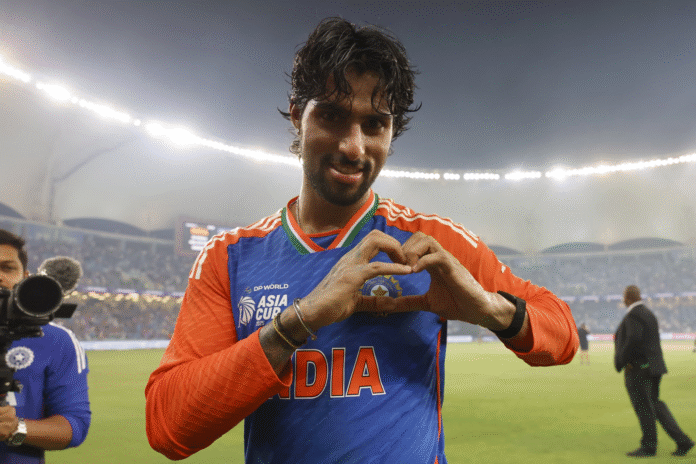
Some matches are not about runs and wickets alone. They are about symbolism, context, and timing. The Asia Cup 2025 final between India and Pakistan in Dubai was one such game.
In the aftermath of the Pahalgam terror attack and Operation Sindoor, the mood in India was tense, nationalistic, and emotional. This wasn’t merely a cricket match — it was a moment where victory became a necessity. Anything less was unacceptable.
India delivered. And at the center of it all stood 22-year-old Tilak Varma and the magician Kuldeep Yadav, two players who proved that youth and resilience can carry the weight of a billion expectations.
A Collapse That Could Have Broken India
Chasing 147, India was reduced to 20 for 3 — a nightmare start in a high-pressure final. The three pillars of India’s batting — Abhishek Sharma, Shubman Gill, and skipper Suryakumar Yadav — had fallen cheaply.
At that point, two things were happening simultaneously:
- Pakistan’s bowlers were charged up, sensing the kill.
- Indian fans felt déjà vu — memories of failed chases in crunch matches loomed large.
But unlike past collapses, India found calm in Tilak Varma.
Tilak Varma: The Coming of Age Innings
Tilak’s knock was not just about scoring 69 runs; it was about how he scored them.
- His first 26 balls brought just 24 runs — strike rotation, nudges, patience.
- His next 27 balls brought 45 runs — aggression, boundaries, risk-taking.
This dual tempo mirrored the template of two legends:
- Dhoni’s composure early in an innings.
- Kohli’s ruthless finishing once set.
What made it special was context. Finals against Pakistan don’t forgive mistakes. Tilak not only survived, he imposed himself. When Rinku Singh hit the winning boundary, it felt symbolic — the “next generation” of India’s middle order had arrived.
Kuldeep Yadav: The Spell That Changed Everything
If Tilak was the anchor of the chase, Kuldeep Yadav was the architect of Pakistan’s downfall.
Pakistan had raced to 107 for 1 after 12 overs. A score above 200 looked realistic. Then came Kuldeep.
- 13th over: dismissed Saim Ayub, breaking the momentum.
- 17th over: ripped through the middle order with three wickets.
From 107 for 1, Pakistan imploded to 146 all out. Kuldeep’s 4 for 22 was the classic example of how spin, guile, and control can outwit brute power in T20 cricket.
Without that collapse, Tilak would never have had the stage.
The Haris Rauf Irony
Every India–Pakistan clash has its drama. This one came courtesy of Haris Rauf, who earlier mocked India with a “plane crash” gesture — a reference to the propaganda around Operation Sindoor.
In the final, irony struck. Rauf went for 50 runs in just 3.4 overs — the most expensive spell of the match. To top it, Bumrah bowled him and returned the same gesture. The symbolism was brutal: the man who mocked a crash, crashed himself.
Abhishek Sharma: The Tournament’s Real Star
Though he failed in the final, Abhishek Sharma’s consistency was unmatched.
- 314 runs at a strike rate of 200.
- Three half-centuries.
- Six innings above 30 in seven games.
Named Player of the Tournament, Abhishek underlined that India’s batting future is in safe hands.
Why This Victory Mattered More
Beyond the scoreboard, this win mattered for several reasons:
- Psychological Edge – India extended its streak to eight straight wins over Pakistan since 2022. That’s more than dominance; it’s mental ownership.
- Political Undertone – Given the national mood post-Operation Sindoor, victory carried emotional weight. Cricket became a proxy for resilience.
- Generational Shift – Tilak, Abhishek, and Rinku proved India is no longer dependent on Kohli, Rohit, or Dhoni legacies. A new order is already here.
- Spin > Pace – Once again, India’s spinners decided a match that was otherwise tilting towards Pakistan’s fast bowlers.
Looking Ahead: World Cup 2026
The rivalry isn’t going anywhere. Next year’s T20 World Cup in India will once again bring the two nations face to face, though Pakistan’s matches will be staged in Sri Lanka. If this Asia Cup final is any indication, the psychological advantage remains firmly with India.
Final Word
When Churchill said, “Victory at all costs,” he wasn’t talking cricket. But on a charged Sunday night in Dubai, his words echoed through every Indian fan’s heart.
For India, this wasn’t just a win. It was catharsis, statement, and celebration — all rolled into one. And at the heart of it, two names will be remembered: Tilak and Kuldeep.