

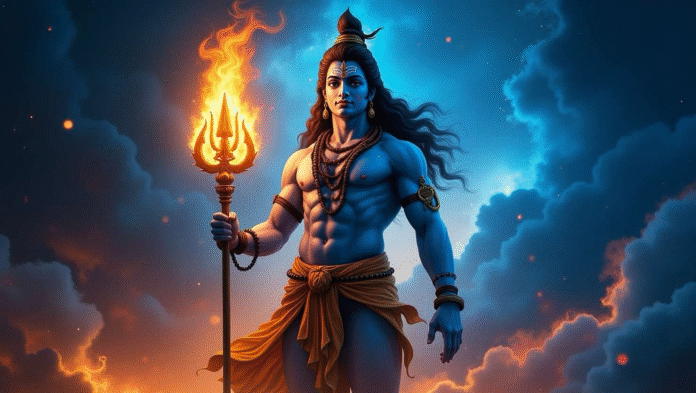
Is Shiva a mystery or a science yet to be understood? He may be called a mystery because his lifestyle suggests a recluse, and his meditation posture suggests a profound ascetic yogi. Legend describes him as God, and in his divine acts, he can be seen as an ordinary human being—sometimes a half-naked wanderer living with ghosts, or sometimes a supreme vibration or sound of consciousness.
Shiva has always existed beyond easy definition. He is simultaneously myth and metaphysics, folklore and philosophy, symbol and science. Perhaps that is why he remains the most enigmatic figure in the Indian civilizational imagination—accessible to the devotee, yet elusive to the scientist.
The Paradox of the Shiva Family
When we look at the Shiva family, a fascinating paradox emerges. Lord Shiva carries a cobra on his shoulder, yet Ganesha’s mount is a rat—natural prey for the serpent. Kartikeya rides a peacock, which feeds on snakes. Mother Parvati rides a lion, while Shiva’s mount Nandi the bull would be prey for the lion. In nature, these beings would be enemies, yet in the Shiva household, they coexist in harmony.
This symbolic family represents the triumph of consciousness over instinct, harmony over conflict, and unity over diversity. Shiva’s third eye symbolizes destruction, while his matted locks release the river Ganga—the symbol of life and nourishment. In one hand he holds a conch, the sound of creation; in the other, a trident, the symbol of cosmic balance. Creation and destruction coexist within him, just as opposites coexist within his family.
The Shiva Family in India’s Geography
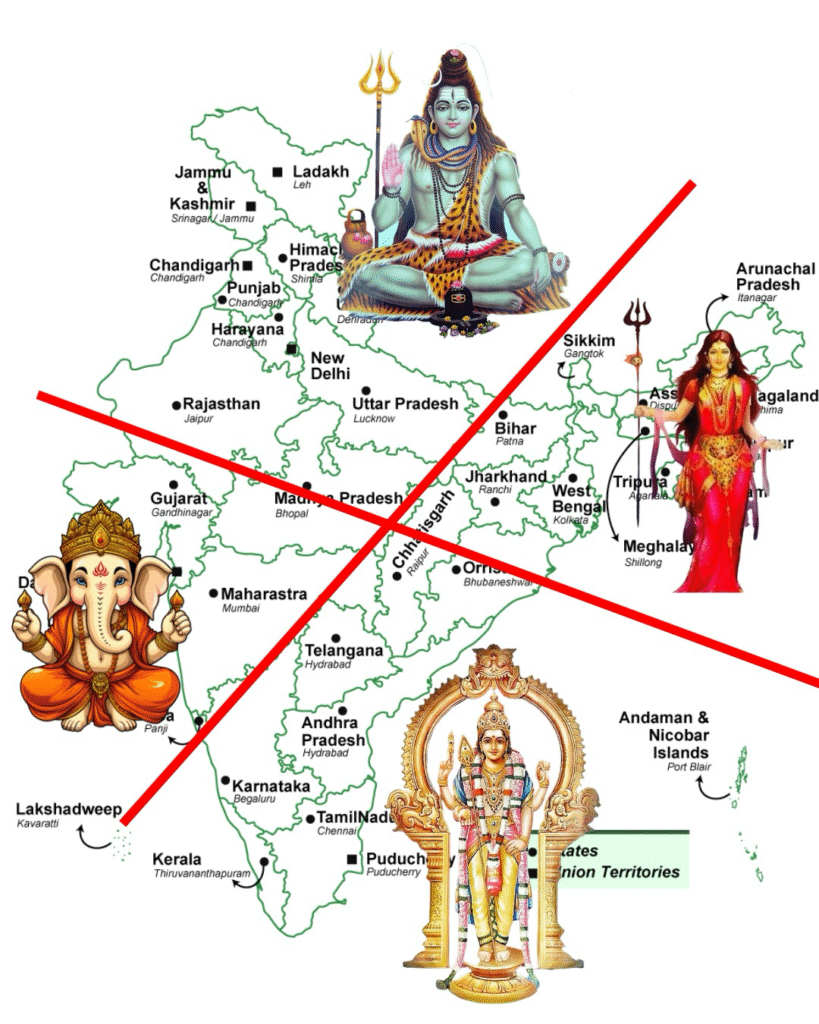
The Shiva family is not just a spiritual concept—it is also geographically reflected across India. Kartikeya (Murugan) is primarily worshipped in South India, Ganapati in Central and Western India, Parvati in Eastern and Northern India, and Shiva prominently in Northwestern India.
This distribution is not accidental. It reflects cultural currents, migration patterns, and the layered evolution of Indian civilization, where different regions resonated with different aspects of the Shiva consciousness.
Jyotirlingas and the Golden Ratio
The twelve Jyotirlingas—sacred manifestations of Shiva across India—are believed by some scholars and mystics to follow the Golden Ratio (1.618), a universal proportion found in nature, galaxies, and human anatomy. Their spatial arrangement from Somnath to Rameswaram forms a circular and petal-like geometry, echoing cosmic patterns.
The conch shells associated with Shiva also follow the same ratio, suggesting that ancient Indian sages understood universal aesthetics and cosmic geometry long before modern science rediscovered them.
The Mystery of Mount Kailash
Mount Kailash, the mythical abode of Shiva, remains one of the greatest mysteries on Earth. Unlike Mount Everest, it has never been summited. It appears as a perfect pyramid, aligned precisely with the cardinal directions, composed largely of granite.
Scientists and explorers have reported unusual magnetic fields in the region, radar anomalies suggesting hollow structures, and biological changes such as accelerated hair and nail growth. While scientific explanations remain debated, the mystique of Kailash continues to reinforce Shiva’s image as a cosmic presence beyond human reach.
The Science of Shiva Temple Construction
Shiva temples are not merely places of worship—they are architectural and energetic marvels. Ancient texts like Mayamatam and Samarangana Sutradhara describe precise rules involving geometry, astronomy, acoustics, and Vaastu Shastra. Many temples are aligned with geomagnetic lines and cosmic directions, creating centers of subtle energy.
Yet Shiva also needs no grand temple. A simple stone under a peepal tree, offered water and milk, becomes a living shrine. From Pipaleshwar Mahadev beneath a tree to Kheleshvar Mahadev in a stadium, Shiva is equally present. The sacred is not confined to architecture—it is activated by awareness.
Shiva’s Spirituality and Philosophy
Shiva is both the ascetic yogi and the householder husband, both emptiness and infinity. He represents Satyam (truth), Shivam (auspiciousness), Sundaram (beauty), Shunya (void), and Anant (infinite).
He destroys to create, withdraws to manifest, dissolves to regenerate. In Shiva, detachment becomes beauty, and paradox becomes harmony. He is the Brahman—simple for the devotee, yet an unsolved riddle for science.
A Poetic Invocation
“Shunya hai saadhaa hua nakshatra saare maun hain
Bhasm hai rami hui, sir par sajjit Som hai
Vishdhar dhara kanth jiske, sir par sajjit Som hai
Saadhana mein aadi yogi jap raha Om Om hai”
(“The void is perfect, all the stars are silent.
Ashes are smeared, and Soma is adorned on his head.
The poisonous snake has its throat adorned with Soma.
In meditation, the original yogi is chanting Om Om.”)

(The writer of this article is Pankaj R Panchal, a student of Haridev Joshi university, Jaipur)