

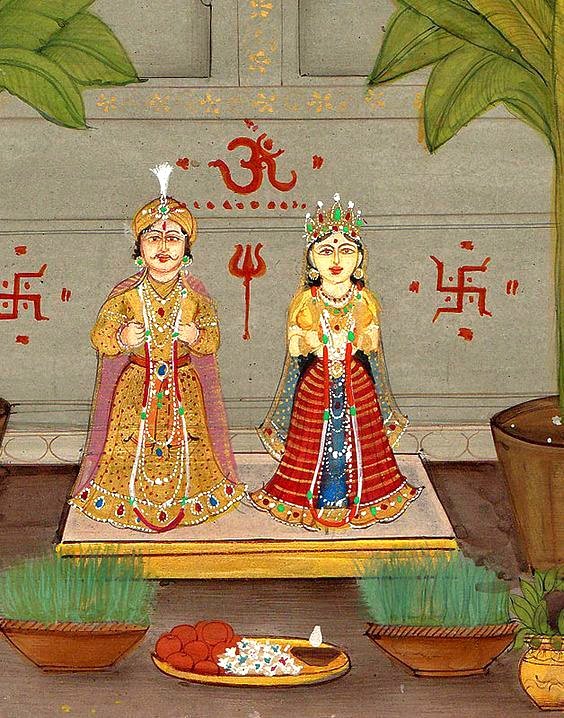
There are some festivals that dazzle with grandeur, and then there are those that quietly settle into the soul, Gangaur belongs to the latter. It is not just seen; it is felt. It arrives softly in Rajasthan just after Holi, when the colours begin to fade and the air carries a gentle warmth of spring. In that subtle transition of seasons, Gangaur unfolds, not as a single celebration, but as a lived experience of devotion, memory, and timeless grace.
The Significance of Gangaur
At its heart, Gangaur is dedicated to Goddess Gauri and Lord Shiv, whose union is seen as the most complete expression of companionship. But Gangaur is not merely about divine worship—it is about the deeper idea of balance in life.
Gauri represents nurturing strength, fertility, and devotion, while Shiva embodies stillness, detachment, and cosmic energy. Together, they form a harmony that reflects how life itself must be lived—with patience, understanding, and mutual respect. This is why Gangaur is celebrated not just for marital happiness, but for emotional strength, inner resilience, and the ability to sustain relationships with grace.
For married women, it is a prayer for the well-being and longevity of their husbands. For unmarried girls, it becomes a quiet hope for a partner who mirrors the depth and integrity of Shiva. Yet beyond these meanings, Gangaur speaks to something universal—it is about connection, continuity, and the beauty of faith carried through generations.
The Story of Gauri’s Return: A Daughter Comes Home
One of the most touching legends associated with Gangaur is the belief that during this time, Goddess Parvati returns to her maternal home.
She is welcomed not as a distant deity, but as a beloved daughter. This idea carries deep emotional resonance in Indian culture, especially in Rajasthan, where a woman’s bond with her maika is filled with tenderness and nostalgia. For a few days, Gauri lives among her people, surrounded by affection, care, and celebration.
And then comes the moment of departure.
Lord Shiva arrives to take her back, symbolising the return to her marital home. This farewell is not just ritualistic—it is deeply emotional. It reflects the delicate reality of a woman’s life, where love exists in both homes, yet she must constantly move between them. The final immersion of Gauri’s idol carries this emotion of ‘vidai—a goodbye that is both beautiful and bittersweet.
The Tapasya of Parvati: Devotion as Strength
Another powerful legend speaks of Parvati’s unwavering determination.
It is believed that she performed intense penance to attain Shiva as her husband. Her devotion was not passive; it was a conscious act of strength and faith. Through her tapasya, she proved that love and commitment require patience, courage, and inner clarity.
This story gives Gangaur a deeper philosophical meaning. It reminds us that devotion is not weakness—it is resilience. It is the ability to remain steadfast even in uncertainty, and to shape one’s destiny through belief and effort.
Faith That Sustains Life: Stories of Hope and Abundance
Folk traditions across Rajasthan also speak of times when women, facing drought or hardship, prayed to Gauri with unwavering faith. It is believed that their devotion brought rain, prosperity, and renewal to the land.
In these stories, Gauri becomes more than a symbol of marital bliss—she becomes a देवी of life itself, one who listens, nurtures, and restores balance. Gangaur, therefore, also becomes a celebration of nature’s cycles—of fertility, growth, and the promise that after every hardship, life finds a way to bloom again.
The Rituals of Worship: Where Devotion Becomes Daily Life
Gangaur is not confined to a single day; it is experienced over nearly sixteen days.
The rituals begin just after Holi, as women sow wheat or barley seeds in earthen pots. These seeds, nurtured daily, grow into green Jawara—symbolising life, prosperity, and renewal. It is a quiet yet powerful act, reflecting how care and patience lead to growth.
Each morning, women perform the pooja of Isar and Gauri with flowers, water, turmeric, vermilion, kumkum, mehendi and kajal. Fasting becomes a part of the discipline, but it is observed with calm devotion rather than rigidity. The listening of the Gangaur vrat katha adds meaning to the rituals, connecting each act to the stories of the divine.
Gauri is adorned like a bride, reflecting beauty, dignity, and completeness. In this adornment, women often see their own reflections—not just as individuals, but as carriers of tradition and faith.
Songs That Carry Generations
No description of Gangaur is complete without its geet. These traditional songs are not written in books; they live in memory, passed from one generation to another.
Sung in groups, they speak of love, longing, and devotion—of Gauri waiting, of Shiva arriving, and of the emotional rhythms of life. There is a quiet intimacy in these gatherings, where women come together not just to sing, but to share stories, laughter, and belonging.
In these moments, Gangaur becomes more than a ritual—it becomes a shared cultural experience. Lines like “Gor Gor Gomti, Isar puje Parvati…” may sound simple, but they carry generations of emotion within them.
A Celebration in Colour and Grace
As the festival progresses, it begins to reflect in the outer world as well. In cities like Jaipur, Udaipur, and Jodhpur, the streets come alive with processions, music, and colour.
Women dressed in traditional poshaks, vibrant lehengas and odhnis, adorned with jewellery and mehendi and beautiful Shringar, create a visual celebration that is both elegant and rooted. The final processions, where idols of Gauri are carried with devotion and joy, bring the community together in a shared moment of celebration.
And yet, as the idols and the jawara that is grown is immersed in water, there is a quiet stillness—a reminder that even the most beautiful moments must gently come to an end.
The Taste of Tradition
Gangaur is also felt through its flavours. The sweetness of Ghewar becomes symbolic of the festival itself. Often sent from a woman’s maternal home, it carries with it love, memory, and a sense of belonging that transcends distance. Sweets like Malpua, kheer and Gune are also made.
Gangaur~ more than a festival
For Rajasthan, Gangaur is not just a festival—it is a reflection of its soul. It carries within it stories of love, strength, devotion and faith, woven together with the rhythms of everyday life.
And for anyone encountering it for the first time, Gangaur offers something rare—a glimpse into a world where celebration is not just about festivity, but about feeling. Where every ritual has meaning, every song has memory, and every prayer carries the quiet beauty of belief.