

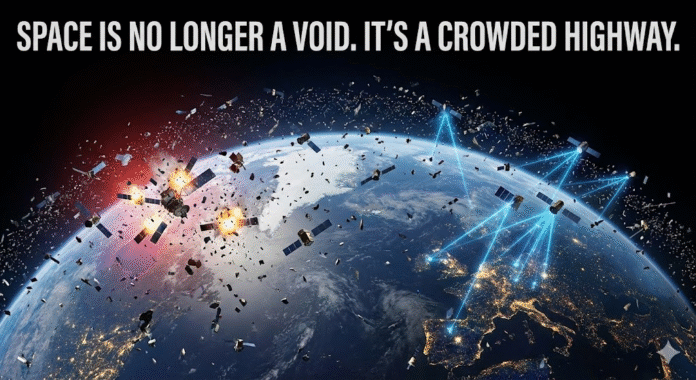
A viral video from satellitemap.space has reignited debate over the growing number of satellites surrounding Earth. The clip visualises more than 9,600 satellites in low-Earth orbit (LEO) as of early February 2026, with a majority belonging to SpaceX’s Starlink constellation, which provides internet connectivity to remote and underserved regions.
The animation, which shows Earth encircled by dense rings of moving dots, left many viewers unsettled. Social media users described the scene as “terrifying,” voicing concerns about privacy, light pollution, and the long-term impact on space safety. Some also warned that the rapid expansion of satellite networks could worsen the risk of space debris and future collisions.
However, experts and space analysts have urged caution against taking the visuals at face value. They point out that the video can be misleading because satellites are extremely small relative to the vastness of space. On average, each satellite occupies roughly 100 million cubic kilometres, meaning there is still significant distance between objects in orbit.
Specialists also stress that modern satellites are equipped with active manoeuvring systems that allow operators to adjust their paths and avoid collisions. As a result, despite the growing congestion, serious in-orbit collisions remain rare.
That said, challenges persist. Astronomers have repeatedly flagged issues such as interference with ground-based telescopes, increased brightness in night skies, and the cumulative risk posed by space debris. With projections suggesting that the number of satellites in orbit could approach 100,000 by the end of the decade, managing traffic in space is becoming an urgent priority.
The viral video has once again highlighted the need for stronger global regulations and coordination to ensure that the benefits of satellite technology do not come at the cost of long-term sustainability of Earth’s orbit.