

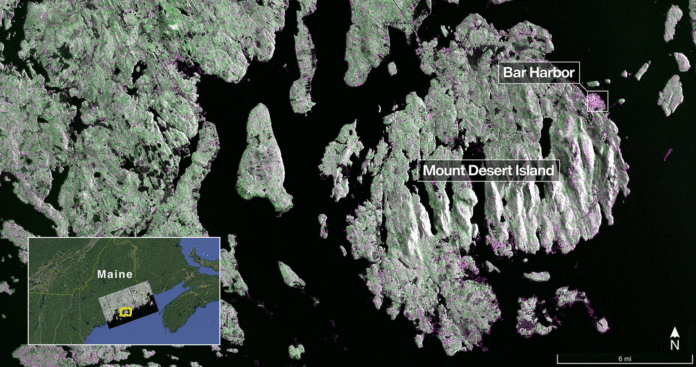
The NASA-ISRO Synthetic Aperture Radar (NISAR) satellite has transmitted its first images of Earth, marking a major milestone as the joint mission moves toward full science operations later in 2025. The high-resolution radar data is expected to significantly enhance disaster response, infrastructure monitoring, and agricultural management across the globe.
Overview of the NISAR Mission
NISAR is a collaborative Earth observation mission between NASA and the Indian Space Research Organisation (ISRO). Launched on July 30, 2025, the satellite uses advanced L-band Synthetic Aperture Radar (SAR) technology to capture detailed images of Earth’s surface. Its radar imaging capabilities work regardless of weather conditions or daylight, making it ideal for consistent, year-round surface monitoring.
First Images and Their Importance
The initial radar images include views of Mount Desert Island in Maine and parts of northeastern North Dakota. These images show remarkable detail, clearly distinguishing features such as water bodies, forests, bare ground, and human-made structures. Objects as small as five meters are visible. The images also reveal land use patterns, including wetlands, agricultural fields, and irrigation systems, offering valuable insights into both natural and human-modified landscapes.
Key Technological Features of L-Band SAR
NISAR’s L-band radar penetrates clouds and vegetation, enabling uninterrupted data collection. It can distinguish between various types of land cover, such as low vegetation, dense forests, and urban environments. This level of precision is essential for accurately monitoring ecosystems and tracking changes caused by human activity or natural processes.
Applications in Environmental and Resource Monitoring
The data from NISAR will be instrumental in:
- Tracking forest cover changes and wetland health
- Monitoring crop growth cycles and agricultural productivity
- Assessing the impact of climate change and human development
- Supporting disaster management efforts, such as flood or landslide prediction
- Enabling sustainable land use planning and conservation strategies
A Model of International Collaboration
NISAR stands as a symbol of successful collaboration between the United States and India, combining NASA’s radar technology expertise with ISRO’s launch capabilities. Beyond Earth observation, the mission is expected to contribute valuable data for planetary science and future exploration of the Moon and Mars.
Conclusion:
The successful transmission of NISAR’s first Earth images signals the beginning of a new era in global environmental monitoring. With its powerful radar capabilities and international backing, NISAR is poised to become one of the most impactful Earth science missions of the decade.