Basking under the success stories of sports stars? Feeling delighted to see how KL Rahul outperformed his own record to set another record? Wanna see yourself repeating similar success stories? Read these five inspirational sports quotes that will push you to perform better…
“If you can’t outplay them, outwork them.”– Ben Hogan
“Persistence can change failure into extraordinary achievement.”– Marv Levy
The five S’s of sports training are: stamina, speed, strength, skill, and spirit; but the greatest of these is spirit.”– Ken Doherty
“An athlete cannot run with money in his pockets. He must run with hope in his heart and dreams in his head.”– Emil Zatopek
“Continuous effort — not strength or intelligence — is the key to unlocking our potential.”– Liane Cardes
Kings XI Punjab captain KL Rahul on Thursday smashed many records in IPL by hitting 132 on 62 balls — the highest individual score by an Indian player in the IPL which helped him cross the 2,000-run mark and take his team to 206/3 in 20 overs against Royal Challengers Bangalore here.
KL Rahul became the first Indian to make the highest score in the IPL, surpassing the earlier record of 128 not out by Rishabh Pant.
It was Rahul’s second IPL century and overall fourth century in T20s.
Rahul ended the innings unbeaten on 132 off 69 balls, by including 14 fours and seven sixes. This is the first century by any player in the ongoing season of the league.
Rahul also became the fastest Indian batsman to make 2,000 IPL runs, surpassing the 8-year-old record held by batting great Sachin Tendulkar. Rahul made this record in his 60th innings while Tendulkar reached the landmark in his 63rd innings.
The Wildlife Protection Act is being amended. The Union Ministry for Environment Forest & Climate Change (MoEFCC) wants to add tougher penalties for breaches of this legislation. It will provide a larger role for Eco-Development Committees (EDCs), which serve for kind of joint management of forest resources between the forest department and local people living in the fringes of protected areas.
This Act was promulgated in 1972, scripted by the then India’s Director, Wildlife, Dr. MK Ranjitsinhji. The Ministry has generally remained under fire from conservationists’ lobby owing to its tardy approach to implement rules. In fact, role of forest officers, belonging to Indian Forest services, has been questioned. It is they who implement conservation initiatives in all states.
Dr. MK Ranjitsinji addressing a Ministry meeting on Great Indian Bustard at WWF-India office in New Delhi (Photo by Harsh Vardhan)
Dr. Ranjtsinhji has remarked in an email dialogue with some conservationists that “Bureaucrats of my ilk are mere pawns in that power game. It is we who show the politicians the way to subvert the welfare of forests, because we know the system better. We don’t deserve to be called foresters and forest secretaries, but personal assistants of politicians.”
The Forest Rights Act is a major factor. What next?
Dr. Ranjitsinhji suggests, “Firstly, scrap MoEFCC and all state forest departments. Forests should be handled by the respective Ministry/Departments of Tribal Welfare.
Secondly, scrap the All India Forest Service. Revert back to the state service as it was till the 1960s. A state service forest officer will be placed to serve each Gram and Zila Panchayat, because that is where the decision making will be.”
Former Principal Chief Conservator of Forest, Madhya Pradesh, HS Pabla adds: “I think any amendments to any of the forest laws are useless unless we align them with the Forest Rights Act, 2006. As all the reserve forests and Protected Areas are likely to be claimed by communities as community forest resources sooner or later, it will be up to them to decide whether to manage them as Protected Areas or as something else.”
About Dr Ranjitsinhji
Dr. Ranjitsinhji is a conservation luminary. His knowledge on wild species is second to none. He defended the cause of Great Indian Bustard and now working on bringing the Cheetah in to India. His wish to ensure both species flourish in India’s wild, looks like getting fulfilled. He is being heard so the Act’s new ‘avtaar’ should have his re-branding. To this author, he sent a one-line suggestion, “grow old with me…the best is yet to be!”
Halcyon days again for conservation in India? Is it?
(Please see: The feature photo is a rare photo like that of the Cheetah with a Caracal in a corner, and on a charpoy. )
Says Harsh Vardhan, a renowned environmentalist, “This photo is from my collection obtained from former Director of City Palace Museum (my good friend, Yaduendra Sahai, who is no more) who received it from Oodey Ram Ram Chander, a photography shop on MI Road, now extinct, and dated 1890). The picture reflects how Cheetah and Caracal were maintained in Jaipur through families as patronized by princes……record for wild species at home. He says, “I could not succeed in tracing out the house no. of this owner so far.“
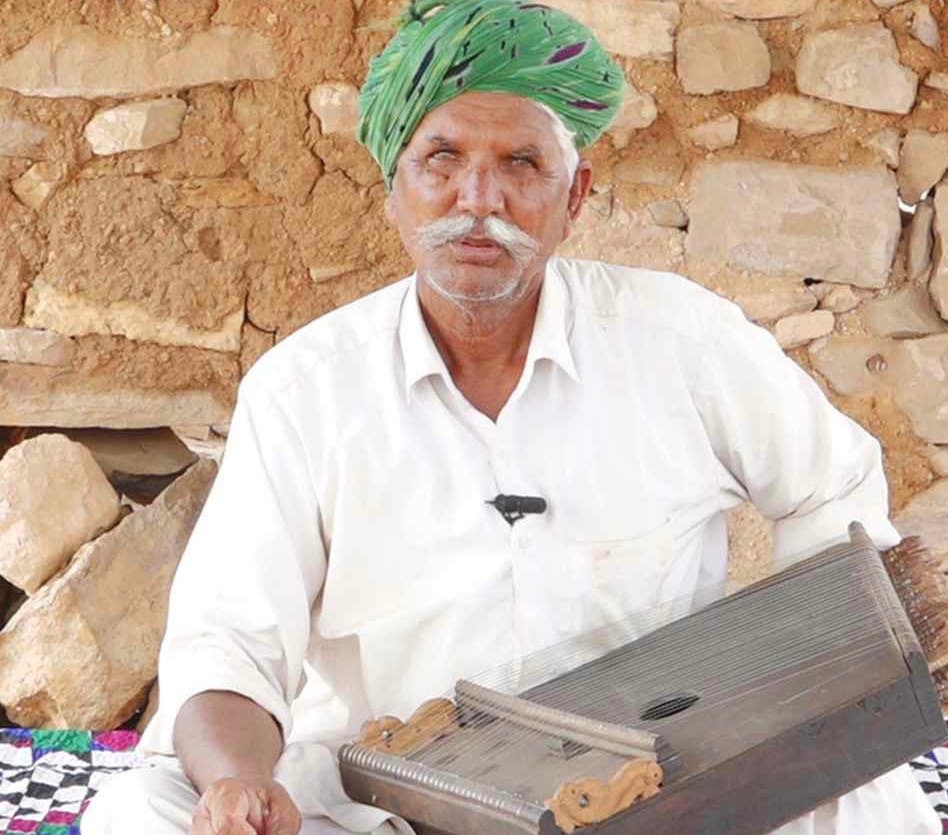
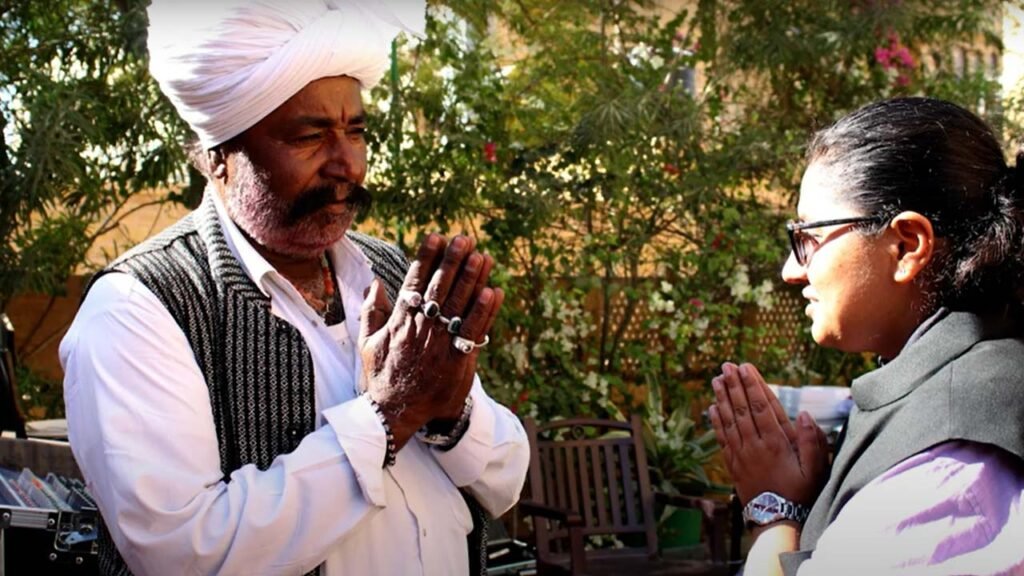
Let’s meet a young musicologist based in New Delhi, Ayesha Vasdev, who after being a DJ, became the founder trustee of Sangeetcar, an organisation dedicated to archiving, reviving and preserving the intangible cultural heritage of folk music in India. Ayesha is supporting the Manganiyar tradition in Rajasthan in diverse ways…
By Harsh Vardhan
A drop in the ocean matters! That is what has happened with the Manganiyar community in the Thar Desert through this young musicologist based in New Delhi, Ayesha.
Chanan Khan, one of the Manganiyar artist, could not play his instrument called Surmandal as it was inoperative. Ayesha not only fixed it but also offered him with an additional instrument. Such folk instruments are made in villages and are nowhere available for sale-purchase.
Chanan Khan with Surmandal
At 31, she has spent long sessions in the desert to understand how the folk tradition is surviving despite pangs and pathos of economic strains in lives of folk musicians. She offered them stage at New Delhi and also flown some artists to Japan for an India Show.
Speaking on how she supports the cause of Manganiyaar tradition, Ayesha says, “We do so by recording the songs in the highest possible audio-video resolution and by creating an online and real time presence for the artist” she told EB&W Media.
Ayesha’s great grandfather, Sir Brijnath Singh was an avid patron of Maihar Music. He and Baba Allaudin Khan Sahab together created what we refer to as the Maihar Gharana of classical music. Her maternal grandmother’s father Moti Singh Mahida is also known as the father of Gujarati Poetry. His poems are still an integral part of Gujarati literature, giving him the title of the Pearl of Gujarat.
She spent a year under the tutelage of Holger Jetta learning about western classical music and composition. She attended the Alchemea College in London to pursue a diploma in Sound Engineering. There she worked with the reputed Abbey Road Studios and was exposed to a multitude of genres in music.
She had become a DJ at the age of 17. Whilst DJing, she attended A. R. Rahman’s music academy – KMMC in Chennai and did a foundation course in western classical music. She has worked with companies like GAIL, Rock it, Dineout and so on.
“All our dreams can come true, if we have the courage to pursue them.” – Walt Disney
“The secret of getting ahead is getting started.” – Mark Twain
“I’ve missed more than 9,000 shots in my career. I’ve lost almost 300 games. 26 times I’ve been trusted to take the game winning shot and missed. I’ve failed over and over and over again in my life and that is why I succeed.” – Michael Jordan
“Don’t limit yourself. Many people limit themselves to what they think they can do. You can go as far as your mind lets you. What you believe, remember, you can achieve.” – Mary Kay Ash
“The best time to plant a tree was 20 years ago. The second best time is now.” – Chinese Proverb
Pragya Shekhawat has her roots coming in from a small village in Jhunjhunu district of Rajasthan, however, her big goals helped her take this village on the global map after she was recently commissioned as a second Lieutenant in the US Air Force.
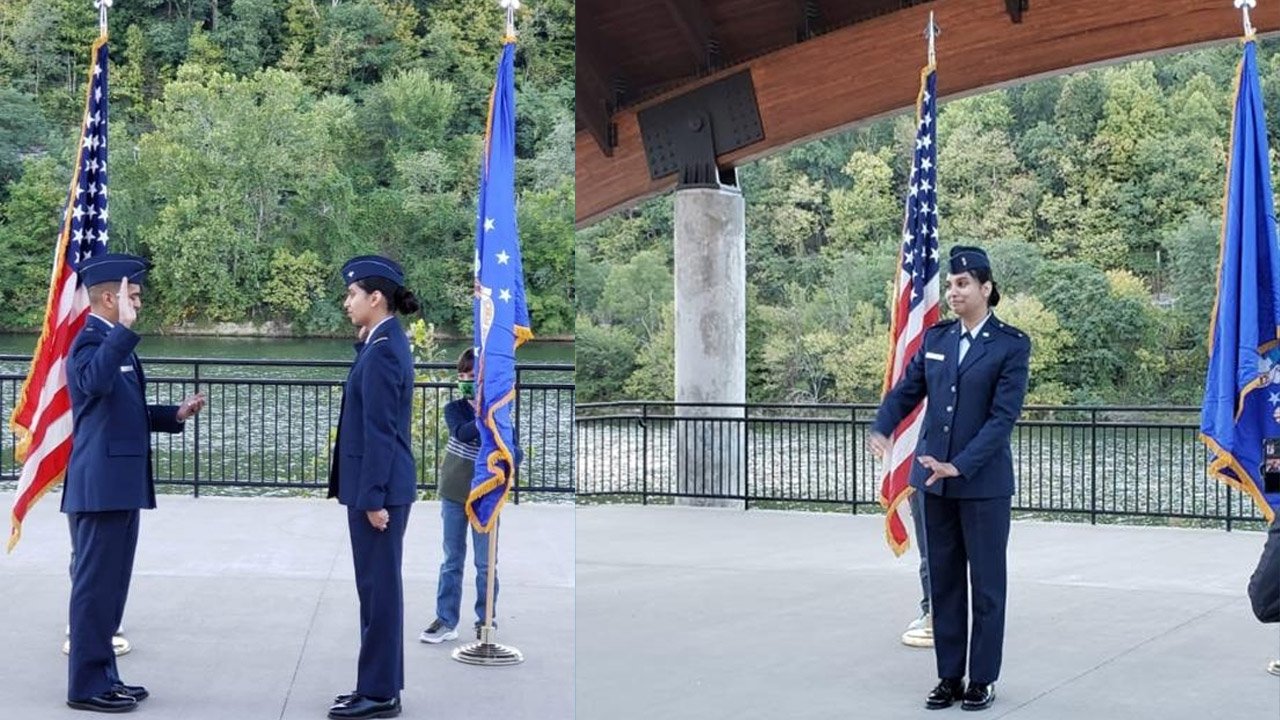
Pragya Shekhawat has been commissioned as a second lieutenant in the US Air Force on 19 September 2020 and the entire village is celebrating this honour, said her uncle Basant Singh Shekhawat.
Pragya’s brother is also serving US Air Force
Pragya’s brother Suveer Shekhawat was also commissioned in the US air force in 2015, he said, adding that after rigorous training, Suvir started flying war planes. Suvir Shekhawat, who joined the American Air Force as a second lieutenant five years ago, is currently serving as a Captain after receiving promotion.
The young siblings’ family resides in Jakhal village situated on Guda-Nawalgarh road in Jhunjhunu district.
Pragya giving her first salute to her brother who is Captain with US Army
Pragya gave her first salute to her brother
On this occasion, Pragya gave her first salute to her brother. Due to the corona epidemic, salute ceremony of the US Airforce were celebrated in a simple manner sans any fanfare . Pragya’s 91-year-old grandmother, Icharaj Kanwar, also joined the ceremony..
Pragya shares a special bond with her village Jakhal, says her uncle Basant Singh.
When Pragya taught robotics to village students of India
Pragya visited this village three years back and was here for around a year. During this stay of hers, she taught robotics to the children of the village.
After training the kids in robotics, they were motivated to participate in a national level competition organised in Gurgaon where this team from Jakhal was given a special honour. It was the only team from Rajasthan to have attained this honour.
Pragya’s father Dushyant Singh pursued his MSc and Bed here and did a teaching job in Sirohi, however later he left the job and went to the US
There, he attained his engineering degree and started working as a scientist. Pragya’s mother, Archana Kanwar is a teacher.
Pragya and her brother were born in America and both of them have been coming to their village frequently for they are quite close to their roots, said Basant
Each year, on 23 September, the eyes of innumerable war heroes, their family members and supporters of the Indian Army are moistened!
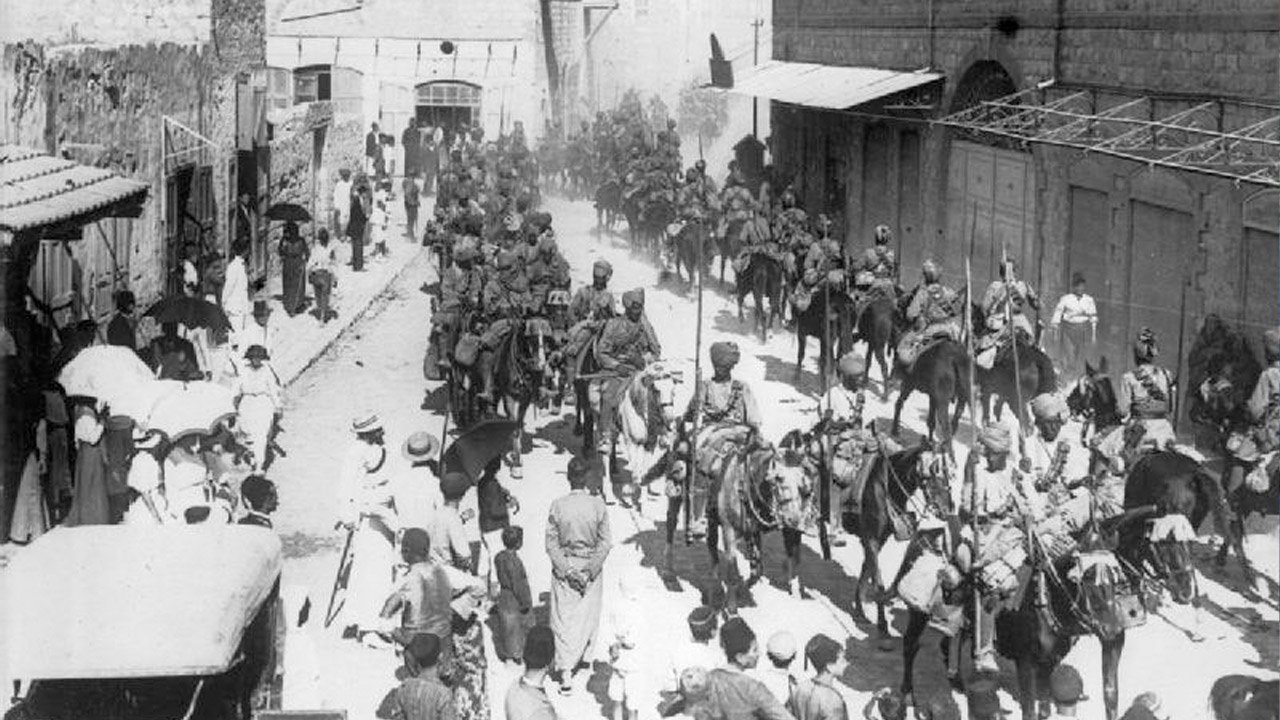
This is the day when Haifa, a coastal town In Israel, was saved by their cavalry squadron from attack by Ottomans.
900 Indian soldiers interred in cemeteries
Israel Government celebrates it as a national event to pay homage to nearly 900 Indian soldiers who are interred in cemeteries thee following this battle. The lone event is held at headquarters of 61 Cavalry by playing a polo match and offering flowers to the martyrs.
These were three Indian Cavalry Regiments: Mysore, Hyderabad and Jodhpur Lancers, that helped liberate Haifa following a dashing charge. In this action, they represented the 15th Imperial Service Cavalry Brigade of the then British Indian Army.
Done it, the Sowar shouted while Tent pegging
Captain Aman Singh Bahadur and Dafadar Jor Singh were awarded the Indian Order of Merit (IOM) and Captain Anop Singh and 2nd Lt Sagat Singh were awarded the Military Cross (MC) as recognition for their bravery in this battle while Major Dalpat Singh was awarded a Military Cross for his bravery.
Major Dalpat Singh sacrificed his life in the action
Israel celebrated centenary of this battle in 2018 and former Maharaja of Jodhpur, Gaj Singh, and Brigadier M S Jodha, grandson of Aman Singh Bahadur, also attended it. India has renamed the iconic Teen Murti War Memorial as Teen Murti Haifa Chowk. It is to commemorate that action by Indian soldiers.
61 cavalry is the only horse regiment in India
It needs to be mentioned here that 61 Cavalry is the only horse regiment in India. It is an amalgam of various Lancer and Cavalry units that had been raised by former rulers. So it has battle inoculation from distance and hoary sources. The battalion is located at Jaipur and has been responsible for providing horsemanship to armed personnel, an experience getting rarer. Under-trainee cadets for defence services undergo horse riding as an essential drill.
What an irony! Govt attempting to lose horse power for ever
An irony! The Government is in process of disbanding this regiment in a bid to convert its personnel as an armoured unit. Where its nearly 300 horses will go? To army veterinary corps or to President’s House? It shall push a long tradition into background. Losing horse power for ever.
It might be difficult to believe but it is a real fact that Chavand in Rajasthan, the last capital established by Maharana Pratap where he spent the last days of his life, presently lies in shambles, courtesy the ignorance of Rajasthan Government. EB&W Media reviews the medieval glory of Indian history with the feature image capturing Rana Pratap’s Memorial (he was cremated) at Chavand…
By Harsh Vardhan
Chavand, basically, is a place where Pratap lived for about two decades and breathed his last on June 29, 1597. Presently, one needs to walk through the rubbles to try to trace out the penultimate period of this hero, who was the bravest amongst all braves, in the mediaeval Indian history.
Awaiting the restoration of Mewar ro maan’ (prestige of Mewar region), Maharana Pratap’s armoury, stables, store-rooms and the main apartment at this place where he lived till his last, have fallen flat to ground
He set up his capital at Chavand after Haldi Ghati Battle
This forlorn place is situated around 65 km south of Udaipur where Maharana Pratap had set up his capital after the Haldi Ghati battle was over on June 18, 1576. He tried to reorganise infantry and cavalry to fight back and restore “Mewar ro maan” (prestige of Mewar region) through the new capital at this place. After living there for about two decades, he breathed his last at Chavand in June 1597.
Rana Pratap’s palace in ruins at Chavand
An entry gate, the lone sentinel of one-time Mewar’s capital
The precincts were allowed to decline in character since no one cared to restore or renovate last remains of the nation’s hero. Dilapidated walls reveal living chambers and other buildings. Scattered stones, lime, wooden beams, etc can be re-assembled if a renovation initiative is taken up. It is over a raised hill-side overlooking the main village. An entry gate still stands as lone sentinel of the one time Mewar’s capital.
Poor luck of Rana of Mewar?
What luck for the forgotten Rana? Some years ago, then Governor of Rajasthan tried to push up the official stones. So a marble cenotaph was raised amidst a rectangular garden over an island in Kejad lake, a few kilometres away from Chavand. A stone idol of Lord Shiva is placed beneath the cenotaph, reminder of Lord Ekling ji. A bridge was created to link the island with main land. And a tin hoarding raised at entrance to give details of entire Sisodia clan. It looks wind blown, too obvious not cared after having been installed.
A metal plaque about the Pratap clan at Chavand
Rana’s legacy appeals all
Swallows breed at the balconies raised around the small garden. Open-billed Stork, Painted Storks, Red-naped Ibis, and Egrets are found scurrying water to search mollusk, fish, frogs etc. A leopard walks down the cenotaph at evening time. The Jaisamand Sanctuary is not far away. The site is awesome with Rana’s legacy as authentic background, to be fashioned out as a new destination: walking down Rana’s capital and folding up at the cenotaph. To be laced with period icons like the Mewari horse, images of battle-hungry warriors surviving on “macca ri roti” (corn bread), etc.
Rana being neglected at Haldi Ghati too!
Neglect towards this Rana is too obvious at Haldi Ghati. A tiny cenotaph signifies the place where his war horse, Chetak had fallen down for ever. A museum on his legacy is run by a private entrepreneur, showing off flimsy historic yarns. Down the road, couple of cenotaphs stand amidst a small green to eulogize warriors who fell in that battle.
Tourism and Archaeology authorities’ fail to mark foot prints on Pratap’s land
The Tourism and Archaeology authorities’ foot prints are difficult to be observed. Contrary to it, Kumbhalgarh, where this Rana was born on 9 May 1540, is restored and agog with visitors. Udaipur, where this Rana seldom lived, show cases Rana’s Statue at Moti Magri forest regime. The display is fairly majestically with appreciable upkeep.
Who shall bell the cat at Chavand?
Who shall bell the cat at Chavand? Governor or Chief Minister of Rajasthan? Or the Mewar ruling house, successor of the famed Rana? EB&W Media is informed that some people at Chavand claim ownership of Rana’s ruins and waiting for an official call. Can their case be heard logically? A gold-mine for tourism now to be allotted to some one?
At a time when the world battles with an unseen enemy in the form of COVID-19, the International Day of Peace is being celebrated this year with theme of ‘Shaping Peace Together’ on September 21. International Day of Peace is also known as the World Peace Day which strengthens the ideals of peace, both within and among all nations and peoples.
UNESCO also shared a tweet calling for the need of sustainable peace in the wake of COVID-19 pandemic bringing in crisis across the globe.
The need for sustainable peace has never been so meaningful amid #COVID19. Just as this health crisis affects all, our response must involve everyone everywhere – with inclusion & solidarity.
— UNESCO 🏛️ #Education #Sciences #Culture 🇺🇳😷 (@UNESCO) September 20, 2020
With the world needing peace and harmony, here comes the inspirational and warm quotes about peace and love.
“Peace cannot be kept by force; it can only be achieved by understanding”
– Albert Einstein
“Peace comes from within. Do not seek it without”
– Buddha
“Peace is a daily, a weekly, a monthly process, gradually changing opinions, slowly eroding old barriers, quietly building new structures”
– John F. Kennedy
“Peace begins with a smile”
Mother Teresa
“Imagine all the people living life in peace. You may say I’m a dreamer, but I’m not the only one. I hope someday you’ll join us, and the world will be as one”