Prithvi Vilas Palace is an offbeat getaway in Jhalawar
Prithvi Vilas Palace, a 130-year-old palace, has been converted into a heritage hotel in Jhalawar offering an experience of old bygone era Rajput chieftain residence.
This palace is recommended for offbeat getaways as it is an experiential heritage hotel, has large rooms furnished with life size paintings, frescoes, jharokas, balconies and has an open courtyard.
The property offers a variety of multi-cuisine meals such as Indian, Continental, Rajasthani and Rajput cuisine along with wellness options include an Ayurvedic massage centre.
The recreational options include a swimming pool, library, puppet shows and folk dance. Excursion activities include cycling tours, treks, jeep – camel – horse safaris, drive to Mukundgarh, Mandawa, Fatehpur and Lohargal and sightseeing
About Jhalawar
Jhalawar is a heritage town situated on border of Madhya Pradesh / Rajasthan border at a distance of 90 kms from Kota and is known for its temples with architectural significance.
As NASA’s Perseverance rover touched down on the surface of Mars after seven months in space, an Indian-American named Dr Swati Mohan, first confirmed that the rover had survived a particularly tricky plunge into the Martian atmosphere.
This Indian American Swati Mohan virtually spearheaded the successful landing of Perseverance that will search for signs on life on the Red Planet.
Swati Mohan has participated in several key NASA missions like the Cassini (a mission to Saturn) and GRAIL (a pair of spacecrafts in formation on the Moon).
She immigrated to the US from India when she was just age one and was inspired by ‘Star Trek’ series at age 9.
Mohan holds a Bachelor of Science degree in Mechanical and Aerospace Engineering from Cornell University and has completed her MS and PhD from MIT in Aeronautics/Astronautics.
Mohan wanted to be a pediatrician but she was inspired by her first physics class and saw “engineering” as a way to further her interest in space exploration.
She has been a member of the Perseverance Rover mission since its inception at NASA’s Jet Propulsion Laboratory in Pasadena, California.
The BERA BOND is a new coffee-table by Sundeep Bhutoria
Story By- Harsh Vardhan
At a time wild Tigers are in chase, Sundeep Bhutoria has engaged Macmillan publishing to sensitise readers about Leopards in Bera landscape.
About Bera and Rebaris
Bera is situated in the Pali district of Rajasthan and is often nicknamed as the ‘Leopard Country’ as it is home to one of the highest densities of leopards.
The 170-page coffee-table book (The BERA BOND) is heavy in content. But it unpacks stark humour about incredible tolerance of local shepherd community called Rebaris.
Their hamlets, agricultural fields, pastures, etc. are guarded by these predators.
“While across the globe, the coexistence of big cats with humans is marked by conflicts, the Leopards and the villagers in Bera have not attacked each other for decades” authoritatively declares this Kolkata based writer.
It has become an absorbing account of all wild big cats in the world. From the male Pasha hiding amidst granite rocks to females like Neelam and Zia, playing hide and seek with overseas and domestic visitors, you read to know more.
Lady Leopard, Neelam with her cubs, Heera and Panna, names like those of the Rebari shepherds who live along with such predators
Trace leopards at dawn and duskhere!
The text carries an inquisitive reader towards low hills, surrounded by knots of villages and a vast water body called Jawai, having a strong linkage with erstwhile royal family of Jodhpur, nay Marwar. The geography is limited for people. But Leopards find it limit-less. One time nocturnal, now this crafty animal marks its attendance, almost at an appointed hour at dawn and dusk. Like to meet him at a temple? Brilliant photos portray all this.
Villagers treat this wild animal as a divine associate
The rural fate rests on pastoral economy. Leopard’s destiny has to oscillate over the sheep-flocks. He has to stealthily snatch away a lamb to meet both ends meet. The rural folk do not mind the loss. They treat this wild animal as a divine-associate! The writer scratches local vegetation: spider-flowers, wild mushrooms, wild fungus, euphorbia, and thorny acacia trees. The photograph of a sub adult Indian Courser: wonder if any one reported it earlier? Birds at Jawai are named. So are other mammals eg Rusty-spotted Cat.
Meet this conservationist Shatrunjay
Sundeep praises Shatrunjay Pratap Singh, who spread out a rustic-looking yet most luxurious lodge at Bera. Its wondrous location enables you to spot Leopards from one’s room. He is a fierce conservationist and is adamant not to increase room-numbers, seven only! Ethics at cost of revenue. At a young age, he has become an ex situ guardian for this habitat which ironically does not enjoy appropriate regulations. Do what you like here and no entry fee to check you.
An inspirational approach runs through the text to offer tips for other wildlifers. Shatru has received a benign patron in Sundeep who has caused a niche in penmanship-partnership. CP Singh Rathore, Gopal Singh and Umesh Gogna have been acknowledged for their photography. Shatru, his wife, Katyani Kumari and their twins find appreciable mention for their impeccable hospitality and unending smiles. One shall have to visit the scene to understand what is in store.
Sundeep Bhutoria, the Kolkata-based author at the Jawai Dam, a consequential equity across the Bera landscape
For a community-led conservation initiative
Sundeep has donned a new attire by embracing wilderness and its denizens. Nearly 40% of his total books revolve around wild species. The Bera Bond is truly a promotional enterprise: “My only intention behind writing this book is to inspire people to save the big cats.” He prefers to dedicate it to Aavya and Manjari. Any reason photos of a few hotels, citation of weddings and personas in attendance, have been laced in? To entice such aficionados in to wildlife conservation?
Summing up this first travelogue treatise on Leopards, the writer sounds an optimistic note, “Bera holds out hope of a remarkable turnaround through a community-led conservation initiative.”
But he also bleeds: Any reason why Bera has not been declared as a Community Reserve to let local stake-holders start receiving economic benefits out of Leopard centric tourism? The answer may lie with good Samaritans in forest department, some cited by him in this text.
Phad painting of Rajasthan is a 700 year old legacy. Depicting a kind of scroll painting, it narrates the elaborate religious stories of local deities and Gods.
Passed down over generations within a single family, it finds its origin in Shahpura near Bhilwara in Rajasthan,
Many centuries back, these traditional paintings, created as travelling or mobile temples, were carried by priest-singers of the Rabari tribe, called Bhopas and Bhopis. They sang and performed stories of their local deities including Devnarayanji (a reincarnation of Vishnu) and Pabuji (a local hero). The Phad painting were unrolled, or unfolded after sunset, and they performed in front of village members till the night. This is perhaps why the paintings are called ‘Phad’, which means ‘fold’ in the local dialect.
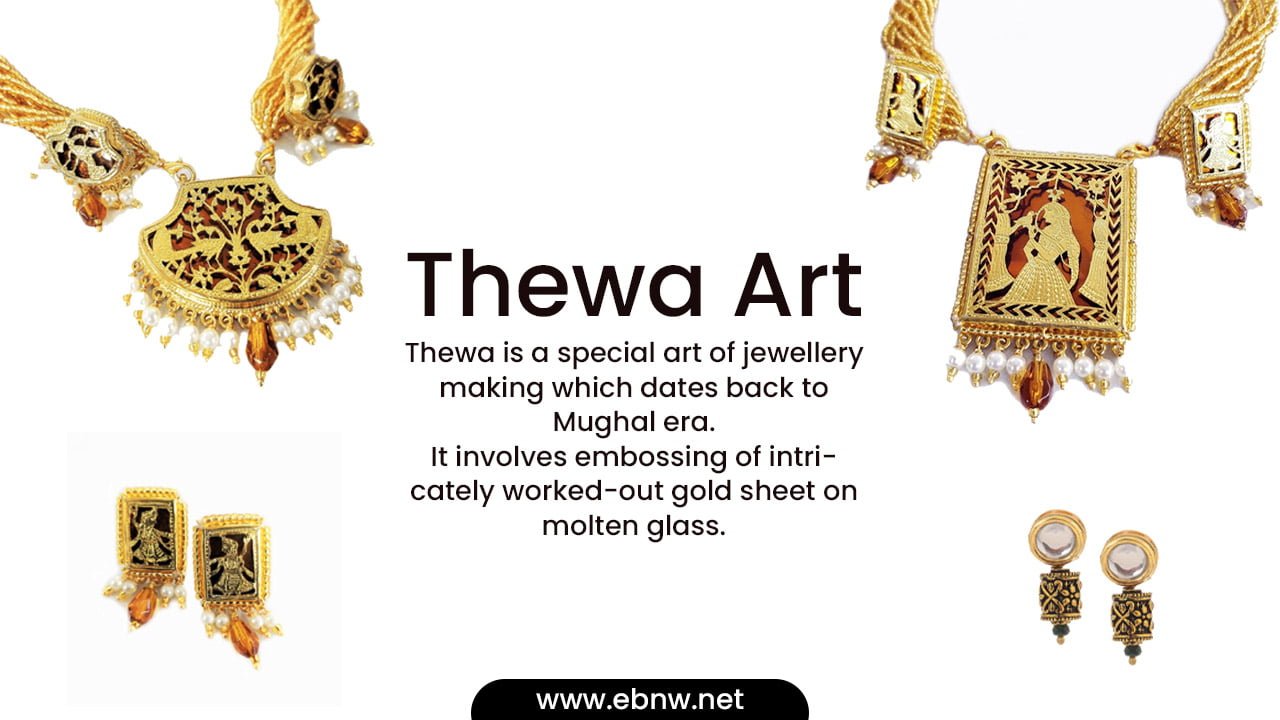
Thewa is a special art of jewellery making which dates back to Mughal era. It involves embossing of intricately worked-out gold sheet on molten glass.
This traditional art of fusing 23K Gold with multicoloured glass originated in Pratapgarh district of Rajasthan. The glass is treated with a special process to bring out glittering effects, which in turn highlights the intricate gold work. The whole Thewa piece is hand crafted which takes around a month’s time by skilled artisans.
Thewa uses motifs on jewellery, showcasing the culture, heritage and tales of romance and valour of Rajasthan .
Origin:
The origin of Thewa art goes back to 1707 when a craftsman named Nathu ji Soni from Pratapgarh invented the process to create this art, considered as one of the most expensive art forms. His skills were passed on to the next generation of his family who call themselves “Raj-Sonis”. Many craftsmen from this family have been honoured with esteemed awards including UNESCO, National and State Government awards.
In 2011, the Raj-Sonis of Rajasthan made their way into the Limca Book of Records; this is the only family with nine national awards. In 2015, Mahesh Raj Soni was bestowed with Padma Shree for his excellent Thewa handicraft.
Pichwai paintings of Rajasthan originated in Nathdwara in Udaipur district around 400-year-old. Being vibrant, attractive, intricate and visually stunning, these paintings depict the tales from Lord Krishna’s life.
The characteristic features of Pichwai paintings are large eyes, a broad nose and a heavy body, similar to the features on the idol of Shrinathji, a divine form of Lord Krishna. These paintings showcase various legends surrounding Lord Krishna.
These intricate paintings take anywhere between two weeks and a few months, depending on the size of the canvas and detailing of the work.
Meenakari, one of the most complex crafts, was introduced in Rajasthan by Raja Mansingh of Amer at the turn of the 16th century. He brought in artisans adept in the Meenakari art from Lahore and established them in Jaipur.
Jaipur hence became the hub of meenakari art with the influx of highly skilled craftsman from Lahore. In next few years, the talent of the craftsmen made the place a specialized centre of meenakari designing.
Basically, Meenakari is an art of painting or embellishing on various types of metals with vibrant colours made in dramatic motifs of birds, flowers and leaves.
It was initially a Persian craft but it soon flourished and was used to create mesmerising designs on the back of traditional Polki jewellery. Soon, it became a design of its own, and was called as reversible jewellery.
The complex craft, today, also passes through the same phase as it was 500-years ago starting with the designer (naquash), who goes to the goldsmith (sonar). He then goes to kalamkar who engraves the design and then the enamelist (meenakar) applies the colour. This artefact then goes to the polisher (ghotnawala), then to the stone-setter (jadia), and finally it is passed on to the stringer (patua) for the final touches.
Meenakari, not just restricting itself to jewellery, now includes décor products like jewellery boxes, idols, dining sets, trays, cupboards, bowls, sculptures, key chains and more. Initially, done only on gold, it is now also done on silver and copper now.
Koo App, an Indian alternative to Twitter is making news these days! Wanna know who are the brains who brought the Koo App in the market? How did Koo got its funds? What is the past history of Koo inventors? Here comes a synopsis…
Men behind bringing in the Koo App
Koo App, the microblogging site, has been co-founded by entrepreneurs Aprameya Radhakrishna and Mayank Bidwatka.
Radhakrishna founded online cab booking service TaxiForSure, which was then sold to Ola Cabs.
Prior to Koo, its parent company — Bombinate Technologies Pvt Ltd — is operating the Indian version of Quora called Vokal after making its official launch.
As per Crunchbase, the company had raised Series A funding from investors including Blume Ventures, Kalaari Capital and Accel Partners India in 2018.
In the latest round of funding made earlier this month, former Infosys CFO TV Mohandas Pai’s 3one4 Capital also invested in Bombinate Technologies.
Basant Panchami 2021: Let’s know about the date, history and significance and celebration of the Spring festival in India. Also, we bring out what time is the shubh muhurat for performing Saraswati puja
Basant Panchami is an auspicious festival of the Hindus, celebrated with great pomp and show across India on the fifth day of the Hindu month of Magha, Shukla Paksha. It is also called Sri Panchami in the South and is dedicated to Saraswati, the wife of Brahma who is considered as the Goddess of knowledge, music, learning and arts by Hindus.
Worshippers have a strong belief that the world would be shrouded in ignorance without Saraswati as she is the one who represents enlightenment. Hence, Saraswati is worshipped on Basant Panchami.
Yellow or basanti, as per legends, are Saraswati’s favourite colour and all celebrations include a shade of yellow on this day.
Vasant Panchami is further believed to be the most auspicious day to get married.
Date and Puja Time:
This year, Vasant Panchami is being observed on February 16, 2021. The Panchami Tithi starts at 3.36 am on February 16 and will continue till 5.46 am on February 17. While the entire day is considered auspicious, the right time for doing the puja is in afternoon.
This temple is Sanwaliya Seth Temple, situated about 65 km from Neemuch in western Madhya Pradesh. The world famous Sanwaliya Seth, also known as Krishna Dham, is located in Mandafia of Dungla tehsil of Chittorgarh district of Rajasthan.
In fact, even smugglers engaged in trading opium consider Sanwariya Seth as their God and offer opium before sending their consignments to their client. They also visit the temple and also send a part of the earnings to God.
Many devotees from the country and the world visit this temple.
The smugglers extract a share of Sanwaliya Seth from the profits of their business. Every month, when the box is opened on Amavasya, then along with the amount of it, opium is also found. As opium is called black gold, Samwaliya Seth is also called the God of Black Gold.
On the new moon day of every month, the donation box of the temple opens in which crores of rupees are received which have been offered to God from smugglers and devotees.