Ghat ki Guni or Ghat Ki Ghuni is a beautifully carved narrow alley stretching between eastern hill range of Aravalis in Jaipur which provide access to the areas situated in the east side of Jaipur & beyond.
Ghat ki Guni is also a starting point of the road leading to Agra -the city of Taj Mahal, hence called Agra Road.
Reginald Herber, Bishop & traveler who came to Jaipur on 28 January 1825 had described Ghat ki Guni in his memoir – Narrative of a Journey through the Upper Provinces of India from Calcutta to Bombay 1824–1825.
“….The pass grew narrower, the path steeper & more rugged as we proceeded along with it & the little stream which we were ascending instead of dimpling amid the grass & stones now leapt & bounded from crag to crag like a Welsh rivulet. Still all was wild & dismal when on a turn of road we found ourselves in front of a high turreted & battlement wall, pierced with a tier of arched window & showing us beyond them the dark green shades of a large oriental garden……”
Founded by Maharaja Sawai Jai Singh II, the founder of Jaipur city in 1739, Ghat ki Guni area envisaged the Mughal style terraced gardens such as Vidhyadhar Garden and Raj Niwas Garden.
These gardens were inspired by Mughal gardens of Delhi, Kashmir and elsewhere. Apart from these gardens, there are dwelling units, Havelis and many temples at both sides of the road. Over the period of time, people moved out of these buildings and the area stands deserted as of now, leaving the marks of a beautiful surroundings where chhatris and jharokhas run parallel in one line, leaving one stunned at the marvel of the beautiful architecture.
Emirates is celebrating the opening of tourism in a different way! It puts a flight attendant on top of world’s tallest building. See here
Emirates, in its instagram page, says, “Real or fake? A lot of you have asked this question and we’re here to answer it. Here’s how we made it to the top of the world’s tallest building, the @BurjKhalifa” and then it shares the video which is as following:
Book Lovers Days is celebrated each day on August 9 to harnesses all the excitement which bibliophiles feel about books into one celebration.
Book Lovers Day is being celebrated with zeal by all book lovers throughout the world. The temples of ‘bookaholics’ are being remembered in different parts of the world and all renowned libraries and galleries have come on twitter to wish the book reading class a happy ‘Book Lovers Day’. See how:
It seemed only fitting to share this image of author Sarah Waters standing in front of the dream bookshelf this #BookLoversDay 📚
Happy #BookLoversDay, a day to celebrate reading and bibliophilia!
We love this drawing by William Orpen from our archives, in which he depicts himself in a library reading books by ‘Wells’ (possibly the author HG Wells).
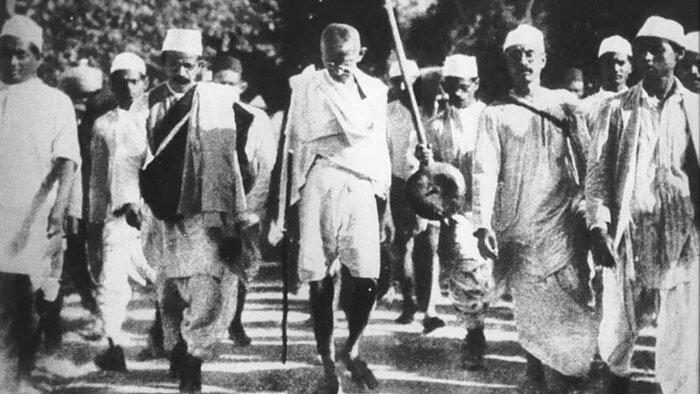
August Kranti Diwas: Know the history and significance of the day which became the turning point of the freedom struggle in India against Britishers’ regime.
The August Kranti movement emerged as the turning point in the history of the freedomstruggle as Mahatma Gandhi gave a call to launch the Quit India movement from August 9, 1942. He called upon Britishers to leave India and exhorted countrymen to “do or die”.
August Kranti Diwas & Quit India Movement
The Quit India Movement is also known as the Bharat Chhodo Andolan which was launched by Mahatma Gandhi on August 8, 1942 at the Bombay session of the All India Congress Committee (AICC). The movement was started to end the British rule in India. As the protest was held in August, it was known as August Kranti or August Movement. Each year, this day is celebrated by paying tribute to freedom fighters who laid their lives for the country.
Gandhi delivered his speech, which commenced the Quit India Movement, at Mumbai’s Gowalia Tank Maidan, which was popularly known as August Kranti Maidan. The ‘Do or Die’ speech went into the hearts of Indians, and many faced the consequences of the movement.
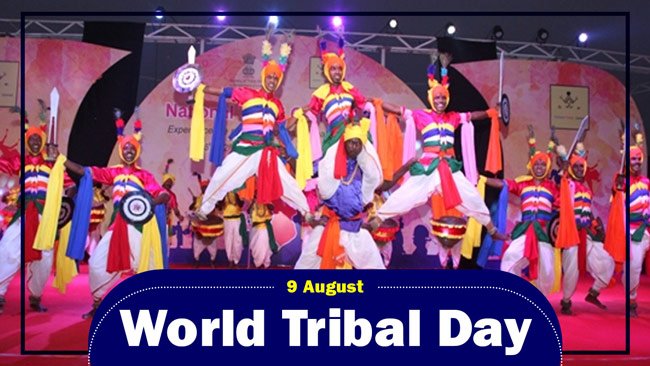
The World Tribal Day is celebrated each year on August 9 all across the world. The tribals speak an overwhelming majority of the world’s estimated 7,000 languages and represent 5,000 different cultures.
The World Tribal Day also called as the United Nations’ (UN) International Day of the World’s Indigenous People is observed on August 9 each year with an aim to promote and protect the rights of the world’s Indigenous population.
This day also recognises the achievements and contributions which the Indigenous people make to improve the world issues such as environmental protection.
It was in December 1994 that the United Nations General Assembly decided that the International Day of the World’s Indigenous Peoples should be observed on August 9th each year.
The so-called date of August 9 was chosen recognising the first meeting of the UN Working Group on Indigenous Populations of the Sub-Commission on the Promotion and Protection of Human Rights held in Geneva in 1982.
World Tribal Day Significance
World Tribal Day is observed to promote and protect the rights of the world’s indigenous population while acknowledging the achievements and contributions that indigenous people make to improve world issues including environmental protection.
As indigenous peoples are often among the poorest ethnic groups in society, the day was very much required. According to the UN, indigenous people have been making up less than 5 per cent of the world’s population but account for 15 per cent of the poorest.
They speak an overwhelming majority of the world’s estimated 7,000 languages and represent 5,000 different cultures.
World Tribal Day Theme
The theme of World Indigenous Day 2021 is “Leaving no one behind: Indigenous peoples and the call for a new social contract
World Tribal Day Quotes
“Modern man has lost the sense of wonder about the unknown and he treats it as an enemy.”
August 7 is celebrated as National Handloom Day each year aiming at generating awareness on the importance of the handloom industry in India. This being the seventh year, the day focuses on the contribution of handloom to the socio-economic development of the country. In fact, the places where these handloom fabric is created also have beautiful sights to behold. From Madhya Pradesh’s Maheshwari to Karnataka’s Ilkal fabric, the most exquisite fabrics have a story to share. Here we bring top four locations where handloom fabric has become a part of the regular fashion
Maheshwar in Madhya Pradesh for Maheshwari handloom: The history of Maheshwar handloom dates back to 18th century when intricate designs were a huge hit amongst royal circles. In fact, the looms at the shore of Narmada river near Maheshwar fort are must to see. This is the place where the story of craftsmanship of Indian labourers come alive in the form of colourful Maheshwari sarees.
Ilkal (Karnataka) for Ilkal handloom: Ilkal is an ancient weaving centre located in the Bagalkot district of Karnataka, which famous for its Ilkah handloom. Travellers visiting Ilkal loves watching the detailing of the saree following a special technique called Tope Teni, under which the pallu is weaved with the body of the saree. The most distinctive feature of Ilkal sarees is the usage of a form of embroidery called Kasuti.
Sualkuchi (Assam) for Golden Muga Silk: Sualkuchi, situated on the northern banks of the Brahmaputra, is famous for its centuries-old heritage of weaving. Besides the picturesque tea gardens, beautiful monasteries and delicious local food, shopaholics should visit the village of Sualkuchi and shop the lovely Muga silk. It is often compared to being as expensive as buying gold.
Bishnupur (West Bengal) for Baluchari sarees: The handloom has depictions of mythological scenes on the pallu of the saree. Located in West Bengal, Bishnupur is currently the only place where one can find authentic Baluchari sarees.
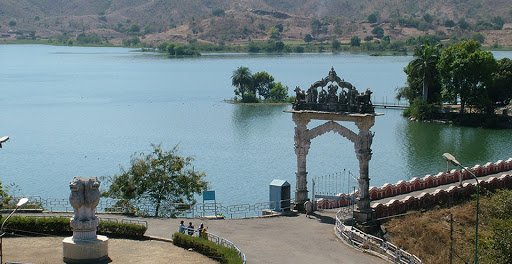
Banswara, situated in Rajasthan, is known as a city of Hundred Islands as there are many pristine green islands situated on the banks of Mahi River.
Banswara is a pretty town of Rajasthan which mesmerises all nature lovers. Its green surroundings and clear blue sky invite the avid traveller to rejuvenate his senses. Lying in the nature’s lap, this place is almost like a heaven and hence many people call it as Scotland of India.
Let’s read a few tweets where nature lovers have posted the picture of the beautiful destination:
— Rajasthan Revealed (@RajasthanReveal) July 31, 2021
This is the #Rajasthan I didn’t know exist. #Banswara, 165 Km away from Udaipur, is a must visit place for its 100 islands, bamboo forests, Bhil tribe, waterfalls and adventure activities. Let’s explore the unexplored & benefit the underprivileged communities. #MyTripToRajasthanpic.twitter.com/ER5gZqa6ku
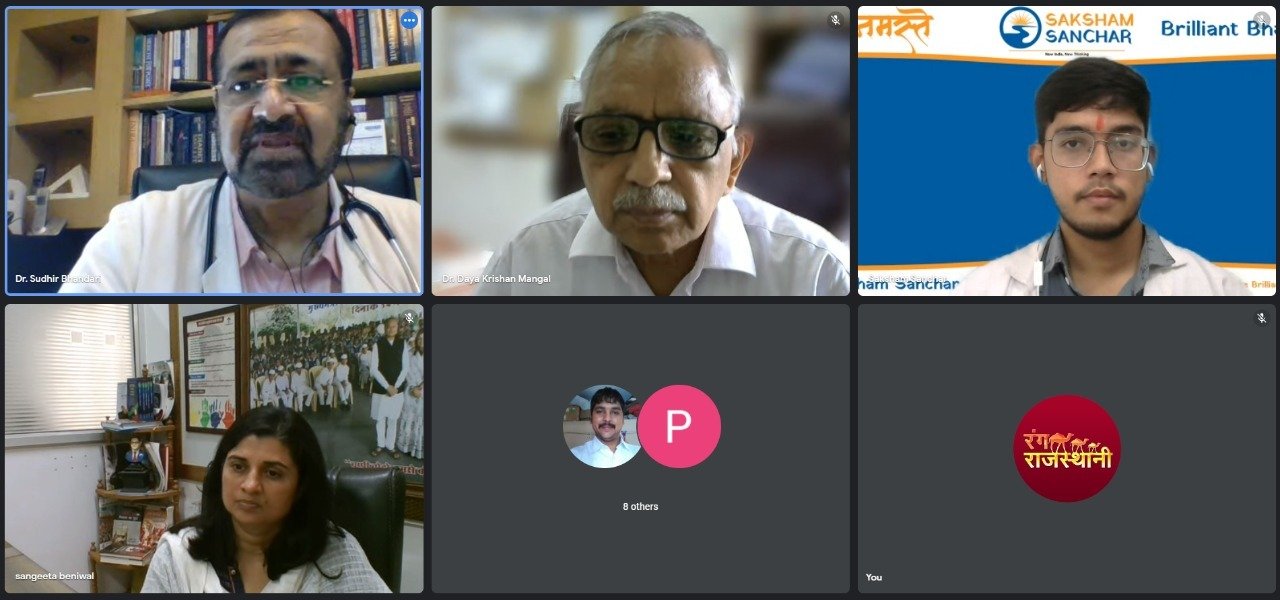
The pandemic has brutally shaken the entire ecology and its functions. To highlight the nutrition crisis that has been faced across all categories of the humanities, Saksham Sanchar organised a webinar on Fighting Nutrition Crisis in India during COVID-19, especially for women and children in India.
Experts such as Sangeeta Beniwal, Chairperson Rajasthan State Commission for Protection of Child Rights, Prashant Agarwal, President Narayan Seva Sansthan, Dr. DK Mangal, Advisor, SD Gupta School of Public Health at IIHMR University and Dr Sudhir Bhandari, Principal SMS, Medical College shared their views on the subject.
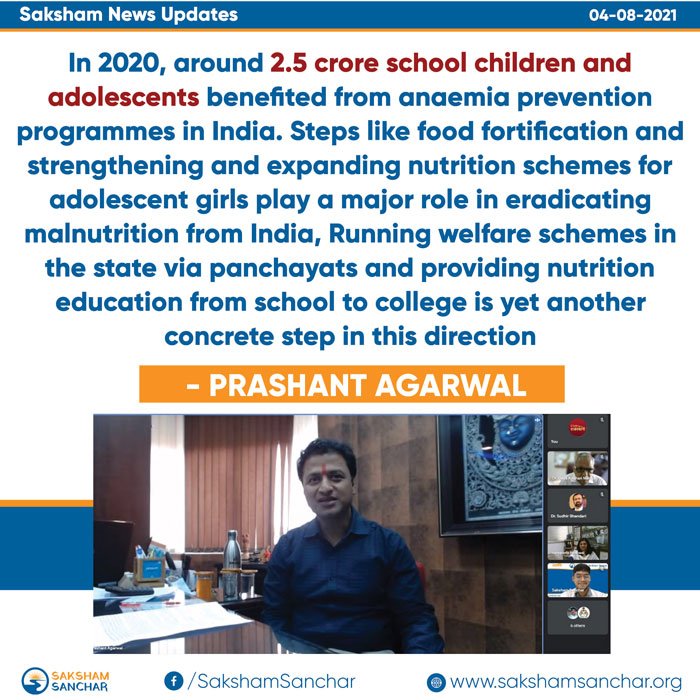
Prashant Agarwal, President, Narayan Seva Sansthan said
“In recent findings, UNICEF supported the nutrition services of the central and state governments for school children and adolescents in school. Also, in 2020, around 2.5 crore school children and adolescents have benefited from anaemia prevention programmes in India. In eradicating malnutrition from India, steps to be taken include food fortification and strengthening and expanding nutrition schemes for adolescent girls. Panchayats play a major role in running welfare schemes in the state and providing nutrition education from school to college.”
Dr Sangeeta Beniwal, Chairman, Rajasthan State Commission for Protection of Child Right said
“Rajasthan Chief Minister Ashok Gehlot has always tried to focus on providing enough food to the very poor, and not with more funding for the existing nutrition-focused welfare programs such as the Indira Rasoi Abhiyan in the state. We all must step forward to reach out to the most affected people and spread awareness to ensure the wellbeing of all the key stakeholders, especially the poor and ignorant sections. It is important for all women to adopt a healthy lifestyle during pregnancy, so that healthy women can give birth to a healthy baby.”
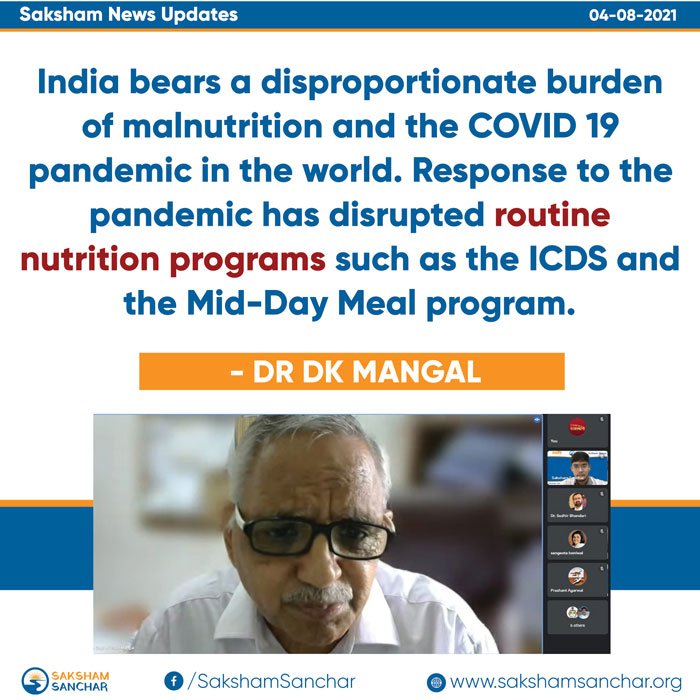
Dr. D. K. Mangal, Advisor, Dr. SD Gupta School of Public Health at IIHMR University, said
“India bears a disproportionate burden of malnutrition and the COVID 19 pandemic in the world. Response to the pandemic has disrupted routine nutrition programs such as the ICDS and the Mid-Day Meal program. This has adversely affected the nutrition status of millions of children and women. The continued COVID pandemic has not allowed us to streamline our nutrition interventions in India and has led many more women and children to suffer due to a lack of food and micronutrients. The impending threat of the third wave of the pandemic is likely to worsen the situation further.”
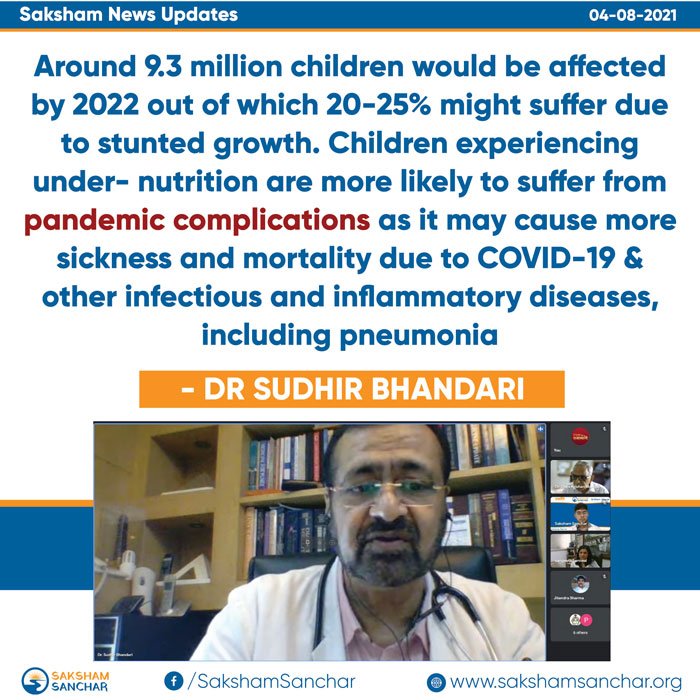
Dr. Sudhir Bhandari, Principal SMS College said
“India initially faced physical challenges during COVID-19. Over time we realised nutrition affected the lives of many where 9.3 million children would be affected by 2022 out of which 20-25% might suffer due to stunted growth. Children experiencing under nutrition are more likely to suffer from pandemic complications.
Under nutrition, may cause more sickness and mortality in people due to COVID-19 & due to other infectious diseases, including pneumonia and various inflammatory diseases. In countries with the 1st and 2nd waves of COVID-19, obesity and non-communicable diseases have been associated with the more severe outcome of the virus. Nutrition status might impact the susceptibility due to COVID-19 and health strategies to reduce micronutrient deficiencies and under nutrition are essential. COVID-19 has had a severe effect on maternal and young children nutritional status. We must strengthen the food security and functioning of the food supply chain to the population. We now must manage cases of acute malnutrition, accelerate micronutrient supplementation and fortification activities, strengthen school feeding and establish nutritional surveillance.”
Experts spoke hinting on various policies, processes and practices needed which include adequate maternal nutrition before and during pregnancy and while breastfeeding; optimal breastfeeding in the first two years of life; nutritious, diverse, safe foods in early childhood; and a healthy environment, including access to basic health, water, hygiene and sanitation services, policies based on gender equity for nutrition, policies indicated in developed and developing countries to be different and opportunities for safe physical activity.