Home Blog Page 636

Ateet Raag: Story of Jaipur’s Paperman

0

In the hustle and bustle of modern life, the significance of the past often gets overshadowed by the allure of the future. Our rapidly changing culture and technology tend to leave behind a trail of memories embedded in everyday objects. However, amidst this ever-evolving landscape, there exists a unique initiative that is breathing life into forgotten relics, connecting the new generation with the essence of civilization itself. Welcome to the enchanting world of “Ateet Raag.”

Hailing from the culturally rich city of Jaipur, “Ateet Raag” is a studio that has embarked on an extraordinary journey to resurrect the past, meticulously preserving the stories and sentiments that lie within ordinary objects. Spearheaded by the visionary director Vinay Sharma, this initiative embodies artistic thinking and investigative prowess, weaving the tapestry of history through paintings and narratives.

The roots of “Ateet Raag” trace back to Vinay Sharma’s early days, where a seemingly mundane act triggered a lifelong passion. At the tender age of eleven, he rescued his aunt’s radio from being discarded, setting in motion a fascination that would ultimately culminate in the curation of a remarkable collection comprising 250 radios today. This devotion to preserving the past earned him a moniker – “Paperman” – derived from his extensive collection of diverse memorabilia.

Vinay Sharma’s philosophy encapsulates the transformative power of positive thinking. He firmly believes that any old object can metamorphose into an artistic marvel if given the right perspective. His collection is a testament to the idea that the relics of yesteryears can serve as invaluable windows into the evolution of civilization itself. Through his work, Sharma aspires to open an educational center that serves as a heaven for the curious minds of today’s generation. Here, the stories of the past will be presented in intriguing ways, fostering a reservoir of positive energy within the young learners.

The impact of Vinay Sharma’s dedication has rippled beyond the confines of his studio. His endeavors have been documented in films that encapsulate his journey, such as “Vinay Sharma Film” and “Call from the Past.” These documentaries offer a glimpse into the remarkable life and mission of this guardian of history.

“Ateet Raag” is an ode to nostalgia and a heaven for aficionados of antiquity. It stands as a testament to the notion that art and history are intertwined, and every artifact carries a story waiting to be heard. Vinay Sharma, the heart and soul of this venture, is more than just a collector; he’s a custodian of memories, an artist who immortalizes the past in vibrant strokes and vivid tales.

For art lovers and history enthusiasts alike, meeting Vinay Sharma is akin to stumbling upon a treasure trove of wisdom and creativity. His passion is infectious, and his heart is always open to fellow admirers of the arts. “Ateet Raag” is a symphony that reverberates through time, harmonizing the present with the echoes of the past, and nurturing a deeper appreciation for the heritage that shapes our very existence.

Annapurna food packet yojana Rajasthan: A boon for the poor amid inflation

0

The Rajasthan government has launched a new scheme to provide free food packets to the poor and needy families in the state. The Annapurna food packet yojana Rajasthan, which was inaugurated by Chief Minister Ashok Gehlot on August 15, 2023, is expected to benefit over 1.10 crore families every month.

The scheme is part of the ₹19,000 crore ‘Inflation Relief Package’, which was announced by the chief minister in the state budget for 2023-24 to provide relief to the public from rising prices. Under the scheme, each food packet will contain one kilogram each of chana dal, sugar, salt, one litre soybean refined edible oil, 100 gram each of chilli powder and coriander powder, and 50 gram of turmeric.

The eligible beneficiaries will get the Annapurna food packets every month from the fair price shops (FPS) for free, for which the FPS will get a commission of ₹10 per packet. The scheme is primarily meant for the families covered by the National Food Security Act (NFSA), but it will also include the non-NFSA families who received financial assistance of ₹5,500 each during the COVID-19 pandemic.

The chief minister said that the Annapurna scheme would help realise his government’s resolution of “no one should sleep hungry in Rajasthan” and that his government’s public welfare schemes are “not freebies” but are being implemented with “excellent” financial management. He also urged the central government to implement social security schemes, similar to the ones launched in Rajasthan, all over the country.

The Annapurna scheme is the latest among a host of public welfare schemes launched by the Congress government in the state. Some of the other schemes are providing LPG cylinders for ₹500, health insurance of ₹25 lakh annually per family, accidental insurance coverage of ₹10 lakh, and additional employment of 25 days under the Mahatma Gandhi National Rural Employment Guarantee Act (MGNREGA).

The Annapurna scheme has been welcomed by the people of Rajasthan, especially those who are struggling to make ends meet amid inflation and unemployment. The scheme has also been praised by various social activists and experts as a timely and effective measure to ensure food security and nutrition for the poor. The scheme is expected to generate a lot of goodwill and support for the ruling party in the upcoming assembly elections in the state.

Rajasthan Premier League 2023: All you need to know about the new T20 tournament

0

The Rajasthan Cricket Association (RCA) has announced the launch of a new T20 tournament, the Rajasthan Premier League (RPL), which will feature six franchises and some of the best domestic and international players. The RPL is scheduled to take place between August 19 and September 10, 2023, with matches being held at the Baraktullah Khan Stadium in Jodhpur and the SMS Stadium in Jaipur.
The RPL is modeled on the lines of the Indian Premier League (IPL), with each franchise having a squad of 18 players, including seven international players and 10 IPL players. The franchises will be based in Jaipur, Jodhpur, Sikar, Kota, Bhilwara, and Udaipur, and will be owned by prominent industrial houses. The bidding process for the franchises will start from August 1 and will be conducted online through the RCA website.
The RPL will have a total of 34 matches, with each team playing each other twice in a round-robin format. The top four teams will qualify for the playoffs, which will consist of two qualifiers, an eliminator, and a final. Each match will be of 20 overs per side and will be played in either day or night sessions. The RPL trophy is designed with silver and gold work and is expected to be a coveted prize for the teams.
The RPL aims to provide a platform for the local talent of Rajasthan to showcase their skills and compete with some of the best players in the world. The RCA president Vaibhav Gehlot said that the RPL will also boost the cricketing infrastructure and economy of the state and will attract more fans and sponsors to the game. Some of the notable players who are likely to feature in the RPL are Sanju Samson, Jos Buttler, Trent Boult, Shimron Hetmyer, Jason Holder, Adam Zampa, Joe Root, Yuzvendra Chahal, Prasidh Krishna, and Deepak Hooda .
The RPL will be broadcasted live on various platforms and will have high-quality production values. The RPL is expected to generate a lot of excitement and interest among the cricket lovers and will add another dimension to the T20 landscape in India.

Sri Sri Krishna Balaram Mandir, Jaipur: A Temple of Divine Grace and Cultural Heritage

0

Sri Sri Krishna Balaram Mandir, Jaipur, also known as Hare Krishna Mandir or Akshaya Patra Mandir, is a temple of Lord Krishna and His brother Balarama, located in the city of Jaipur, Rajasthan. The temple is a part of the Hare Krishna Movement, a global spiritual organization founded by His Divine Grace A.C. Bhaktivedanta Swami Prabhupada, who is revered as the Acharya or spiritual master of the movement.

The temple was inaugurated on April 17, 2016, by the President of India, Shri Pranab Mukherjee. The temple is situated on a sprawling 7-acre campus, which also houses the Akshaya Patra Foundation, a charitable organization that provides mid-day meals to millions of school children across India. The temple complex also includes a guest house, a restaurant, a bakery, a gift shop, a library, a museum, and a children’s park.

The temple is a magnificent structure that showcases the rich architectural and cultural heritage of Rajasthan. The temple is built in the Rajasthani style, with intricate carvings, paintings, and sculptures depicting the pastimes of Lord Krishna and His devotees. The temple has three domes, each representing one of the three presiding deities: Sri Sri Radha Govinda, Sri Sri Gaura Nitai, and Sri Sri Krishna Balarama. The temple also has a 60-feet-high flag post (dhwaja stambha) and a 56-feet-high pillar of lamps (deepa stambha), which are lit every evening.

The temple is open to all visitors from 4:30 am to 1:00 pm and from 4:00 pm to 9:00 pm every day. The temple offers various spiritual and cultural activities for the visitors, such as:

  • Deity darshan: The visitors can have a glimpse of the beautiful deities of Lord Krishna and His associates, who are dressed in colorful outfits and adorned with jewels and flowers. The visitors can also participate in the daily aratis (worship ceremonies) and kirtans (devotional songs) that are performed in the temple.
  • Prasadam: The visitors can relish the delicious prasadam (sanctified food) that is offered to the deities and distributed to the devotees. The prasadam is prepared with pure vegetarian ingredients and cooked with love and devotion.
  • Books: The visitors can browse through the library and the gift shop, where they can find various books on spirituality, philosophy, culture, and history written by Srila Prabhupada and other eminent authors. The books are available in different languages and formats.
  • Museum: The visitors can explore the museum, where they can see various exhibits and displays that depict the life and teachings of Srila Prabhupada, the history and culture of Rajasthan, and the glories of Lord Krishna and His devotees.
  • Park: The visitors can enjoy the park, where they can find various attractions for children, such as swings, slides, seesaws, etc. The park also has a fountain and a pond with lotus flowers and fish.

Sri Sri Krishna Balaram Mandir, Jaipur is not just a temple but a center of spiritual learning and cultural enrichment. It is a place where one can experience the divine grace of Lord Krishna and His devotees, and also learn about the rich heritage of Rajasthan. It is a place where one can find peace, happiness, and harmony in this chaotic world.

Embroidered Elegance: Unveiling the Timeless Beauty of Phulkari Art

0

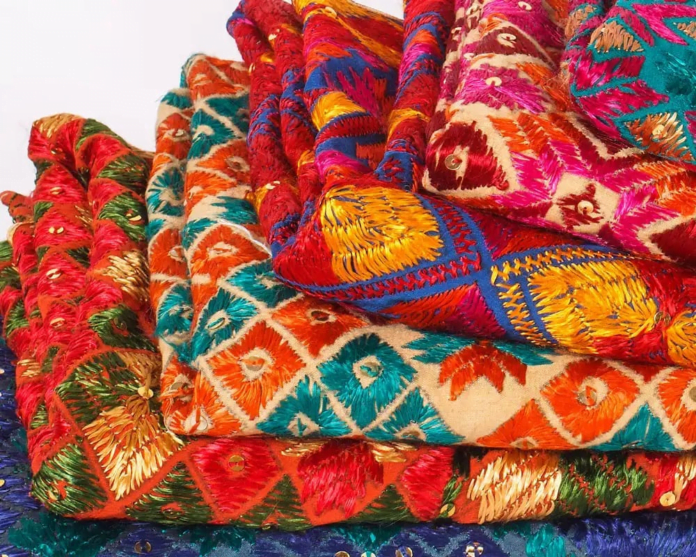
The term “Phulkari,” a word hailing from the Punjabi vocabulary, is a fusion of two eloquent words: “Phul” meaning ‘flower’ and “Kari” meaning ‘work.’ Thus, Phulkari eloquently translates to ‘flower work’ or ‘floral work.’ Originating in the 15th century within the heart of Punjab, this vibrant embroidery style was pioneered by the skilled hands of Punjab’s women. It emerged as a rural handcrafted tradition that resonates with the essence of Punjab’s folk culture.

Although Phulkari suggests a floral focus, it encapsulates much more than mere blossoms. This artistry extends to encompass various motifs, geometrical patterns, and shapes. Vibrant and vivacious, Phulkari breathes life and color into the everyday existence of people. Its fame has spread far beyond Punjab, captivating hearts across the globe. Crafted predominantly by women, Phulkari embodies a celebration of womanhood, a testament to their creativity and skill.

The inception of Phulkari carries with it a tapestry of theories and narratives. While it is said to have been prevalent across different regions, it found its stronghold in Punjab. Some theories trace its roots to Iran, where it was referred to as “Gulkari,” echoing the same floral essence. However, a distinct difference in style sets Phulkari apart. Another theory suggests that the Jat tribes introduced this art form during their migration to India, settling in Punjab, Gujarat, and Haryana. Despite these diverse narratives, the earliest written reference to “Phulkari” appears in the 18th-century Punjabi literature. Waris Shah’s rendition of “Heer Ranjha,” a poignant Punjabi tragic romance, offers glimpses of this traditional artistry, evoking images of bridal attire adorned with Phulkari embroidery. This legacy also finds mention in the Mahabharata, Vedas, Guru Granth Sahib, and in the melodies of Punjabi folk songs.

The heart of Phulkari’s history beats within the customs and traditions of Punjab. In bygone times, the birth of a girl was celebrated with the commencement of Phulkari embroidery. Mothers and grandmothers would diligently embroider these masterpieces, believing that their daughters would be the creators of generations to come. These Phulkaris, lovingly created, would be presented to the daughters at the time of their weddings. This tradition, interwoven with status, saw parents offering dowries ranging from 11 to 101 Baghs and Phulkaris.

Phulkari’s craftsmanship was traditionally intertwined with purity and durability, making use of silk and Mulmul fabrics. The intricate artistry reflected the virtues and character of the creator. Formerly reserved for personal use, Phulkaris adorned women during weddings, festivals, and joyous occasions, adding vibrancy to their lives. This domestic art was a canvas for women to express their creativity, infusing their daily routines with hues of exuberance.

Over time, Phulkari weathered adversities and resurged from the ashes. In the aftermath of the partition in 1947, this tradition found renewed life as organizations encouraged women to create Phulkaris to sustain their families in the face of the refugee crisis. While hand embroidery was the norm, modern techniques and materials have introduced machine embroidery, allowing for greater accessibility and flexibility in creation.

The Phulkari embroidery technique is a harmony of colors and craftsmanship. Employing a darn stitch on coarse cotton cloth known as “khaddar,” vibrant silken threads bring life to this canvas. The stitches intertwine in symmetrical designs, creating a signature aesthetic. In the past, Phulkari adorned shawls and odhnis, but today, it graces sarees and churidar kameez, evolving with the times while retaining its essence. The thread by thread weaving forms a geometric grid, resulting in exquisite motifs and intricate borders.

The artistry of Phulkari is amplified through colors. Four colors of khaddar—white, red, blue, and black—each held significance. White symbolized the elderly and widows, red embodied young girls and brides-to-be, while blue and black hues were for daily wear. The red shade, synonymous with youthful passion, orange representing energy, and white signifying purity, each color infused Phulkari with deeper meanings.

Motifs drawn from imagination, nature, and daily life are the heart of Phulkari. Belans (rolling pins), kakhri (cucumbers), chandrama (moon), and satranga (seven colors) are just a few examples. From mundane objects to vibrant landscapes, these motifs wove emotions and creativity into every thread. Different types of Phulkari, such as Thirma, Darshan Dwar, Bawan Bagh, Vari-da-bagh, and more, manifest distinct narratives within this artistic legacy.

The journey of Phulkari is one of resilience, evolution, and timelessness. It lives on as a testament to the tenacity of tradition amidst a changing world, its vibrant threads weaving a connection between generations and cultures. From the hands of women to the realm of high fashion, Phulkari continues to illuminate with its beauty and heritage.

What is Vishwakarma Yojana? A Scheme to Empower Traditional Artisans and Craftsmen in India

0

On the occasion of India’s 77th Independence Day, Prime Minister Narendra Modi announced the launch of the Vishwakarma Yojana, a scheme to empower traditional artisans and craftsmen in India. The scheme is set to be introduced on Vishwakarma Diwas (September 17), which is celebrated as the day of the divine architect and engineer in Hindu mythology.

The Vishwakarma Yojana is a scheme for strengthening and nurturing the Guru-Shishya parampara or family-based practice of traditional skills by artisans and craftspeople working with their hands and tools. The scheme aims to benefit individuals skilled in 18 traditional trades, such as carpentry, boat making, blacksmithing, locksmithing, pottery, goldsmithing, barbering, tailoring, masonry, and garland making, among others.

The scheme has a budget allocation of Rs 13,000 crore and will cover both urban and rural areas. It will provide various benefits to the beneficiaries, such as:

  • Financial aid: The scheme will provide credit support up to Rs 1 lakh in the first tranche and Rs 2 lakh in the second tranche, with a concessional interest rate of 5%.
  • Recognition and certification: The scheme will issue the PM Vishwakarma certificate and ID card to the artisans and craftsmen, giving them a professional identity and recognition.
  • Skill enhancement: The scheme will offer opportunities for skill enhancement through basic and advanced training programs. The participants will also receive a stipend of Rs 500 per day during their training period.
  • Modern tools and equipment: The scheme will provide financial support of up to Rs 15,000 to the beneficiaries to procure modern tools and equipment, enhancing their efficiency and productivity.
  • Quality improvement: The scheme will aim to improve the quality and global reach of the products and services crafted by the artisans and craftsmen. It will also integrate them within domestic and global value chains.
  • Marketing support: The scheme will extend marketing support to the beneficiaries through various platforms, such as e-commerce portals, exhibitions, fairs, etc.
  • Digital payments: The scheme will promote digital transactions among the beneficiaries through various modes, such as UPI, QR codes, etc.
  • Social security: The scheme will provide social security benefits to the beneficiaries, such as health insurance, pension, etc.

The Vishwakarma Yojana is a visionary step towards preserving and promoting the rich heritage of traditional skills in India. It will also empower the artisans and craftsmen who are instrumental in driving the rural economy and creating employment opportunities. The scheme will also contribute to the nation’s journey towards a greener future by encouraging eco-friendly practices and technologies.

PM-eBus Sewa Scheme: A Game-Changer for Urban Mobility and E-Mobility in India

0
Sample Image

The Union Cabinet, chaired by Prime Minister Narendra Modi, has approved the PM-eBus Sewa Scheme, a landmark initiative to transform urban mobility and e-mobility in India. The scheme aims to deploy 10,000 electric buses across 169 cities on a Public-Private Partnership (PPP) model, with an estimated cost of Rs. 57,613 crore. The Central government will provide Rs. 20,000 crore as support for the scheme, which will span over 10 years.

The PM-eBus Sewa Scheme is expected to have multiple benefits for the environment, the economy, and the society. It will reduce noise and air pollution, curb carbon emissions, and enhance public transportation by increasing the share of bus-based mobility. It will also generate direct employment opportunities for 45,000 to 55,000 people and foster innovation and sustainable supply chains in the e-mobility sector.

The scheme covers cities with populations above three lakh, including Union Territory capitals, the North Eastern Region, and Hill States. It prioritizes areas without organized bus services and promotes green urban mobility initiatives such as bus priority, multimodal interchange facilities, NCMC-based Automated Fare Collection Systems, and charging infrastructure.

The scheme also provides full support for behind-the-meter power infrastructure and charging facilities for e-buses. The responsibility of running the bus services and making payments to bus operators lies with the States/Cities. The Central Government will extend support by providing subsidies as outlined in the scheme to facilitate the operation of these buses.

The PM-eBus Sewa Scheme is a visionary step towards embracing electric mobility and enhancing urban transportation in India. By leveraging the power of electric buses and promoting environmentally conscious initiatives, the scheme is set to reshape the mobility landscape, foster job creation, reduce pollution, and contribute to the nation’s journey towards a greener future.

Kathputli: The Enchanting Art of Indian Puppetry 

0

Simran Saini reports on the Kathputlies of Rajasthan..

In the heartland of India’s rich cultural tapestry, there exists a centuries-old art form that weaves together storytelling, tradition, and visual splendor – Kathputli, the enchanting world of Indian puppetry. Derived from the Hindi words “katha” (story) and “putli” (doll), Kathputli is a captivating form of entertainment that has fascinated audiences for generations. With its intricate craftsmanship, vibrant characters, and diverse narratives, Kathputli continues to transcend time, delighting both young and old. 

Kathputli traces its origins to the ancient tales of Rajasthan, a region renowned for its folk traditions and artistic heritage. Rooted in the socio-cultural fabric of the region, this form of puppetry was initially used as a means to convey moral and social messages to the masses, often in the form of fables and parables. Over time, it evolved into a mesmerizing blend of artistic expression, entertainment, and cultural preservation. 

Artistry and Craftsmanship at the heart of Kathputli lies the craftsmanship of the puppeteers, who are both skilled artisans and master storytellers. These puppets are meticulously handcrafted, adorned with intricately designed costumes, and manipulated with dexterity. Made from wood, cloth, and strings, these puppets come to life through the hands of the puppeteer who deftly controls their movements, gestures, and expressions, infusing them with a lifelike essence. Narratives and Themes Kathputli performances cover a diverse range of narratives that reflect the societal values, folklore, and myths of the region. These stories often include tales of heroism, love, morality, and local legends. Through their vibrant performances, puppeteers bring these narratives to life, captivating audiences with their animated characters and engaging dialogues. Theatrical Charm a Kathputli performance is more than just a visual spectacle; it is a harmonious blend of music, dance, and storytelling. Traditional musical instruments such as the dholak, tabla, and harmonium accompany the puppeteer’s narration, enhancing the dramatic impact of the performance.The dynamic interaction between the puppeteer and the puppets creates a sense of enchantment, transcending the boundaries between reality and fiction. 

Contemporary Relevance While traditional puppetry has faced challenges in the modern era, Kathputli has managed to adapt and survive. Contemporary puppeteers have embraced new themes and styles, incorporating social issues and global influences into their performances. Additionally, efforts to preserve and promote this ancient art form have led to workshops, festivals, and cultural exchanges that help keep the legacy of Kathputli alive. Kathputli stands as a testament to the enduring power of artistic expression and cultural heritage. With its captivating blend of storytelling, craftsmanship, and theatrical charm, it continues to weave its magic, captivating audiences and preserving the essence of India’s cultural legacy. As we admire the intricately designed puppets dancing on the strings of tradition, we are reminded of the beauty that lies in the past, and the importance of nurturing these cultural gems for generations to come.

CPL 2023: How to watch the Caribbean Premier League live in India

0

The Caribbean Premier League (CPL) 2023, one of the most popular T20 cricket leagues in the world, is set to begin on August 17, 2023. The tournament will feature six teams: Barbados Royals, Guyana Amazon Warriors, Jamaica Tallawahs, St Kitts and Nevis Patriots, St Lucia Kings, and Trinbago Knight Riders. The teams will play each other twice in a round-robin format, followed by the playoffs and the final. The final will be played on September 25, 2023.

The CPL 2023 promises to be a thrilling spectacle for cricket fans, as it will showcase some of the best players from the West Indies and around the world. Some of the star attractions include Chris Gayle, Kieron Pollard, Dwayne Bravo, Andre Russell, Nicholas Pooran, Shimron Hetmyer, Faf du Plessis, Ravi Bopara, Ambati Rayudu, and many more.

For Indian cricket fans who want to watch the CPL 2023 live, there are multiple options available. The CPL 2023 will be telecast live on Star Sports Network’s TV channels in India. Fans can tune in to Star Sports 1 and Star Sports 1 HD to catch all the action. The matches will start at different times depending on the day and venue. The timings are as follows:

  • 7:30 PM IST
  • 4:30 AM IST
  • 5:30 AM IST

Alternatively, fans can also watch the CPL 2023 live streaming online on the FanCode app and website in India. FanCode is the exclusive streaming partner of the CPL 2023 in India. Fans can either buy a pass for each match for ₹15 or a pass for the entire tournament for ₹99. FanCode will also provide live scores, highlights, fantasy tips, and expert analysis for the CPL 2023.

The CPL 2023 is expected to be a highly competitive and entertaining tournament, as the teams vie for the coveted trophy. Jamaica Tallawahs are the defending champions, having won their second title in 2019. Trinbago Knight Riders are the most successful team in the history of the CPL, having won four titles. Can they reclaim their glory or will there be a new champion this year? Watch the CPL 2023 live in India to find out.

Molela Terracotta: Where Timeless Artistry Meets Earthly Wonders 

0

Simran Saini reports on Molela Terracotta..

Step into the enchanting realm of Molela, a small village nestled amidst the rugged terrain of Rajasthan, India. While its size may be modest, the artistic heritage it cradles is nothing short of magnificent. Molela is a place where the earth comes alive in the hands of skilled artisans, giving birth to intricate and awe-inspiring terracotta creations that tell tales of tradition, craftsmanship, and an unbreakable bond with the land. 

A Glimpse into the Origins Unearthing the Beauty of Molela Terracotta The story of Molela’s terracotta art dates back centuries, tracing its roots to the Bhil tribe – the indigenous people of the region. As generations passed, the art form evolved, weaving itself intricately into the cultural tapestry of Molela. What began as a humble expression of daily life, soon blossomed into a thriving art form, capturing the imagination of connoisseurs and enthusiasts alike. From Clay to Canvas The Craftsmanship Behind Molela Terracotta At the heart of Molela’s terracotta artistry lies clay – a simple yet profoundly versatile material. Skilled artisans mold and shape the clay with deft hands, transforming it into an array of exquisite forms. The process is a delicate dance between tradition and innovation, where age-old techniques meet modern sensibilities. Once the terracotta masterpiece takes form, it’s time for the artists to unleash their creativity. Elaborate designs, intricate patterns, and motifs inspired by nature and mythology adorn each piece, creating a mesmerizing blend of rustic charm and artistic finesse. The artisans’ brushes seem to breathe life into the clay, turning it into a canvas of stories waiting to be told. 

A Symphony of Art and Nature The Themes of Molela Terracotta Molela terracotta doesn’t merely capture the eye; it speaks to the soul. The motifs that grace these creations are a tribute to the village’s close relationship with the land. You’ll find intricate depictions of animals, birds, and flora, each intricacy reflecting the deep connection between the artisans and their surroundings. However, it’s the portrayal of Hindu mythology that truly sets Molela terracotta apart. As you wander through the village’s bylanes, you’ll encounter stunning terracotta panels that depict scenes from ancient epics like the Ramayana and Mahabharata. The tales come alive in vibrant hues, a reminder of the artists’ ability to breathe life into the clay and immortalize stories that have been passed down through generations. Preserving Tradition in a Changing World The Legacy of Molela Terracotta In a world where traditions sometimes give way to modernity, Molela’s terracotta art stands strong as a beacon of resilience. The artisans of Molela have managed to strike a harmonious chord between preserving their heritage and embracing contemporary influences. While the traditional motifs and techniques remain sacrosanct, newer generations of artists infuse their own interpretations, ensuring that the art form remains relevant and captivating. 

Bringing Molela Terracotta to the World A Global Connection Thanks to the advent of technology and the ever-expanding reach of e-commerce, Molela terracotta is no longer confined to the village’s boundaries. Enthusiasts from around the world can now bring a piece of Molela’s artistic heritage into their homes. From intricately designed wall panels to elegant pottery, each piece tells a story that transcends borders and connects cultures. A Journey Through Time and Clay Molela terracotta is more than just an art form; it’s a testament to the indomitable spirit of creativity and the profound bond between humans and the earth. With each stroke of the brush, each delicate indentation, Molela’s artisans breathe life into clay, infusing it with the essence of their village, their traditions, and their stories. As you gaze upon a Molela terracotta creation, you’re not merely observing art – you’re witnessing the magic of a time-honored craft that has stood the test of time. So, the next time you hold a piece of Molela terracotta in your hands, remember that you’re holding a piece of history, a piece of culture, and a piece of a village that continues to shape its destiny one stroke at a time.