Home Blog Page 634

Apple Event 2023: iPhone 15, Apple Watch Series 9, Apple Watch Ultra 2 and more

0

Apple has unveiled its latest products and services at its annual wonderlust event on September 14, 2023. The tech giant announced four new iPhones, two new Apple Watches, and its plans to go carbon neutral by 2030. Here are the key highlights from the event:

iPhone 15 and iPhone 15 Plus

Apple introduced the iPhone 15 and iPhone 15 Plus, the successors of the iPhone 14 and iPhone 14 Plus. The new models feature a Dynamic Island design, which allows the display to extend to the edges of the device and create a seamless experience. The display is also Super Retina XDR with OLED, which offers stunning colors and contrast.

The iPhone 15 and iPhone 15 Plus also come with a major camera upgrade, with a 48 MP main sensor that can capture more details and light. The camera system also supports ProRes video recording, which is a professional format for high-quality video editing. The new models also have a LiDAR scanner, which enables faster autofocus and better depth sensing.

The iPhone 15 and iPhone 15 Plus are powered by the A16 Bionic processor, which is the first-ever 4 nanometer chip. The processor delivers faster performance and better efficiency than the previous generation. The new models also support MagSafe charging and accessories, which attach magnetically to the back of the device.

The iPhone 15 and iPhone 15 Plus are built of Aerospace-grade aluminum and color built into the foundation of the back glass itself. They are available in five colors: Starlight, Midnight, Blue, Pink, and Red. The screen size is 6.1″ for the iPhone 15 and 6.7″ for the iPhone 15 Plus.

The iPhone 15 starts at $799 for 64 GB of storage, while the iPhone 15 Plus starts at $999 for 128 GB of storage. The new models will be available for pre-order on September 17 and will ship on September 24.

iPhone 15 Pro and iPhone 15 Pro Max

Apple also announced the iPhone 15 Pro and iPhone 15 Pro Max, the premium models of the new iPhone lineup. The iPhone Pro models are made of Titanium, which Apple says is the same alloy as the Mars Rover. The Titanium gives the devices a sleek and durable look. The iPhone Pro models are available in four colors: Black Titanium, White Titanium, Blue Titanium, and Natural Titanium.

The iPhone Pro models have a similar Dynamic Island design as the iPhone 15 and iPhone 15 Plus, but with a larger display size of 6.4″ for the iPhone 15 Pro and 6.9″ for the iPhone

Sundha Mata Temple: A Spiritual Journey Through History and Scenic Beauty

0

Nestled amidst the picturesque landscapes of Rajasthan’s Jalore district, the Sundha Mata Temple stands as a testament to devotion and architectural splendor. This ancient temple, dedicated to Chamunda Devi, has a history that spans over 900 years and is perched atop the Sundha Hill, part of the majestic Aravalli range. Here’s a guide to this sacred place, its history, and how to reach it.

Historical Marvel

The Sundha Mata Temple boasts intricate craftsmanship, with its marble pillars reminiscent of the renowned Delwara Jain temples in Mount Abu. Inside, you’ll find three historical inscriptions that narrate the area’s rich history. The earliest inscription, dating back to 1262 AD, commemorates the Chauhans’ victory and the Parmars’ decline. The second, from 1326, and the third, from 1727, offer further glimpses into the temple’s storied past.

A Divine Retreat

The temple, constructed from the enchanting yellow sandstone of Jaisalmer, radiates a unique beauty, and it’s here that the divine mother is revered. Facing the temple is Bhureshwar Mahadev, creating a spiritual harmony as both Shiva and Shakti are enshrined on Sundha Mountain.

When to Visit

For a delightful experience, plan your visit to Sundha Mata Temple between October and March, during the cool winter season. Rajasthan’s scorching summers can make travel uncomfortable, and monsoons may hinder your exploration. Thus, the winter months offer the perfect climate for a serene pilgrimage.

Nearby Attractions

While at Sundha Mata Temple, explore the nearby attractions that add to the charm of your journey:

1. Jalore Fort: A testament to architectural brilliance, this fort is believed to have been built between the 8th and 10th centuries. Perched on a steep hill, it offers panoramic views.

2. Topkhana : A historic Sanskrit school constructed between the 7th and 8th centuries, it’s adorned with captivating stone carvings.

3. Sarai Temple: Located at an altitude of 646 meters on the Jalore Mar Kalshchal hill, this temple pays homage to Maharishi Jabali and was built by Rawal Ratan Singh.

4. Jalore Wildlife Sanctuary: A unique private sanctuary in India, it’s a haven for wildlife enthusiasts and is home to endangered species.

5. Neelkanth Mahadev Mandir: Situated in Bhadrajun tehsil, this temple dedicated to Lord Shiva offers a tranquil spiritual experience.

How to Reach

– By Air: The nearest airport to Jalore is in Jodhpur, approximately 140 kilometers away. Jodhpur Airport is well-connected to major Indian cities like Mumbai and Delhi.

– By Road: Sundha Mata Temple is easily accessible by road from cities such as Jodhpur, Jaipur, Ajmer, Ahmedabad, Surat, and Mumbai, making it a convenient destination for road trips.

– By Train: You can also reach Sundha Mata Temple by train, with Jalore Railway Station being the nearest railhead. Trains from Jodhpur Division Network, Mumbai, and Gujarat connect to this station, facilitating smooth access to the temple.

Embark on a spiritual journey, steeped in history and surrounded by the natural beauty of Rajasthan, as you visit the Sundha Mata Temple and explore the enchanting destinations nearby.

Jal Jhulni Ekadashi: A Spiritual Celebration of Divine Purification

0

Jal Jhulni Ekadashi, also known as Apara Ekadashi or Bhadrakali Ekadashi, is an important Hindu festival that falls on the eleventh day of the bright fortnight in the Hindu month of Bhadrapad. This sacred occasion carries profound significance and is observed with great devotion and reverence by Hindus across India.

On Jal Jhulni Ekadashi, devout Hindus worship Lord Vishnu, particularly in his Vamana Avatar, the dwarf incarnation. Observing this fast with sincerity and dedication is believed to bring immense blessings and prosperity into one’s life. Apart from being a harbinger of wealth, this Ekadashi holds another significance – it is associated with Mother Yashoda’s act of washing Lord Krishna’s clothes. Thus, Jal Jhulni Ekadashi is also celebrated as Padma Ekadashi.

Jal Jhulni Ekadashi Festival:

Jal Jhulni Ekadashi is celebrated with great enthusiasm and devotion. Devotees wake up early before dawn and take a holy dip in sacred rivers, lakes, ponds, and other natural water bodies. This purifying bath is believed to cleanse the body and soul, absolving individuals of their sins and negative karma.

One of the prominent traditions of this festival is the grand procession of Lord Vishnu, often depicted on a beautifully decorated palanquin (palki). The deity is carried with great pomp and show, accompanied by melodious bhajans and kirtans (devotional songs), creating an atmosphere of spiritual fervor.

The ritualistic immersion of Lord Vishnu’s idol in a sacred water body is another significant aspect of Jal Jhulni Ekadashi. Devotees believe that this act symbolizes the divine presence and blessings of Lord Vishnu in their lives.

Fasting and Devotion:

Fasting plays a central role in the observance of Jal Jhulni Ekadashi. Devotees abstain from consuming grains, cereals, and certain vegetables on this day. Instead, they opt for a simple diet consisting of fruits, nuts, milk, and root vegetables. Fasting is viewed as a form of self-discipline and a means to focus on spiritual growth.

The fast continues until the next morning, and devotees break it with a meal that adheres to the Ekadashi dietary restrictions. This practice is believed to purify the body and mind, allowing individuals to connect more deeply with the divine.

Jal Jhulni Ekadashi is a day of profound spiritual significance, a time when devotees seek inner purification, blessings, and a stronger connection with Lord Vishnu. It emphasizes the importance of devotion, self-discipline, and the cleansing of the soul, much like the ritualistic immersion in sacred waters. This sacred festival not only nourishes the spiritual fabric of Hinduism but also serves as a reminder of the enduring faith and devotion of the devotees who celebrate it with unwavering dedication.

Rahul Gandhi & Sam Pitroda discuss India achieving 5 trillion USD economy status by 2030

0

The Foundation for Critical Choices for India (FCCI) hosted an interactive session on September 10, 2023, at the Van der Valk A4 in Hoofddorp, Netherlands, featuring Member of Parliament in India, Rahul Gandhi and President of Indian Overseas Congress, Sam Pitroda. 

With India’s population soaring to a staggering 1.42 billion and its economy valued at approximately 3.60 trillion USD, the nation’s ambitious goal of achieving a 5 trillion USD economy by 2030 was at the forefront of discussions. Remarkable advancements in life expectancy and literacy rates underscored India’s remarkable growth. India’s abundant cultural diversity and vast potential had positioned it as a prominent global player. 

Dr. Pramod Agrawal, Vice President (Programs) of FCCI, offered insights into FCCI’s activities and flagship projects, setting the stage for meaningful public engagement. The event delved into India’s role as a consensus builder, its youthful demographic dividend, its status as the world’s largest democracy, and its significant place among the world’s major economies. When asked how they believe India can benefit from and support its demographic dividend, Gandhi and Pitroda emphasized on creating and expanding the manufacturing sector in India. 

They raised poignant questions about whether India would merely observe as China dominates manufacturing and production sector or will we create a vision for ourselves. Gandhi emphasized the importance of transitioning from trading and assembling to actively manufacturing all components locally. 

India needs to also move away from dependence on other countries for raw materials such as those used in pharma sector. We need a green energy strategy and that also requires our job and education system to change in order to cater to a different set of development requirements. We need to plant seeds of specific visions that have the power to provide compounded progress over decades to come. 

After a vote of thanks, FCCI also presented their book compiling 40 years of their work towards Indian growth, to the guests. 

For additional information about the Foundation for Critical Choices for India, please visit their website at http://www.fcci.nl. 

Exploring User Experience: How Finndit Simplifies Business Search

0

Finndit is among the most prominent and fastest growing local search engines and business listing platforms in the country. It has been operational for years now and has garnered lakhs of business listings already. The establishments have witnessed exponential growth in a short span of time by getting access to a large audience and the reach of Finndit. 

When businesses establish their presence on these platforms in the online realm, they become more noticeable to potential customers. This increased visibility brings about wide-ranging impacts, ranging from driving sales and increasing revenue for businesses to generating fresh employment prospects. Furthermore, customers gain the advantage of convenient access to a varied array of local products and services, enhancing their options and overall interactions. Here are some of the top features of Finndit.

Intuitive Interface

Finndit is available on mobile through an App or website. When open Finndit, either on smartphone or website, the interface is quite user-friendly. The engineers at Finndit have developed a platform taking care of the UI and UX aspects. The layout is quite self-explanatory. Everything is arranged in such a way that the user can directly head to his/her destination.

There are blocks which represent a category on which you could click to reach your goal instantly. Alternatively, you could select a whole host of categories and sub-categories from the menu located on the side bar. Moreover, your could even enter your location and witness all the businesses near your location. In this way, you could get access to the location, working hours, contact information about various shops and stores in your vicinity. Hence, the overall interface is quite effective and easy to use.

Personalized Recommendations

Another key area which enables a smooth and time-effective experience on Finndit is personalized recommendations. Depending on your search and location, you will get recommended things that you might be interested in. In this way, your search results guide the platform to offer you a wide variety of services. 

It ensures that before selecting a business you would like to interact with, you explore all similar stores to compare the products, prices and services. This also, sort of, mandates the businesses to offer their support and services at competitive prices. In this manner, the businesses and customers get into a win-win situation.

Caters to User Needs

This point relates back to the previous section. Because you get access to the lakhs of business ventures, the platform allows the results to be user specific. In this way, the users don’t need to spend a lot of time browsing on the app or website. They get direct results and recommendations depending on their search keywords. This makes sure that they get directly connected to what they are looking for. Hence, the overall efficiency of the entire ecosystem is enhanced.

Finndit is a great platform for all those who might have shifted to a new place and don’t have time to roam around in their surroundings. They could access the market through their smartphone or laptop screen. This ensures that we leverage the technology available to use in this day and age to increase the convenience for humans.

India’s GITA at G20 Summit

0

Priyanshi Pareek reports on the G20 summit..

What is G20?

The G20 or Group of Twenty, is a club of countries that meets to discuss global economy, political issues and sustainable development. 

The Meeting of G20 Summit 2023 took place in New Delhi at Bharat Mandapam International Exhibition-Convention Centre (IECC). G20 Summit 2023 was scheduled on 9th and 10th September 2023.

The G20 Summit is held every year but this time was something different, an AI Anchor, Gita hosted global leaders at G20 Summit 2023.

An exhibition titled ‘Bharat: The Mother of Democracy’ was showcased at the G20 Summit 2023. The Exhibition was organised to throw light on the Indian traditions and democratic values for the foreign guests. The exhibition gave a tribute to India’s rich cultural and traditional heritage from ancient civilizations. GITA was engaged for the same purpose, additionally the anchor would greet them in a customised manner. 

According to some sources GITA stands for Guidance, Inspiration, Transformation and Action. GITA answers queries from the resource bank of GITA, it can also chant Shlokas and speaks in Hindi and English.

The replica is 5 feet tall, weighing 120 kilograms, all crafted in bronze. She thinks of the world on an equal footing, representing independence and liberation.

 Artificial Intelligence (AI) is important in today’s world, as it offers great potential in the field of learning, skilling and education. We should utilise the benefits of AI in areas like socio-economic development, global workforce, and research and development. 

The Majestic Gates of Jaipur’s City Palace: A Journey Through Time

0

The City Palace in Jaipur, a resplendent architectural marvel, stands as a testament to the grandeur and heritage of the Pink City. As you approach this regal edifice, you are greeted by a series of magnificent gates, each bearing a unique tale of craftsmanship, history, and culture. Let’s take a closer look at these splendid entrances that beckon visitors into the heart of Jaipur’s royal legacy.

tripoli Gate: A Triumph of Three Roads

The first of these gateways is the Tripolia Gate, which derives its name from its unique structure. “Tripolia” means three roads, and this gate was designed to allow the royal processions to head in three different directions from here. Its significance goes beyond its practicality; it symbolizes the wealth of Jaipur’s history and the grandeur of its rulers.

Virendra Pol: The Regal Welcome

As you venture further into the City Palace, the Virendra Pol welcomes you with open arms. This gate embodies the essence of Rajput architecture, featuring a ‘Jharokha’ or balcony adorned with two pilasters and a chhatri (pyramidal roof). The chhatris atop the gate are crowned with five bulbous finials, adding an air of magnificence to its already regal presence.

Udai Pol: The Essence of Mughal-Rajput Fusion

The Udai Pol is a prime example of the fusion of Mughal and Rajput architectural styles. The upper portion of this gate boasts quintessential Rajasthani elements, including the chhatris. However, the gateway itself exudes Mughal influences, featuring elements like the majestic arch and ‘Dantedaar Mihrab.’ The entire gate is adorned with opulent glass mosaic tiles, a stunning combination of Persian imports and Rajput finesse.

The Seasonal Symphonies: Peacock, Lotus, Rose, and Lehariya Gates

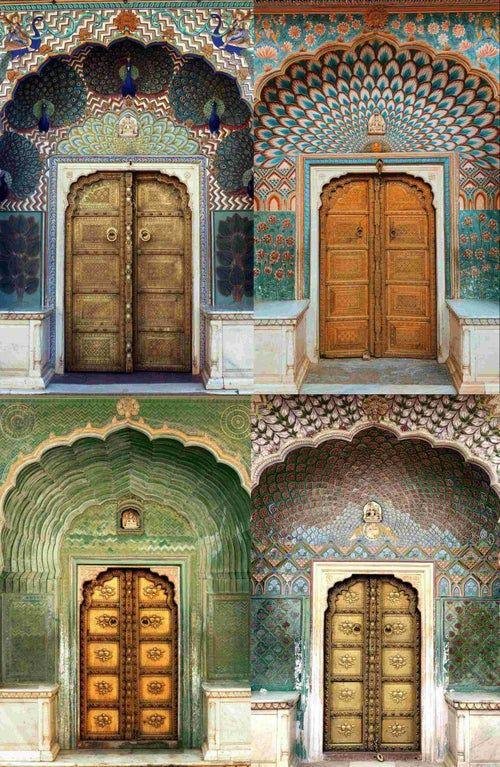
As you delve deeper into the City Palace, you’ll encounter smaller gates that symbolize the four seasons. The Peacock Gate, adorned with five peacocks in the arch and their vibrant tails cascading down in a rainbow of colours, represents autumn. The Lotus Gate showcases intricate lotus patterns in red and yellow tiles, symbolizing summer. The Rose Gate captivates with its rose petal decorations, evoking the chill of winter. Lastly, the Lehariya Gate, or Green Gate, enthrals with its lush green tile floral designs, representing spring.

A Window to Deities and Floral Artistry

Each of these gates bears a deity’s image at its centre, surrounded by intricate floral patterns. These artistic depictions offer a glimpse into the deep-rooted spirituality and reverence 

embedded in Rajput culture. They also showcase the craftsmanship that has stood the test of time, captivating generations with their beauty and symbolism.

Visiting the City Palace and its enchanting gates is like stepping into a living museum of history and artistry. These entrances not only provide access to the palace’s inner treasures but also serve as portals to the grandeur and heritage of Jaipur. As you pass through these gates, you embark on a journey through time, experiencing the rich tapestry of Rajasthan’s past.

How to Reach:

The City Palace is conveniently located at the heart of the Pink City, with excellent accessibility via auto-rickshaws and taxis.

Best Time to Visit:

The Palace is open daily between 9 am and 5 pm. The ideal season to explore Jaipur and its wonders is from October to March when the weather is pleasant.

Entry Fees:

 Indian visitors can enter with an entrance ticket priced at Rs. 200, while foreigners are charged Rs. 500. A separate ticket is required for access to the Chandra Mahal. For those interested in exploring both the Palace and Jaigarh Fort, a combined ticket option is available.

The Philippine Arena: A Glimpse into the World’s Largest Indoor Arena

0

Indoor arenas, often characterized by their oval or circular design, serve as versatile spaces for a wide range of events, including musical performances, sporting spectacles, and theatrical productions. These enclosed venues, derived from the Latin word “Harena,” boast a unique feature—an expansive central area surrounded by tiered seating to ensure maximum visibility for spectators. Among the most iconic historic arenas stands the Colosseum of Rome. Today, arenas are designed to accommodate large audiences, with the Philippine Arena leading the pack as the world’s largest indoor arena, boasting a staggering seating capacity of 55,000 spectators.

1. The Philippine Arena: A Monumental Marvel

Situated in Bocaue, Philippines, the Philippine Arena stands as the largest multipurpose indoor arena globally, covering a sprawling 140 hectares. Owned by the Iglesia Ni Cristo (INC) institution of the New Era University, its construction commenced in August 2011, with South Korea’s Hanwha Engineering leading the way. The grand project reached completion in May 2014 at a cost of $213 million.

Spanning four floors, the main ground floor covers a vast expanse of 36,443.6 square meters, and the structure soars to a height of 65 meters. Notably, the Discovery Channel recognized the arena as a safe structure against typhoons and earthquakes in the Philippines. Moreover, in 2014, the Guinness World Records acknowledged it as the largest multipurpose indoor theater. This architectural wonder has earned international acclaim, showcasing the Philippines’ commitment to world-class infrastructure.

2. Paris La Défense Arena: Setting the Stage for the 2024 Olympics

Constructed with an eye on the 2024 Olympics in Paris, France, the Paris La Défense Arena, located in the Nanterre suburb of Paris, can accommodate up to 40,000 attendees for concerts. Beyond musical events, it plays host to various sporting events, including basketball and rugby games, as well as the Paris Motorcross.

3. Romexpo: Romania’s Versatile Indoor Arena

Romexpo, situated in Bucharest, Romania, serves as a dynamic indoor arena with a concert capacity of 40,000 spectators. Operating since the 1960s, it adapts its space for a multitude of purposes, including sporting events and large expos.

4. Saitama Super Arena: Japan’s Multipurpose Marvel

Japan boasts the world’s second-largest indoor arena in the form of the Saitama Super Arena, located in Saitama City. With a maximum seating capacity of 37,000, it stands out for its movable seating sections, allowing for flexibility in event size. The arena caters not only to basketball and professional wrestling but also to major music and sports events, including appearances by NBA basketball teams, NHL ice hockey, and WWE Raw.

5. SC Olimpiyskiy: Moscow’s Sporting Hub

Moscow, Russia, hosts the third-largest indoor arena globally, the Sports Complex Olimpiyskiy, also known as the Olympic Stadium or Olimpiski. Constructed for the 1980 Summer Olympics, this arena accommodates up to 35,000 attendees. Throughout its history, it has been a venue for numerous sporting events, including the Kremlin Cup tournament and the Euroleague Final Four in 2005.

In 2014, the stadium was auctioned, with Zao Neftegazprod and Oil Company acquiring 65% ownership for approximately $108 million. Today, the SC Olimpiyskiy continues to be a central hub for sports and entertainment in Moscow.

Indoor arenas stand as remarkable structures that transcend time and serve as epicenters of culture, entertainment, and athleticism. From the sprawling Philippine Arena to the versatile Paris La Défense Arena, these remarkable venues continue to captivate audiences and make history as they host a myriad of events, leaving an indelible mark on the global stage.

Exploring Rajasthan’s rich Museums

0

Priyanshi Pareek reports on the Museums of Rajasthan..

Museum is a place where valuable and interesting objects are kept for showcase. It is a non-profitable place, for the service of society that researches, collects, preserves our materials of cultural and historical value. Museums also promote our cultural heritage, sculptures, historical objects etc, whereas Rajasthan is a fusion of
handicrafts, heritage, diverse culture and has a wonderful warrior history. By this we can say museums in Rajasthan means a blend of old heritages with modern era.

Rajasthan is a land of museums and the largest museum in Rajasthan is The Albert Hall Museum in Jaipur which also works as the State museum of Rajasthan. It is situated in Ram Niwas Garden and is the perfect example of Indo-Saracenic Architecture. It is also called the Government Central Museum. It is noted for its
amazing art collection and galleries. The museum has a rich collection of paintings, stones, crystal works, jewellery and sculptures.
Some other museums of Rajasthan are:

  • The Government Museum, Ajmer, was established in 1908. It has a rich collection of sculptures, paintings and weapons. The sculptures are from Gupta and Kushan periods.
  • Dungarpur Museum, Dungarpur was established in 1931. It has a rich collection of sculptures, paintings and weapons. The sculptures are from the Gupta period. The paintings highlight the life of Maratha rulers.
  • The Fateh Prakash Palace Museum, Chittorgarh was established in 1929. It has a rich collection of weapons, which are from the 16th Century.
  • The Ganga Golden Jubilee Museum, Bikaner was established in 1924. It has a rich collection of sculptures, paintings, and weapons. The weapons and paintings show the life of Maratha rulers.
  • The Fort Museum, Junagarh Fort, Bikaner was established in 1923. It has a rich collection of sculptures, paintings, and weapons.
    Apart from the above mentioned there are many more museums in Rajasthan including, Alwar Government Museum Birla Museum, Pilani, The City Palace Museum, The Abhaneri Stepwell, The Amer Fort, The Hawa Mahal, and The Jaigarh Fort, The Jal Mahal, The Jantar Mantar.
    Museums are important for everyone, but mostly for students. Museums are institutes where children can learn about diverse cultures, fresh ideas and creative
    works. If we read a book about our old heritage, it just gives us theoretical knowledge but museums can give you practical knowledge, you can see all the paintings and sculptures from your eyes.

Maharaja Madho Singh I: A Colossus in Jaipur’s Storied History

0

In the grand tapestry of Indian history, Maharaja Madho Singh I of Jaipur emerges as an extraordinary figure, both in stature and significance. Towering at an imposing 7 feet and boasting a remarkable weight of 215 kilograms, with a chest reputedly spanning 4 feet, Maharaja Madho Singh I was also used to known as “A Giant in Jaipur’s History”. The guides at Jaipur’s City Palaalce often drew parallels between him and the legendary Kumbhakaran from Indian mythology, painting a vivid picture of the awe-inspiring presence of this larger-than-life monarch.

Beyond his remarkable physical attributes, Maharaja Madho Singh I’s contributions to art, architecture, town planning, literature, and religion were equally colossal. His reign left an indelible mark on Jaipur and its surrounding regions, far surpassing the attention garnered by his remarkable physique.

One of his most noteworthy achievements was the establishment of Sawai Madhopur, a meticulously planned city that stands as a testament to his visionary approach to urban development. Additionally, he laid the foundation for the thoughtfully designed town of Sri Madhopur, showcasing his unwavering commitment to structured and organized growth.

In the realm of architecture, Maharaja Madho Singh I’s legacy endures through the magnificent palaces he commissioned. Among these architectural marvels is Madho Niwas, an integral part of the Chandra Mahal complex within the City Palace. He also undertook the construction of Madho Vilas, a leisure palace nestled in the heart of Jai Mahal. These palaces stand as enduring architectural gems, reflecting the grandeur and opulence of his era.

The Maharaja’s reverence for culture and spirituality manifested in the creation of the Sisodia Rani ka Bagh, also known as the Queens’ Gardens, along with numerous temples. These serene and picturesque places continue to be revered by both visitors and locals, serving as a testament to his deep-rooted commitment to faith and aesthetics.

Maharaja Madho Singh I was not merely a ruler but also a patron of the arts. His reign witnessed the revival of the painting atelier, known as surathkhana. Within these artistic sanctuaries, court scenes and portraits were meticulously crafted, capturing the essence of his rule and the rich cultural tapestry of his time. His unwavering support extended to sportsmen from his state, enabling them to compete in events both within and beyond the region, underscoring his multifaceted endorsement of the arts and athletics.

Culturally curious, Maharaja Madho Singh I ventured into the world of literature. He facilitated the translation of Shaikh Sadi’s Gulistan into Sanskrit and encouraged the creation of numerous Sanskrit works, dramas, and poetic compositions. Notable among these literary gems are Veli Rukmani, Madhav Natakam, Madhava Vijaikavyama, Rajaritinirupana, and Sataka, which continue to illuminate the literary heritage of his time.