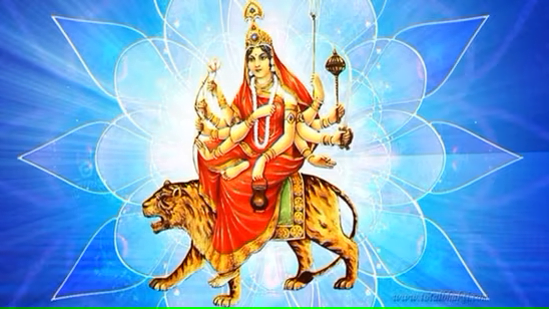
As the resplendent festival of Chaitra Navratri unfolds, devotees immerse themselves in worship, fasting, and rituals dedicated to the divine feminine energy embodied by Goddess Durga. Each day of Navratri is dedicated to a different manifestation of the Goddess, known as Navadurga. On the third day, worshippers pay homage to Maa Chandraghanta, the embodiment of strength, peace, and serenity.
Who is Maa Chandraghanta?
Maa Chandraghanta is the married form of Maa Parvati, the divine consort of Lord Shiva. She is depicted with a crescent moon adorning her forehead, symbolizing beauty and grace. Riding a tigress and possessing ten hands, Maa Chandraghanta carries various weapons and symbols, including a lotus flower, arrow, bow, and prayer beads. Her serene presence is believed to dispel negativity and protect her devotees from harm. Legend has it that the sound of her bell has the power to vanquish demons and instill courage in her worshippers.
Chaitra Navratri 2024 Day 3: Significance and Observances
Chaitra Navratri, celebrated during the Hindu month of Chaitra, holds immense significance for devotees worldwide. The nine nights of Navratri symbolize the victory of good over evil, with each day dedicated to worshipping a different aspect of Goddess Durga. Maa Chandraghanta, worshipped on the third day, represents inner strength, tranquility, and the ability to overcome challenges.
Puja Rituals and Observances
Devotees observe various rituals to honor Maa Chandraghanta on the third day of Navratri. The day typically begins with devotees waking up early, adorning themselves, and offering prayers to the Goddess. Traditional rituals include offering jasmine flowers, rice, and sandalwood to the deity, followed by an abhishek (ritual bathing) with milk, curd, and honey. Special offerings such as sugar bhog are prepared and presented to the Goddess as a token of devotion.
Chaitra Navratri 2024 Day 3: Auspicious Timings
According to Drik Panchang, the auspicious timings for observing Chaitra Navratri Day 3 are as follows:
Tritiya Tithi begins at 5:32 pm
Moonrise at 07:33 pm
Vijaya Muhurat from 2:30 pm to 5:21 pm
Ravi Yoga starts at 06:00 am on April 11 and ends at 1:38 am on April 12.
The Color of the Day: Yellow
Yellow is the auspicious color associated with the third day of Navratri. Devotees dress in yellow attire to pay homage to Maa Chandraghanta. Yellow symbolizes joy, optimism, and positivity, reflecting the Goddess’s serene and benevolent nature.
Puja Mantra and Stotra
Reciting mantras dedicated to Maa Chandraghanta is an integral part of Navratri celebrations. Here are some powerful mantras and stotras to invoke the blessings of the Goddess:
Chaitra Navratri Day 3, dedicated to Maa Chandraghanta, offers devotees an opportunity to seek inner peace, strength, and protection. By observing rituals, reciting mantras, and embracing the divine energy of the Goddess, worshippers can navigate life’s challenges with courage and grace. As the festival continues, may the blessings of Maa Chandraghanta illuminate the path of all her devotees.
Spectrum@Metro, a one-stop destination for leisure and shopping in Noida, has become the talk of the town, offering a holistic experience to visitors. Phase 1 of the premium high-street project in Noida Sector 75 spans 6 acres, while Phase 2 of Spectrum@Metro spans 9 acres. The project boasts world-class amenities and facilities, thus making it an attractive destination for visitors.
The high-street project is located in close proximity to major residential areas such as Noida, Greater Noida, Ghaziabad, and Delhi, offering easy access to a large population. Visitors can also easily access the high street through many modes of transportation, including the Noida Sector 50 metro station, just a few minutes from the project. This connectivity makes it easy for visitors to commute to and from the complex. Furthermore, the project is excellently connected to the rest of Noida and the NCR region. It is just a short drive from the Noida-Greater Noida Expressway, which connects it to major business districts.
Spectrum@Metro is a perfect blend of style and superiority and stands as the pinnacle of excellence in Noida. The high street project has been making waves in Noida’s real estate market, offering a rich experience in retail, office, and entertainment spaces. Spectrum@Metro hosts the most popular global brands across lifestyle, food, fashion, etc., setting it apart from other projects nearby. The project’s emphasis on creating aesthetically pleasing and accessible spaces has been a significant draw for visitors and investors alike.
The high street is an all-under-one-roof destination for food, shopping, and entertainment and is home to various renowned brands. Spectrum@Metro has dedicated spaces for multiple genres, including entertainment zones like Smaaash- a gaming and entertainment centre where families can dive into the world of virtual reality, sports, and other recreational activities. The project also boasts fine dining options like Domino’s, BBQ Co., Starbucks, Berco’s, Baskin & Robbins, Naturals Ice Cream, and many more, offering an array of delightful treats. These ensure that Spectrum@Metro caters to diverse preferences, making it a destination for shopping, culinary experiences, and leisure.
Furthermore, Phase 1 of Spectrum@Metro comprises SkyJumper that allows visitors to enjoy the adventurous world of SkyJumper. Spanning 71,000 sq. ft., the trampoline park offers an unparalleled fun and thrilling experience. Within the park lies an extraordinary realm of amusement, fitness, and sports- an avant-garde family entertainment enclave. The one-of-a-kind indoor sports facility offers families a top-notch entertainment experience, thus, presenting Spectrum@Metro as the most extensively curated family entertainment centre.
Food and entertainment are paramount at Spectrum@Metro. Whether you want a fantastic shopping experience, quench your taste buds, or indulge in thrilling entertainment activities, Spectrum@Metro has it all! Furthermore, the commercial spaces have been meticulously crafted with a strong emphasis on distinctive layouts and amenities catering to the needs of both merchants and patrons. Consequently, it is a desirable choice for prospective investors looking for a robust investment prospect within the family entertainment zone domain and visitors looking for an ideal entertainment hub.
The Institution of Engineering and Technology (IET) has opened applications for the eighth edition of its prestigious IET India Scholarship Award, with a combined prize money of Rs 10 Lakhs. Open to students of all AICTEUGC-approved institutes, the IET India Scholarship Award programme aims to reward and celebrate individual excellence and innovation among undergraduate engineering students in India.
Previous winners have gone on to join industry leaders like Google, Apple, Boeing, Deloitte, and MIT, and some have even become entrepreneurs themselves.
The Award evaluates participants across parameters that include academic performance, extracurricular activities, range of outreach activities and their ability to come up with creative engineering solutions to solve societal challenges. In the first round, students are shortlisted based on their academic performance as well as extracurricular activities. They then progress to an online test on STEM subjects and technical expertise. Students who clear the cut-off score are then invited to present their technological solution to a pertinent societal challenge in the regional rounds. Regional winners finally battle it out in the national finals to win the title.
Shekhar Sanyal, Director and Country Head, IET India said, “As technology continues to revolutionise our world, nurturing and recognising the next generation of engineering leaders becomes ever more critical. The IET India Scholarship Award is our way of celebrating and supporting engineering talent. Last year’s applications boasted exceptional talent, and I am confident this year will be no different. I wish all the participants the best of luck, and eagerly anticipate seeing their innovative ideas come to life.”
The IET India Scholarship Award 2024 is guided by an esteemed Advisory Board consisting of prominent academicians and nationally recognised corporate leaders. The committee is chaired by Prof Abhijit Chakrabarti, Former Vice Chancellor, Jadavpur University, Kolkata.
“I am delighted to announce the inauguration of the IET India Scholarship Award 2024. We are eager to engage with the most promising young minds in the Indian engineering community for the eighth edition. Our past winners have made significant strides, and we take immense pride in their accomplishments. I look forward to witnessing the innovative approaches that undergraduate engineering students will bring forth this year, further solidifying the legacy of excellence associated with the IET India Scholarship Award,” said Prof. Abhijit Chakrabarti, Chairman, IET India Scholarship Award Advisory Committee.
The past seven editions of the IET India Scholarship Award have witnessed tremendous participation from across India with the last edition having received over 43,000 applications. Instituted in 2013, the annual IET India Scholarship Award underlines the IET’s commitment to India’s engineering community. The programme aims to reward innovative thinking from the next crop of engineers entering the workforce and is part of a wide number of the IET’s initiatives focused on improving the quality of engineering in India.
Applications are now open for the 2024 edition. For more information, please visit – bit.ly/3TSwZYf
About the IET
The IET is one of the world’s largest engineering institutions with over 154,000 members in 148 countries. It is also the most multidisciplinary – to reflect the increasingly diverse nature of engineering in the 21st century. The IET is working to engineer a better world by inspiring, informing and influencing its members, engineers, technicians and all those who are touched by or touch the work of engineers.
About IET India
The India chapter of the IET started operations in India in 2006, from Bangalore. Given the increasing global importance of India as an engineering hub, its aim is to make an impact that has relevance both locally and internationally. Its strategy is to bring a telling difference to the overall competency and skill levels within the Indian engineering community and play an influencing role in the industry in relation to technology innovation and solving problems of public importance. The organisation plans to do this by working in partnership with the industry, academia and the Government, focusing on the application of practical skills within both learning and career life cycles, and driving innovation and thought leadership through high-impact sectors.
The Indian Army recently underwent an amazing training with Japan in Bikaner, Rajasthan. Under this training, the soldiers were trained to confront terrorists on borders with the help of hawks and dogs, said officials.
It needs to be mentioned here that Japan and India are jointly conducting exercises named Dharma Guardian in Mahajan Field Firing Ranges here in Bikaner.
Under the part of the exercise, the ‘terrorists’ hidden in the imaginary village were traced by the eagle who was trained by the Army. The help of the drone was not taken as it could have alerted the terrorists via drone’ sound. The eagle searched for the ‘terrorists’. This eagle had a camera on its head and a GPS chip on its back. When the ‘terrorists’ were detected, dogs were sent there. The dogs attacked the ‘terrorists’ and injured them, said officials.
Col Amitabh Sharma, PRO, Indian Army, said, “We have a dog unit under which different types of dogs are being trained. In this exercise in Mahajan Field Firing Ranges, a dog unit also participated. These assault dogs can sniff the things connected with terrorists and can attack them. In this exercise, best practices were learnt after incorporating this dog unit. Since medieval times, India has been using all possible assets including trained wildlife and now, training has been imparted to use these assets in a different and better way, he said.
When the dogs and hawks together injure and disarm the terrorists, then Indian soldiers can go near them and capture them. This is the idea of the training, he added.
Now let’s have a quick glimpse of animals who are trained for Army operations:
1. Raptors for aerial surveillance:- Using raptors with head-mounted camera system for aerial surveillance represents a remarkable fusion of nature and technology. This innovative approach leverages the natural flight capabilities of birds to discreetly and effectively gather aerial intelligence. By affixing small, lightweight camera system to the heads of trained birds, such as black kite, eagles or falcons, we can achieve stealthy and flexible reconnaissance missions. Birds possess an innate ability to navigate complex terrains, making them ideal for surveying remote or challenging areas. Additionally, their unobtrusive presence reduces the risk of detection compared to conventional drones or aircraft, making this method an invaluable asset for border security, and various other applications that require unobtrusive aerial surveillance.
2. Assault Dogs: Assault dogs serve as invaluable assets in enhancing security and operational effectiveness in CI/CT ops and hinterland. They undergo rigorous training in varied scenarios and conditions to develop skillsets which make them invaluable assets in apprehension, search in blind, BUA search, jungle search, vehicle assault and other such scenarios to provide strategic edge, surprise element and most importantly that golden second to own tps. Assault dogs exhibit exceptional agility, intelligence, and working obedience, making them indispensable for any op. They are also trained for specialized tasks like parachute jumps, slithering from helicopters in challenging terrains and behind enemy lines. They serve as force multipliers, augmenting the capabilities of military units and enhancing situational awareness. With their unwavering loyalty and versatility, Military Assault dogs contribute significantly to the success and safety of military operations along with reducing collateral damage to minimum.
Explosive Detection Dogs: Explosive detection dogs, also known as bomb-sniffing dogs, are highly trained canines that are capable of detecting a wide range of explosives and explosive-related materials.
These dogs are often employed in various security and law enforcement settings to help detect and prevent potential threats.
Key capabilities of explosive detection dogs:
Sensitivity to Odors: Dogs have a highly developed sense of smell, which allows them to detect even trace amounts of explosives that might be undetectable to human senses or technology.
Training: Explosive detection dogs undergo extensive training to recognize and alert their handlers to the presence of explosives. This training involves exposure to various explosive scents and environments to reinforce their detection abilities.
Accuracy: When properly trained and handled, explosive detection dogs can achieve a high level of accuracy in detecting explosives, making them valuable assets in security operations.
Versatility: These dogs can be trained to detect a wide range of explosive materials, including traditional explosives like TNT as well as improvised explosive devices (IEDs).
Mobility: Explosive detection dogs can move quickly and effectively in various environments, making them well-suited for tasks such as searching vehicles, buildings, and open areas.
Deterrent Effect: The presence of explosive detection dogs can serve as a deterrent to individuals considering carrying out explosive-related activities, potentially preventing incidents before they occur.
Mine detection dogs.
Mine detection dogs are trained to locate and alert their handlers to the presence of landmines and other explosive remnants of war (ERW). These dogs are crucial in humanitarian demining efforts, helping to make land safe for civilians and facilitate post-conflict reconstruction.
Key capabilities of mine detection dogs:
Sensitivity to Odors: Similar to explosive detection dogs, mine detection dogs have a highly developed sense of smell, allowing them to detect the odor of explosives used in landmines and ERW.
Training: Mine detection dogs undergo specialized training to recognize the specific odors associated with landmines and ERW. This training includes exposure to various types of mines and ERW to reinforce their detection abilities.
Accuracy: When properly trained and handled, mine detection dogs can achieve a high level of accuracy in locating landmines and ERW, reducing the risk to deminers and civilians.
Versatility: Mine detection dogs can work in various terrains and environments, including rural and urban areas, making them valuable assets in demining operations worldwide.
Mobility: These dogs can cover large areas of land relatively quickly, helping to speed up the demining process and make it more efficient.
Safety: By locating landmines and ERW, mine detection dogs help to protect deminers and civilians from the dangers posed by these devices.
Cost-Effectiveness: While the initial training and maintenance costs of mine detection dogs can be significant, their use can ultimately be cost-effective compared to other demining methods, especially in areas where access is difficult or technology is limited.
Overall, mine detection dogs play a crucial role in humanitarian demining efforts, helping to save lives, prevent injuries, and create safer environments for communities affected by landmines and ERW.
Royals Sports Group-owned franchise Rajasthan Royals on April 10th launched the first of its kind match-day viewing experience for select spectators attending the team’s matches against Gujarat Titans on 10th April and Mumbai Indians on 22nd April at the Sawai Mansingh Stadium. This match-day viewing experience becomes one of the first instances in the world of sport and entertainment which features fans having the opportunity to watch their favourite players in action from a hot air balloon which will be stationed 45 feet above the ground.
The objective behind introducing the first-ever hot air balloon ride to fans present at the stadium is to provide them with a unique matchday experience from an altitude of 45 feet that shows a holistic picture of the iconic Sawai Mansingh Stadium. In the past, various sporting leagues and entertainment shows have experimented with offering unique propositions to the fans in order to create a wholesome matchday package, but this is the first time that spectators will have the chance to experience the world-class Indian Premier League (IPL) action floating high in the air.
For this experience, two fans make the trip at a single time accompanied by the pilot to enjoy this special viewing. The ride commences next to Inner Gate No. 10 of the Sawai Mansingh Stadium, with the franchise taking all measures to ensure all safety protocols are in place for each of the rides, and making it a comfortable and memorable experience for the fans.
Speaking about the unique offering, Jake Lush McCrum, Chief Executive Officer, Rajasthan Royals, commented, “We are always looking at ways of innovating to enhance the fan experience and push the boundaries of how sport is viewed. With the introduction of the first-ever hot air balloon viewing experience, we’re taking this commitment to new heights, quite literally. We’re thrilled to pioneer this unique approach to viewing, placing our fans squarely at the center of the excitement. This activity will create memorable moments for our supporters that resonate long after the final ball is bowled.”
The Royals are looking to make it five wins out of five against Gujarat on Wednesday, and will then travel to Mohali and Kolkata for their next two respective away games, before returning to Jaipur to face Mumbai on 22nd April.
World Animal Protection is alarmed to note the recent incidents of elephants turning violent in Rajasthan, Kerala and West Bengal and causing bodily damage and human deaths. A Russian tourist was attacked by an elephant in the precincts of Amer Fort in Jaipur recently, several elephants turned violent during festivals in Kerala and a man was trampled to death in a temple in Kerala and a mahout was crushed to death by an elephant in the ISKCON temple in Mayapur in West Bengal.
“All these instances reveal a serious lack of welfare measures and illustrate the weakness of keeping elephants in captivity in constrained surroundings. We ought to ensure that elephant abuse in captivity is ended by stopping the entry of wild elephants into captivity. We also stress that elephants currently in abusive situations in captivity are rehabilitated properly following best protocols and preferably in their home states and elephant range states,” says Gajender Kumar Sharma, Country Director, World Animal Protection in India.
Regarding the recent incident of an elephant killing a mahout in ISKCON temple in Mayapur, World Animal Protection has written a letter to the Chief Wildlife Warden of West Bengal, urging proper rehabilitation of the two elephants held at ISKCON temple. “We strongly maintain that elephants are wild animals and should be cherished where they belong in the wild. It has been brought to our attention that this particular elephant has turned aggressive on at least one earlier occasion, endangering the life of a mahout. We implore the forest department of West Bengal to take cognizance of this unfortunate incident and look into rehabilitating the ISKCON temple elephants ideally and preferably to a protected forest area within West Bengal,” says Gajender Kumar Sharma, Country Director, World Animal Protection in India.
Information indicates that ISKCON has obtained elephants from Assam, a natural elephant range state. According to World Animal Protection, ISKCON can choose to voluntarily relinquish their two elephants and continue to promote compassion for all living creatures through their teachings, murals, paintings, artwork and light and sound shows. The elephant as a revered cultural figure in India that is India’s National Heritage Animal will have much to gain if they are respected where they belong in the wild in states like West Bengal and Assam and not brought unnecessarily into captivity, particularly in states that are not natural elephant range states.
World Animal Protection also hopes that the recent incidents expedite the retirement of the captive elephants in Amer Fort and an end to the cruel elephant rides in Jaipur.
Saving money can feel like a daunting task, especially with so many expenses to juggle. But what if there was a way to save money regularly without even thinking about it? That’s where SIP (Systematic Investment Plans) come in. SIPs are a hassle-free way to invest in mutual funds and build wealth over time. Let’s understand how SIPs work and why they might be a great option for your savings goals.
How do SIPs work?
A Systematic Investment Plan, or SIP, is a method of investing a fixed amount of money regularly in mutual funds. Setting up a SIP is easy. First, you choose the mutual fund schemes you want to invest in based on your financial goals and risk tolerance. Then, you decide how much money you want to invest and how frequently you want to invest it. Once you’ve made these decisions, your bank account will be automatically debited for the chosen amount at the specified intervals, and the money will be invested in your chosen mutual fund scheme(s).
SIPs automate the investment process, making it easy for investors to stay disciplined and consistent with their savings habits. By setting up automatic debits from their bank accounts, investors can ensure that they stick to their investment plans without the need for manual intervention. The convenience of automatic investing has led to a steady rise in SIP investments, with a growing number of investors opting for this hassle-free approach to wealth accumulation.
Benefits of SIPs
Rupee Cost Averaging: SIPs allow you to benefit from rupee cost averaging. When the market is up, your investment buys fewer units, and when the market is down, your investment buys more units. Over time, this can help reduce the average cost of your investments.
Flexibility: SIPs offer flexibility in terms of investment amount and frequency. You can start with as little as Rs. 500 per month and increase your investment over time as your income grows.
Power of Compounding: By starting early and staying invested for the long term, you can optimize the power of compounding. Compounding allows your money to grow exponentially over time as your returns generate additional returns. You can also make use of a compound interest calculator to get an estimate of your total maturity amount.
Diversification: Mutual funds offer diversification by investing in a variety of assets such as stocks, bonds, and commodities. By investing in mutual funds through SIPs, you can spread your risk across different asset classes.
Who should invest in SIPs?
SIPs are suitable for anyone looking to save and invest for the future. Whether you’re a young professional just starting your career or a seasoned investor planning for retirement, SIPs can help you achieve your financial goals. They’re especially beneficial for:
First-time investors: SIPs can be suitable option for beginners to enter the world of investing without feeling overwhelmed.
Regular income earners: If you have a steady income, SIPs allow you to set aside a portion of your earnings for investment each month.
Long-term investors: SIPs can be a good option for investors with a long-term investment horizon. By staying invested for the long term, you can ride out market volatility and potentially earn higher returns.
Conclusion
In conclusion, Systematic Investment Plans (SIPs) offer a convenient and disciplined way to invest in mutual funds. By automating your investments, you can save regularly without having to actively manage your portfolio. Whether you’re saving for a down payment on a house, your child’s education, or retirement, SIPs can help you reach your financial goals. So why wait? Start investing in your future today with SIPs.
About Bajaj Finserv Asset Management Ltd
Bajaj Finserv Asset Management Limited, a wholly-owned subsidiary of Bajaj Finserv Limited, has entered the investment solutions industry. Backed by one of India’s most respected and oldest brands, it offers a host of innovative products and solutions to every Indian. With a future-focused and differentiated investment strategy, its ambition is to help every Indian achieve his/her financial goals.
In a thrilling encounter in the ongoing Indian Premier League (IPL) 2024 season, the Rajasthan Royals claimed victory over the Royal Challengers Bengaluru, catapulting themselves to the top of the points table. The match, held on Saturday, saw Rajasthan Royals chase down a challenging target set by RCB, securing a six-wicket win with five balls to spare.
Match Highlights
Jos Buttler emerged as the hero for the Rajasthan Royals, showcasing a stellar performance with an unbeaten century, scoring 100 runs off just 58 balls. Skipper Sanju Samson also played a crucial role, contributing 69 runs off 42 deliveries. Despite Virat Kohli’s impressive century for RCB, scoring an unbeaten 113 runs off 72 balls, it wasn’t enough to secure a win for his team. Faf du Plessis supported Kohli with 44 runs.
Updated IPL 2024 Points Table
The victory propelled Rajasthan Royals to the top of the IPL 2024 standings, with a flawless record of four wins out of four matches played. Meanwhile, RCB finds themselves languishing at the bottom half of the table, having won only one out of their five matches.
Here’s how the IPL 2024 Points Table stands after the RR vs RCB match:
Position
Teams
Matches Played
Win
Loss
NRR
For
Against
Points
Recent Form
1.
RR
4
4
0
1.120
1.120
694/74.4
8
W, W, W
2.
KKR
3
3
0
2.518
666/56.5
552/60.0
6
W, W, W
3.
CSK
4
2
2
0.517
718/78.4
673/78.1
4
L, W, W
4.
LSG
3
2
1
0.483
553/60.0
524/60.0
4
W, W, L
5.
SRH
4
2
2
0.409
809/78.1
787/79.1
4
W, L, W, L
6.
PBKS
4
2
2
-0.220
731/79.1
750/79.2
4
W, L, L, W
7.
GT
4
2
2
-0.580
678/79.1
730/79.5
4
L, W, L, W
8.
RCB
5
1
4
-0.843
869/99.2
908/94.4
2
L, L, W, L
9.
DC
4
1
3
-1.347
704/80.0
805/79.2
2
L, W, L, L
10.
MI
3
0
3
-1.423
533/60.0
572/55.3
0
L, L, L
Playoff Scenario
With Rajasthan Royals, Kolkata Knight Riders, Chennai Super Kings, and Lucknow Super Giants currently occupying the top four spots, the playoff race is intensifying. The top four teams at the end of the league stage will qualify for the IPL 2024 playoffs. The top two teams will compete in the first Qualifier, with the winner advancing directly to the final. The third and fourth-placed teams will clash in the Eliminator, and the victor will challenge the losing team from the first Qualifier in the Qualifier 2. The winner of Qualifier 2 will secure a spot in the final, scheduled for May 26th.
Next Fixture
In the upcoming fixture, the Mumbai Indians will face the Delhi Capitals in a crucial bottom-of-the-table clash early on Sunday. Later in the evening, the Lucknow Super Giants will take on the Gujarat Titans, promising another exciting matchup in the IPL 2024 season.
Trident Group, a renowned global conglomerate observed Blindness Awareness Week as proclaimed by the Indian Government from April 1 to 7. Demonstrating its unwavering commitment towards social responsibility, Trident Group followed a multifaceted approach. In alignment with the global commemoration of the World Health Day, the organisation hosted an awareness session to address vision health disparities on April 6 at Dhaula and culminated Free Medical Health Checkup Camps on April 7 at Madhuban Hospital, Budhni. The organisation remains steadfast in its commitment to corporate social responsibility, striving to make a positive impact on society.
Blindness Prevention Awareness took precedence with its steadfast dedication to promoting healthier communities. By raising awareness and advocating for a clearer future for all, the initiative aimed to address the root causes of vision impairment and empower individuals with knowledge and resources to safeguard their sight. This initiative shed light on the importance of preventive measures and fosters a collective dedication to prioritizing vision health in the broader context of overall well-being.
Expert Dr. Baljinder Singh captivated a diverse audience, comprised of both seasoned veterans and fresh recruits, during this awareness session. Hosted by the Trident Foundation, the event not only drew a crowd in-person but also reached a global audience through its live broadcast on the foundation’s official page.
Building upon the momentum of World Health Day, the Trident Group continued its impactful engagement through Free Medical Health Camps at Madhuban Hospital. These camps serve as a tangible manifestation of the organisation’s commitment to proactive healthcare intervention, offering comprehensive screenings and consultations to over 200 individuals.
Through strategically aligning the collaborations with proactive engagement in social causes, Trident Group continues to make a meaningful difference, advocating for equitable access to healthcare and a more inclusive society. The initiatives of the organisation epitomize the spirit of World Health Day 2024’s theme – “My Health, My Right”, understanding the fundamental principle that health is a basic human right and everyone has the right to access quality healthcare services without discrimination or barriers.
About Trident Limited
Trident Limited is the flagship Company of Trident Group, a USD 2+ billion Indian business conglomerate and a global player. Headquartered in Ludhiana, Punjab, Trident Limited is a vertically integrated textile (Yarn, Bath & Bed Linen) and Paper (Wheat Straw-based) manufacturer. Trident’s towels, yarns, bedsheets and paper businesses have earned global recognition and are delighting millions of customers across India and the world. Trident is one of the largest players in home textile in India. Supplying national, captive, and retailer owned brands, the organization is highly decorated with awards from its customers, vendors, and various government entities in recognition of advancing the highest standards in productquality, social responsibility, and environmental stewardship.
The Company operates in three major business segments: Textiles, Paper and Chemicals with its manufacturing facilities located in Punjab and Madhya Pradesh.
Manipal Academy of Higher Education (MAHE) and the Indian Council of Medical Research (ICMR) have joined forces to inaugurate the Deployment of a Robust Need based aerial healthcare delivery system (DRONE). The program aims to utilize drones for transporting Oncopathological Samples between Peripheral and Tertiary Care Hospitals in Karnataka.
The primary objective of this initiative is to assess the feasibility of transferring materials, such as frozen section samples, from remote locations to peripheral hospitals using aerial means. This endeavor is expected to enhance the healthcare system by enabling surgeons to perform procedures requiring such investigations in rural areas.
Unmanned Aerial Vehicles (UAVs), commonly known as drones, have been gaining popularity across various industries, including healthcare. In India, the lack of intraoperative sample transportation from rural areas presents a significant challenge. The DRONE project seeks to explore the feasibility, utility, and cost-effectiveness of utilizing drones for this purpose. By leveraging drone technology, samples can be transported swiftly, providing immediate access to advanced diagnostics like Frozen section during surgical procedures. If successful, this research could revolutionize healthcare delivery by establishing connections between remote hospitals and laboratory facilities, thereby facilitating complex surgeries for patients in geographically inaccessible regions.
The inauguration ceremony was graced by esteemed dignitaries including Dr. Rajiv Bahl, Secretary, Dept. of Health Research, Govt. of India and Director General, ICMR, and Dr. Atul Goel, Director General of Health Services, DGHS, MoHFW, who served as chief guests. Dr. Sanghmitra Pati, Additional Director General (ADG), ICMR and Director, ICMR-RMRC, Bhubaneshwar, Ms. Anu Nagar, Joint Secretary, Dept. of Health Research, Govt. of India, Dr. Kamini Walia, Scientist G & Head, Division of DDR, ICMR-Hq, New Delhi, Lt. Gen (Dr.) M D Venkatesh, Vice Chancellor, Dr. Sharath K Rao, Pro Vice Chancellor (Health Sciences) MAHE, Manipal, were among the distinguished guests.
Dr. Rajiv Bahl, in inaugurating the project, lauded the initiative’s innovative approach to healthcare delivery, highlighting its potential to revolutionize sample transportation and diagnostic services, particularly in underserved rural areas.
During the event, Dr. Kamini Walia highlighted the significance of the project, emphasizing its potential impact on healthcare accessibility.
Speaking on the occasion, Ms. Anu Nagar emphasized the transformative potential of the DRONE project, stating that it represents a significant step towards bridging healthcare gaps and ensuring equitable access to medical services across Karnataka.
Dr. Sanghmitra Pati underscored the importance of collaborative research efforts in addressing healthcare challenges, expressing optimism about the project’s ability to enhance diagnostic capabilities and improve patient outcomes.
Dr. Atul Goel emphasized the importance of the project in addressing healthcare disparities and enhancing medical services in rural areas.
Lt. Gen (Dr.) Venkatesh congratulated the ICMR for spearheading this pioneering initiative, emphasizing the importance of leveraging technology to address healthcare disparities and improve healthcare access for all communities.
In his presidential address, Dr. H.S. Ballal appreciated ICMR’s collaborative spirit behind this drone project and emphasized the importance of innovation in healthcare. MAHE Manipal has always been at the forefront in such innovation.
The event commenced with a welcome note by Dr. Sunil Aggarwal, Scientist and Program Officer, ICMR. Dr. Kirthinath Ballala, Chief Medical Officer at Dr. TMA Pai Rotary Hospital, Karkala, extended his heartfelt gratitude to all attendees and contributors for their unwavering support and dedication to the DRONE project.
Dr. Narayan Sabhahith, Pro chancellor (Technology and Science), Dr. Giridhar Kini, Registrar of MAHE Manipal, Dr. Padmaraj Hegde, Dean-KMC, Dr. Anand Venugopal, COO-Teaching Hospital, MAHE, Manipal, Dr. Arun Mayya Dean, Manipal College of Health Profession, Dr. Avinash Shetty, Medical Superintendent, Kasturba Hospital, Manipal, Dr. Kuldeep Nigam from ICMR also attended the event.