Home Blog Page 543

Maharana Pratap: Echoes of Valour – Captions to Commemorate the Legendary Warrior

0

Maharana Pratap, the embodiment of Rajput pride and valor, continues to inspire generations. His life and battles are not just tales of the past but are beacons of courage and resilience. As we celebrate Maharana Pratap Jayanti, let’s share captions that reflect his indomitable spirit.

  • “In the footsteps of Maharana: Walking the path of bravery and honor.”
  • “Maharana Pratap’s legacy: A saga of valor that time cannot erase.”
  • “Unbowed, unbroken: Maharana Pratap, the epitome of warrior spirit.”
  • “Echoing the roar of Maharana Pratap: Forever fierce, forever free.”
  • “Maharana Pratap: Not just a name, but a narrative of undying courage.”
  • “Like Maharana, we stand tall against all odds, with hearts full of pride.”
  • “Channeling the courage of Maharana today and always.”
  • “Maharana Pratap’s spirit, unyielding and undeterred.”
  • “A tribute to the timeless valor of Maharana Pratap.”
  • “Echoes of Maharana Pratap’s bravery in every heartbeat of India.”
  • “Standing tall like Maharana Pratap in the face of adversity.”

Earthquake of Magnitude 3.9 Strikes Rajasthan’s Sikar

0

Date and Time: June 8, 2024, at 11:47 PM IST

Details:

  • A 3.9 magnitude earthquake occurred in Sikar, Rajasthan.
  • The earthquake’s epicenter was at 27.41 N latitude and 75.06 E longitude, with a depth of 5 km.
  • Fortunately, no injuries or damages have been reported.

Exploring the Rich Heritage of the Maria Tribal Community

0

The Maria tribe, indigenous to the Indian state of Maharashtra, is known for its distinctive traditions, customs, and cultural practices. This community, classified as a Scheduled Tribe under the Indian Constitution, enjoys specific advantages and rights, helping preserve its unique heritage.

Location

The majority of the Maria tribe resides in the Gondia district of Maharashtra. However, their presence is also notable in other parts of Maharashtra and the neighboring states of Chhattisgarh and Madhya Pradesh. Scattered across various settlements and forested areas, the Maria tribe maintains a close connection with nature.

Language

The primary language of the Maria tribe is Maria, a Dravidian language closely related to Gondi and Koya. Despite its endangered status, Maria is a vibrant part of the tribe’s cultural identity. Many Maria people are also proficient in Marathi, the official language of Maharashtra, and other regional languages. Efforts are ongoing to document and promote the use of Maria and other indigenous languages to prevent their extinction.

Cultural Practices

The Maria tribe’s rich and varied culture is a reflection of their unique history and traditions. Here are some significant elements of Maria culture:

Matriarchal Society

The Maria tribe practices a matriarchal social organization, where women play significant roles in the family and community. Women make important decisions, inherit property, and pass it down to their daughters, highlighting the matriarchal structure’s importance in their society.

Oral Traditions

The tribe has a strong oral tradition that includes folklore, stories, songs, and dances. These traditions are passed down through generations, preserving the tribe’s cultural heritage.

Hunting and Agriculture

The Maria tribe is renowned for its expertise in hunting and agriculture. They utilize traditional techniques like slash-and-burn agriculture to cultivate crops and hunt for food, which are integral parts of their daily life.

Music and Dance

Music and dance are vital aspects of Maria culture. They play traditional instruments such as the dhol, tarpa, and jhanj, and incorporate music and dance into their social and religious gatherings. Their performances are a vibrant expression of their cultural identity.

Religion

The Maria tribe practices a nature-based religion, worshipping nature spirits, forest deities, and ancestors. They participate in various rituals and festivals throughout the year, such as the Warli festival, which reinforces their connection to nature and their ancestral roots.

Traditional Attire and Style

The Maria tribe is known for its unique traditional clothing, which is adapted to the region’s hot and humid climate. Their attire includes:

Women’s Clothing

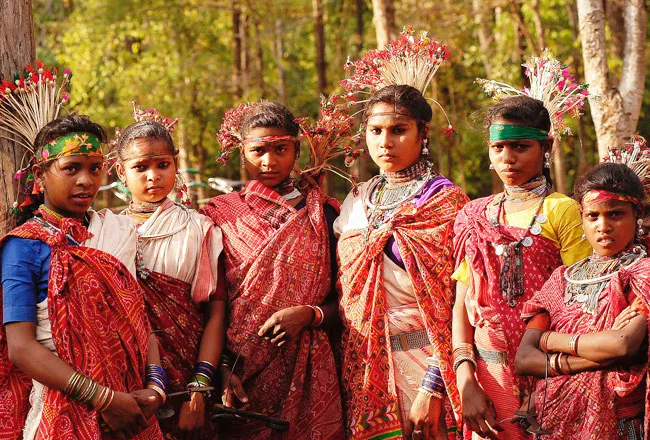
Women wear brightly colored saris, often adorned with intricate beadwork and embroidery. The sari is draped around the body in a distinctive style, accompanied by a blouse and a headscarf.

Men’s Clothing

Men typically wear a dhoti, a piece of cloth wrapped around the waist and legs, often in bright colors and patterns.

Jewelry and Body Art

Both men and women wear jewelry made from locally sourced materials such as shells, beads, and silver. Body art, created with natural ingredients like soil, charcoal, and plant extracts, is used to adorn themselves during special occasions and festivals.

Cuisine

The cuisine of the Maria tribe is diverse and flavorful, reflecting their traditional lifestyle and locally available ingredients. Key staples include:

Rice and Millet

Rice is a staple food often served with various curries and sauces. Millet, another common grain, is used to make flatbreads and porridge.

Tubers and Forest Products

The Maria tribe consumes a variety of tubers, such as yams and sweet potatoes, and incorporates wild game, fruits, and vegetables from the forest into their diet.

Spices

Their cuisine is known for its strong flavors, with common spices including chili, turmeric, coriander, and cumin.

Handicrafts

The Maria tribe is renowned for its intricate handicrafts, which reflect their way of life and cultural heritage. Prominent handicrafts include:

Weaving

The tribe excels at weaving bamboo and other natural fibers into baskets and mats used for storage and transporting goods.

Pottery

Maria pottery, made from clay and adorned with elaborate patterns, is used for cooking, serving, and storing food.

Textiles

The tribe has a long tradition of weaving beautiful saris, dhotis, and other clothing items, often embellished with vibrant embroidery and beadwork.

Jewelry

The Maria tribe creates stunning jewelry from shells, beads, and other natural materials, showcasing their artistic talent and cultural richness.

Summing Up

The Maria tribe, with its rich cultural heritage, traditional practices, and vibrant lifestyle, offers a fascinating glimpse into the diversity of India’s indigenous communities. Their unique customs, oral traditions, and artistic expressions continue to thrive, ensuring that the Maria tribe’s legacy endures for future generations.

The Sahariya Tribe: A Glimpse into Their Life and Culture

0
Sahariya Tribe

The Sahariya tribe, recognized as a special backward tribe, resides predominantly in the north-western part of Madhya Pradesh. They are mainly found in the districts of Shivpuri, Guna, Gwalior, Morena, Bhind, Vidisha, Raisen, Sehore, and Sheopur. Additionally, parts of Rajasthan, particularly in Kota, Shahbad, and Kishanganj, also have Sahariya villages. According to the 1991 census, the Sahariya population in Madhya Pradesh was 332,748.

Historical and Cultural Identity

The Sahariyas are considered a sub-branch of the Kolariyan family and Bheels. They are also known by various names such as Seher, Sair, Savar, Saonar, and Sahra. In the Guna-Shivpuri region, they are referred to as ‘Raut’. The tribe prefers the title ‘Khutia Patel’ as it is a mark of respect. They see themselves as the younger brothers of the Bheels and claim descent from the legendary figures Valmiki and Shabari. According to mythology, the hunter ‘Jara’, who is believed to have caused Krishna’s death, belonged to the Samvar community, which is linked to the Sahariyas.

Village and Housing Structure

A Sahariya settlement, known as ‘Sahrana’, typically features houses arranged in a U-shape, forming a communal courtyard in the center. The women of the tribe decorate their homes with auspicious symbols made from yellow clay, chuhi, geru, and occasionally other colors from the market. These decorations are applied not only on special occasions but also regularly, particularly in the kitchen.

The houses are simple, often made from straw, bamboo, wood, and mud-walls. In some areas, six-foot-high mud walls with tiled roofs are common. The average house measures twelve to fifteen feet in length and width, and serves multiple purposes including cooking, sleeping, and storage. The construction of these houses is overseen by village elders, and the women plaster the walls with chhuhi clay, geru, or yellow clay, showcasing their skills in making graffiti and mandanas (traditional wall art).

Lifestyle and Occupation

The Sahariyas wear dark, bright colors influenced by the neighboring Rajasthani communities. Agriculture is a primary occupation, supplemented by the collection of forest produce. Their diet consists mainly of jowar and bajra rotis accompanied by various vegetables and forest-gathered roots and tubers. On special occasions, gram flour bread is prepared.

Hunting and fishing are favorite pastimes, and the Sahariyas are knowledgeable about herbs and skilled in honey collection. They also engage in traditional crafts such as making baskets, ropes, and brooms, and in woodcutting.

Religious Beliefs and Festivals

Over time, the Sahariyas have adopted the deities and festivals of neighboring folk communities. Sita is their most revered goddess, but they also worship village deities like Thakur Dev, Bheru Dev, Nahar Dev, Dareth Dev, Karas Dev, Bhumiyan Dev, Hariman Dev, and Tejaji.

Language and Art

While the Sahariyas have lost their original language, they speak the local dialects of the regions they inhabit. However, their rich cultural heritage is evident in their ceremonial and seasonal songs, such as Goth-leela, Pandav Katha, Languria, Phag, Janaki Vivah songs, Chakia songs, and Sagdawat-Bagdawat Katha. Their traditional dance, Lehengi, is performed on various occasions, and they have a tradition of theatrical performances based on the life of Tejaji.

Craftsmanship and Household Art

Sahariya women excel in crafting large earthen pots called ‘Pei’ for grain storage, which they intricately decorate with floral, animal, and human designs. These decorations are a highlight of their homes and captivate visitors. The construction of ‘Otla’ (platforms) in the house courtyard is a widespread practice, adding to the functional and aesthetic aspects of their homes.

Summing Up

The Sahariya tribe, with its unique blend of historical significance, cultural practices, and traditional crafts, offers a fascinating glimpse into a community that has managed to preserve its identity while adapting to modern influences. Their vibrant lifestyle, deep-rooted traditions, and artistic expressions continue to be a testament to their rich cultural heritage.

Sanjana Jatav: Breaking Barriers to Become Rajasthan’s Youngest and Wealthiest MP

0

In the heart of Rajasthan, a new chapter in political history is being written by Sanjana Jatav, the youngest and one of the wealthiest members of Parliament (MP) from the state. Her journey to the Lok Sabha is a tale of determination, resilience, and a deep commitment to social change.

Early Life and Education

Born on May 1, 1998, in Bhusawar, Bharatpur, Sanjana Jatav’s roots are deeply embedded in the soil of Rajasthan. Her father, a contractor and former upsarpanch, and her mother, a homemaker, instilled in her the values of hard work and service from a young age. Sanjana completed her BA from Gandhi Jyoti College and went on to earn her LLB from Lords University, Alwar.

Political Ascent

Sanjana’s political journey began with her victory in the Alwar Zila Parishad elections, where she won by a significant margin. Despite a narrow loss in the 2023 Rajasthan Assembly polls, her dedication and potential did not go unnoticed by the Congress party, which fielded her as their candidate from Bharatpur in the 2024 Lok Sabha elections.

Historic Victory

On June 4, 2024, Sanjana Jatav made headlines as she claimed victory from the Bharatpur constituency, defeating her BJP rival by a margin of 51,983 votes. Her win is not just a personal triumph but a symbol of hope for many, particularly the Dalit community to which she belongs.

Vision for Change

As an advocate by profession, Sanjana is no stranger to the struggles of the marginalized. Her campaign resonated with the people of Rajasthan, who have been yearning for solutions to the pressing issues of crime, unemployment, and water scarcity. Sanjana’s legal background and her grassroots connection equip her to address these challenges head-on.

Empowering Women

Sanjana is also at the forefront of the “Ladki Hoon Lad Sakti Hoon” campaign, advocating for women’s empowerment in eastern Rajasthan. Her election is a testament to her belief that women can lead and make a difference in the highest echelons of power.

The Road Ahead

As Sanjana Jatav takes her seat in the 18th Lok Sabha, she carries with her the aspirations of millions. Her focus on solving the water crisis, improving healthcare, and creating employment opportunities is set to ignite a wave of development in her constituency.

Sanjana Jatav’s story is not just about breaking records; it’s about breaking barriers. Her election as the youngest and wealthiest MP from Rajasthan is a beacon of progress, signaling a brighter future for the state and its people.
This article is a fictionalized account based on real events and information available as of June 2024. It aims to provide a narrative on Sanjana Jatav’s political journey and her vision for the future.

How Can I Prevent Mold Growth After Water Damage?

0

Water damage is a severe issue that can lead to significant problems, one of which is mold growth. Immediately addressing water damage is the primary step to prevent mold infestation. Excess water or moisture levels provide the ideal conditions for mold to thrive, which can result in damage to your property and health risks.

Drying out wet areas is crucial to prevent mold after water damage. It is recommended to clean and dry the affected area within 24 to 48 hours as mold can grow quickly. Use dehumidifiers, fans, and heaters to speed up the drying process. Adequate ventilation also plays a significant role in reducing humidity levels.

Go to the Water Damage Specialist to learn more about professional solutions to your water damage problems. Professionals can assess the damage, efficiently clean up water, and reduce the risk of mold growth. Experts have the necessary equipment and knowledge to handle any scale of water damage and prevent the occurrence of mold.

Identifying Water Damage

Early detection is the cornerstone in preventing mold growth from water damage. Over 50% of homes have unknown water damage, potentially leading to serious mold issues. Familiarize yourself with the signs of water damage in your home to address it promptly.

One evident sign is discoloration or dark spots on walls and ceilings. They often appear yellowish, brown, or green, depending on the nature of the damage.

Besides visual signals, use your nose. A persisting damp, musty odor even after thorough cleaning may indicate hidden water damage.

Also, warped walls, floors or ceilings suggest extensive water damage. It’s crucial to seek professional help immediately if you notice this.

Immediate Water Removal

Water damage presents immediate risks for the growth of harmful mold in your home. In such situations, acting fast to ensure moisture and water are completely removed is essential. This first step could determine if you’ll have to contend with mold or not.

An alarming stat reveals that about 70% of homes have mold behind the walls. Keep in mind that any surface or substance that stays damp for 48-72 hours can grow mold. Therefore, swift action towards water removal might save you from health risks and substantial repair costs related to mold remediation.

Use a Wet Vacuum

Wet vacuums are designed specifically for cleaning up water. In cases of flooding or leaks, they can be incredibly efficient in removing water. This tool can easily help you remove considerable amounts of water from your home before it seeps into materials and promotes mold growth.

Air Movers and Dehumidifiers

After vacuuming away standing water, use an air mover to speed up the drying process on carpets, hard floors, or walls. Following this up with a dehumidifier will help reduce moisture content in the air further lessening chances of mold infestation.

Contact a Professional Immediately

If the scale of the water damage seems too overwhelming for you to manage alone, immediately contact a professional restoration service. They have more advanced equipment and trained personnel who can effectively handle extensive damage and hinder the growth of mold.

Prompt Damage Repair

Remember that leaving damaged materials unattended increases chances of mold growth. So, once the area is dry, plan for necessary repairs swiftly. It’s advisable to replace severely damaged items like drywall or carpets to prevent possible future mold growth.

Cleaning Damaged Areas

After a flood or water damage, the initial cleanup is crucial to stop mold growth. Molds can begin to grow within 24 to 48 hours following water damage if the conditions are right. It thrives in moist and warm areas, making your once damp house or business premises an ideal breeding ground.

Personal Safety First

Before beginning the cleaning efforts, ensure you’re protected. Wear a mask, rubber gloves, and protective goggles. This will prevent exposure to any harmful mold spores that have begun forming.

Drying Wet Areas

The next step is vital: drying the wet areas as quickly as possible. Use fans to circulate air, dehumidifiers to decrease moisture levels, and heaters to help expedite the drying process.

Disposing Damaged Materials

All porous materials that have been soaked and can’t be adequately cleaned should be discarded. These include items like carpeting and upholstery, drywall, insulation, paper products, and anything else that could harbor mold growth.

Cleaning Non-Porous Surfaces

Non-porous surfaces like tile floors and countertops should be thoroughly washed with warm water and detergent. Thereafter, disinfect these areas with a solution of bleach and water (1 cup of bleach per 1 gallon of water).

Ensure Proper Ventilation

Keeping your space well-ventilated during and after cleaning. Ensure fans and dehumidifiers are running until all surfaces are completely dry. 

Taking these actions promptly after experiencing water damage can significantly help curb mold growth; providing a safer environment for everyone involved.

Drying Out Excess Moisture

After identifying water damage, your priority should be drying out the affected area. This step is critical to help stop mold growth, as mold thrives in damp environments.

Mold can often lurk unseen, behind walls or under floors. It’s not just unsightly but potentially harmful. Water-damage-related mold is estimated to be responsible for nearly 100% of chronic rhinosinusitis cases. Therefore, it’s essential that you act promptly to dry any lingering moisture.

  • Use dehumidifiers and fans: These tools can expedite the drying process. They not only pull moisture from the air but also promote ventilation.
  • Open windows: This aids in letting out damp air and bringing in fresh air.
  • Sop up standing water: This step is vital to prevent further exposure to moisture that could encourage more mold growth.

Drying takes time; don’t rush it. Ensure all signs of moisture are gone before you consider the area dry. Mold spores only need a little moisture to grow, so don’t leave any chances for them to sprout back.

Ensure all water leaks are repaired and maintain preventive maintenance in your home. By doing this, you reduce the potential risk of mold growth in the future.

Use of Antimicrobial Treatments

After water damage, it’s essential to employ antimicrobial treatments to prevent mold growth. These treatments work by killing or inhibiting the growth of microorganisms like mold, bacteria, and fungi.

The first step is identifying areas that are susceptible to mold growth. Typically, these areas will be damp with high humidity levels. Once identified, an expert should apply the antimicrobial treatment.

  1. Choose the Right Treatment: Not all antimicrobials are created equal. It’s crucial to use those approved by the Environmental Protection Agency (EPA).
  2. Hire Professional Help: Professionals have the necessary tools and knowledge to apply the treatment effectively without causing further damage.
  3. Maintain Proper Ventilation: Ensure the treated area has adequate ventilation to facilitate drying and prohibit mold growth later on.

The duration of treatment can vary based on different factors. For instance, porous materials like carpets and upholstery might require several treatments over an extended period. On the other hand, less porous materials like tile and glass can typically be treated in a single session.

In any case, it’s always advisable to follow up on treatment with periodic inspections. This way, you can monitor any changes and act quickly if necessary. 

Easy preventive measures like this can go a long way in safeguarding your home from harmful mold infestations.

Maintaining Proper Ventilation

Post water damage, effective ventilation is vital to curtail mold growth. You might not see it, but mold can grow on virtually any substance, as long as moisture and oxygen are present. 

Drying out the area promptly prevents mold spores from colonizing. Increasing airflow helps disperse moisture and expedite drying. You can achieve this using fans, dehumidifiers, or HVAC systems.

To systematize ventilation in your flooded areas, you can follow these steps:

  1. Identify damp areas: Before you typify a solution, spot all the damp places in your home.
  2. Deploy adequate equipment: Place dehumidifiers, fans or air conditioners effectively to improve indoor circulation.
  3. Schedule regular checks: Inspect for signs of mold routinely, paying special attention to dark corners and hidden spaces.

Besides artificial ventilation methods, natural ventilation is also beneficial. Opening doors and windows allows fresh air to circulate and helps in reducing humidity levels too. Remember that quick action after water damage is instrumental in preventing mold growth.

Timely Repairs and Maintenance

Protecting your property from mold after water damage begins with timely repairs. Your immediate and swift action can help prevent substantial costs. According to the National Flood Insurance Program, the average flood claim between 2012 and 2016 was more than $30,000, this often included costs related to mold damage.

The potential for mold growth starts as soon as water has infiltrated your home. It’s essential to take steps to begin the drying process within 48 hours to prevent mold spores from establishing themselves.

  • Dry Out Wet Areas: utilize dehumidifiers, fans, and heaters to help expedite the drying process. A faster dry-out can limit mold development.
  • Remove Damaged Materials: unfortunately, some things may not survive water exposure. Dispose of these items quickly to deter any unwanted microbial growth.
  • Cleanse All Surfaces: thoroughly cleaning with soap or a suitable detergent can kill lingering mold spores and help prevent them from multiplying.

Hiring professionalism for repairs is also an excellent strategy for mold prevention. Restoration specialists have the training and tools needed to properly diagnose and repair structural damage caused by moisture.

A regular maintenance schedule can detect potential leaks or seepage points in your home before they lead to significant water damage. You should focus on areas prone to moisture like bathrooms, basements, roofs, or piping systems.

Taking preventive measures such as applying waterproof coatings, improving ventilation or installing water alarms can also be perfect ways for circumventing future unnecessary damages associated with water/mold predicaments.

Some Final Tips

Prevent mold growth after water damage by thoroughly drying the area, maintaining good ventilation, and treating surfaces with an appropriate disinfectant.


Bisleri and TERI Launches a Pioneering Study on ‘Water Credits’ Poised to Transform Water Conservation Initiatives

0

Bisleri International, India’s leading mineral water brand along with TERI School of Advanced Studies has launched an innovative study titled “Water Credits: Impact-Adjusted Virtual Water Footprint”. This collaborative effort sets a benchmark for the beverage industry’s commitment to water conservation.


The study aims to establish a framework for water credits, akin to carbon credits, to promote sustainable water management. Unlike carbon emissions, water savings require a localized approach, factoring in variables such as rainfall and consumption at a watershed level.


Commenting on the significance of the study, Angelo George, Chief Executive Officer, Bisleri International, stated, “At Bisleri, we take immense pride in being a water-positive company, replenishing more water to the ground than we extract. By facilitating discussions and contributing to framework development, the study will drive the realization of water credits as a practical solution. We are grateful to Prof. Dr. Arun Kansal and Ms. Garima Kaushik of TERI School of Advanced Studies for developing a toolkit adaptable across industries to estimate the water footprint. This report underscores our shared commitment to sustainability and environmental stewardship.”


The study evaluates the overall water footprint of the beverage industry, offering a comprehensive understanding of water consumption across its entire value chain. The findings will be shared with the Government of India to facilitate meaningful discussions and framework development, advancing the concept of water credits to become a reality.


The establishment of water credits is crucial, particularly in light of India’s increasingly stressed water resources. Our unwavering dedication to promoting sustainable practices underscores our commitment to safeguarding our precious water resources for generations to come” he further concluded.


Last year, the Prime Minister launched ‘Lifestyle for Environment’ (LiFE) initiative, aimed at fostering individual and community actions to preserve the environment, with rewards to be traded like carbon credits. Given India’s strained water resources, ‘water credit’ has been purposed as one of the key areas in the LiFE initiative, highlighting the significance of establishing water credits to alleviate pressure on India’s water resources.


Bisleri International remains committed to fostering sustainable practices and environmental conservation, leading the charge towards a greener, water-positive future.

Brixton Motorcycles Austria, KAW Veloce Motors, India to Revolutionize India’s Urban Mobility with Model Line-up, Revealed

0

KAW Veloce Motors Pvt. Ltd., India, part of the esteemed KAW Group, has announced a strategic partnership with Brixton Motorcycles Austria, a brand under the Austrian family business KSR Group GmbH, to bring an exciting range of stylish and affordable motorcycles to the Indian market. This partnership aims to meet the growing demand for unique and quality two-wheelers in India, leveraging both companies’ extensive experience and strong family legacies in the manufacturing and retail industries.

The partnership between Brixton Motorcycles Austria and KAW Veloce Motors Pvt. Ltd., India is motivated by India’s status as one of the largest motorcycle markets globally. With a focus on delivering products that stand out in design, quality, and riding pleasure, both companies aim to provide exceptional after-sales service through a vast dealer network across major Indian cities. The collaboration has been in the works for nearly two years, with a shared commitment to catering to the unique preferences of Indian consumers.

KAW Veloce Motors plans to introduce four Brixton models in India by the upcoming festive season: Crossfire 500X, Crossfire 500XC, Cromwell 1200 and Cromwell 1200X. These models embody Brixton’s unique selling points, including Retro-inspired designs, affordability, urban riding suitability, and customization potential. Brixton’s emphasis on stylish design, competitive pricing, and urban practicality sets them apart in the Indian market, appealing to a broad range of riders.

Looking ahead, Brixton Motorcycles Austria and KAW Veloce Motors, India have outlined a two-phase expansion plan. In phase one, they are setting up a manufacturing facility in Kolhapur, Maharashtra, with an annual production capacity of over 40,000 units. The goal is to introduce the existing Brixton motorcycle range, with engine capacities ranging from 500cc to 1200cc. Phase two will see joint development of products specifically for the Indian market at Brixton’s Austria Design Center, alongside expanded manufacturing capabilities. Brixton Motorcycles Austria and KAW Veloce Motors unveil the first set of Brixton Motorcycles Austria launching in India this festive season, hinting at a new era of urban mobility with MotoHaus-inspired outlets. Experience a blend of heritage, technology, and accessible luxury as we bring a new era of motorcycling to key cities including Pune/PCMC, Mumbai, Thane, Nashik, Chennai, Hyderabad, Bengaluru, Cochin, Coimbatore, Ahmedabad, Surat, Vapi, and Panjim.

KAW Veloce Motors’, India long-standing experience in the manufacturing sector has significantly shaped their approach to motorcycle production, ensuring high standards of quality and innovation. Enthusiasts can also look forward to upcoming models from Brixton Motorcycles, such as the Storr 500, an adventure touring bike set to be globally launched in November and subsequently in India.

This strategic partnership marks a significant milestone in bringing high-quality, stylish, and affordable motorcycles to Indian riders, underlining the commitment of both KAW Veloce Motors and Brixton Motorcycles Austria to excellence and innovation in the two-wheeler industry, all under the visionary MotoHaus initiative.

Founded in 1962, the KAW Group has been a cornerstone of the manufacturing industry, providing essential machinery and spares for sugar mills and agro machinery globally. Their profound expertise, combined with a deep understanding of the automotive retail sector, paved the way for the inception of KAW Veloce Motors Pvt. Ltd. (KVMPL), India. Spearheaded by the fourth-generation leader, Mr. Tushar Shelke, KVMPL’s vision is to introduce renowned global two-wheeler brands to India, starting with Brixton Motorcycles, Austria.

Brixton Motorcycles, Austria, part of the KSR Group GmbH, is an Austrian family business with a rich history of over 25 years. The Kirschenhofer brothers, descendants of Otto Petermichl who founded a trading company in 1916, have transformed the business into an international entity known for producing affordable and stylish motorcycles. Their motorcycles, inspired by classic designs and integrated with modern technology, have gained significant popularity in Europe and Asia, particularly among younger riders and urban commuters.

For more information visit our Instagram page: @brixton_india. Follow, like and subscribe!

PIPLANTRI- Story of a village in Rajsamand District of Rajasthan

0

Kamal Dabral, student of Saksham Sanchar Foundation shared the sustainable story of a village in Rajsamand.

This is the story of a village in Rajsamand District of Rajasthan. The story of the land degraded by mining of marble and dumping of marble waste. The story of the land where gender inequality prevailed.

But things changed gradually with a grassroot econominist movement.

Today the villagers plant 111 trees, when a girl child is born and pledge to nurture them as they grow.

The village now boasts of its more than 3,50,00 trees that provide precious forest produce, nurture biodiversity and support livelihoods. 

The village today, has something even more valuable : young, educated girls who believe that these forests will protect our future.

LOCATION :

Piplantri Village in Rajsamand district of Rajasthan, India.

HISTORY :

Piplantri, a village in the Rajsamand district of Rajasthan, was once a victim to denuded land due to marble mining, exhausted foliage and gender inequality.

Before the year 2000, Piplantri faced one of the worst adversities of industrialization. With almost no forests and greenery left, the entire village was dominated by a colossal amount of marble mines and quarries. 

White marble, a much sought stone by the builders for construction industry of modern buildings is available in abundance in the area. Because of large scale mining of the marble the village panchayat faced a problem which is common to such villages i.e.  marble waste was dumped on the village graze land. This dumpling resulted in formation of hillocks of marble waste making the land barren, moreover nothing could be grown on the hillocks as well and the winds blew the fine marble particles with it. The villagers without even realising inhaled it and asthma was a common disease among them. Because of mining drug problem also started to grow up among the village youth. 

Water levels went down till 800 ft. leading to a situation when the villagers would happily share their food but not part with even a single drop of water willingly as scarcely any water was left to drink. 

The village lacked general infrastructure, roads, irrigation and agriculture. With dust from the quarries covering the top soil, the lands went untilled. The villagers worried about no one wanting to marry off their daughters in this village.

THE CHANGE

The story of its transformation began in 2005, with Shri. Shyam Sunder Paliwal, the former Sarpanch (head of the Panchayat) of Rajasthan’s Piplantri village. Mr Paliwal who had studied upto only class eight tried to figure out the problems faced by the villagers. He noted that a water level has gone down alarmingly, the village youth was leaving as there were not enough employment opportunities.  Gender discrimination against the girl child was also prevalent in the area. He realized that Sarpanch alone could nothing; therefore, he devised a strategy to involve the whole community in the developmental work of the Panchayat. 

His initial projects included upgrading the school building and making education more feasible.

The Gram Sabha canceled the dumping permit given to the quarry to dup garbage on the 34 hectares of village common property in exchange for a tiny (1%) royalty on any material extracted from Panchayat territory, and the firm was ordered to empty the property.

The movement of planting trees was spearheaded by the Padma Shri, Shyam Sundar Paliwal, who was devastated after he lost his 17 year old daughter ‘Kiran’ in 2006 to bouts of dehydration. He planted a tree in her memory and encouraged everyone in his village to do the same for their daughters. Soon the village was able to revive their land and even earn additional income through the forest produce. The village now has more than 350,000 trees, with various indigenous varieties, proving to be a boon to the Environment and Climate. 

The initiative has also helped the town’s economy. To keep termites away from the trees, many of which bear fruit, the village has planted more than 2.5 million Aloe vera plants around them. 

Water levels that were below 800 ft have risen up 15ft. to ground level in mere 5 years.

Shri. Paliwal tapped various resources, schemes, and programs devised by the government to remediate the village. Water pipes were installed, education institutions were constructed, higher education became more feasible and infrastructure and sanitization were being developed. Another creative investment was that of the play-pump which was a water pump attached to a merry-go-round. Fresh water was pumped and circulated every time the kids used the swing.

With his increased involvement and humanitarian approach, he tackled three of the most prevalent problems in the most efficient way. Saving the girl child, growing more trees and reviving ground water levels.  

By-Product of the change

To protect the planted trees from termites, aloe-vera plants were planted on the perimeter. Gradually, the villagers realized that Aloe vera could be processed and marketed in a variety of ways. 

The number of aloe-vera plants lying around led to the inception of other women-led initiatives. Starting with 10 women, aloe vera was used to manufacture various products like shampoo, gel and then were commercialized in the market. 

The prize money of Nirmal Village Award (Rs. Five lacs) was put into this enterprise which allowed the production to bloom. Other products from the vegetation were also put into use in the same way.

Gel, Juice and other products of Aloe Vera is being manufactured and marketed enabling more and more employment opportunities to the villagers.

With the increase in irrigation and fertile land, the men left their jobs at the quarries and got back to agriculture and farming. This added to the economic growth of the village as it became more self-sufficient than ever.

COMMUNITY INVOLVEMENT

He encouraged that the whole Gram Sabha comprising all the villagers of the Panchayat gather and participate in the meetings to share their ideas of development of the village. This increased the unity and cooperation among the villagers. They collectively worked on the idea of covering the Marble Waste Hillocks with layers of soil and sand and sowed grass, Planted trees and cultivated Aloe Vera to keep the termite away. In due course because of collective efforts of the villagers under the guidance of Mr  Palival and taking advantage of various Government schemes the villagers were able to cover the hillocks with bamboo, green grass, trees, herbs and medicinal plants. 

To conserve water small ponds were made so that water is stored. The water level also increased.  Now the village has many open wells which are full of water and farmers use this water to irrigate their fields. The village women who earlier would happily give their food to others but not share water with others now have taps at their home with regular supply of water. 

Some of the villagers who had left the village because of unemployment while returning to the village during COVID-19 found that the conditions have changed positively and decided to permanently settle in the village, grow their own crops and lead a happy life with their kith and kin.

THE ECO FEMINISM MODEL OF PIPLANTRI

The village Sarpanch, Mr Paliwal encouraged the villagers to plan more and more trees in common land so that the land is protected from encroachment, the green cover goes on increasing forever and villagers get fodder for the cattle at arms distance. The villagers plant 111 trees on the birth of girl child and 11 trees to remember their dear ones who have left the mortal world. As the trees are associated with the loved ones, the villagers eagerly and enthusiastically protect the trees and ensure that these trees attain fruition and no harm is caused to them by anyone. Over the years the community has planted over 3,00,000 trees on the common grazing land. These trees include Neem, Sheesham, Mango, Amla and many more.

The villagers contribute Rs. 21,000 on the birth of girl child and take Rs. 10,000 from parents of the girl child. The money so collected is put it in a fixed deposit bank account, which can be used only after she turns 18. To make sure that the girl child receives a proper education, the villagers make the parents sign an affidavit (legal contract) which states that the parents will ensure that the girl child is educated and will not be married off before she attains legal age of marriage.

Moreover, parents of the girl child are encouraged to deposit Rs. 500, 1,000 or more per month in accordance to their financial condition. Thus, the girl child has a substantial amount when she grows up for her higher education and marriage.

The villagers celebrate a festival during Monsoon in which the villagers gather together mothers carrying their little fairies in baskets on their heads as Lord Krishna was carried by Vasudev and fathers carrying plants and equipment required to plant the trees.  They sing song, plant trees, girls tie Rakhee on the trees. Thus the Panchayat of 5500 villagers and 1800 families is engaged in the holy duty of conserving the culture and preserving the environment.

RECOGNITION & Popularity

ISRO, from the satellite images of the area, realized that in 2006 this was a Barren Mountain and it became a Green Mountain in 2016. The scientists were surprised to find such an enormous change in only a decade. They sent a team of scientists to verify the fact. They were also amazed by the enormity of the change brought in by the collective efforts of the villagers to protect the environment. After that many researchers, media persons, government officers, NGOs and Panchs and Sarpanchs of many villages visited the Piplantri Gram Panchayat to study the Piplantri Model and implement it with the modification required to suit the needs of their society and surroundings.

Mr Shyam Sunder Paliwal also known as father of eco-feminism in India, has openly declared that he is more than eager to help anyone willing to work for preserving the land and help mother nature sustain its resources.

The initiative that began in 2006 has turned Piplantri village into an oasis. The birth of a girl child is now welcomed and the village is covered with Neem, Mango, Amla and Sheesham trees leading to a higher water level and richer wildlife. 

Shri. Paliwal won the Nirmal Gram Panchayat Award and a Cash Prize of Rs 5,00,000 which was utilized for processing the by-products of plants like aloe vera.

Because of his exemplary work, he  received a Padma Shri Award in 2021.

Mr Paliwal has openly declared that he is willing to guide and work with anyone who is willing to work for the betterment of one’s village.

Sources :

https://www.google.com/url?sa=t&rct=j&q=&esrc=s&source=web&cd=&cad=rja&uact=8&ved=2ahUKEwjb_MuClMaGAxVI-DgGHQvQF88QFnoECFMQAQ&url=https%3A%2F%2Fmissionsustainability.org%2Fblog%2Fthe-piplantri-model%2F&usg=AOvVaw28mEidgBMK6YgQ87nKvYZw&opi=89978449

https://www.google.com/url?sa=t&rct=j&q=&esrc=s&source=web&cd=&cad=rja&uact=8&ved=2ahUKEwjb_MuClMaGAxVI-DgGHQvQF88QFnoECDUQAQ&url=https%3A%2F%2Fphmuseum.com%2Fprojects%2Fgirls-of-piplantri&usg=AOvVaw3j6hxSrZEyEYk_34ZYLHEr&opi=89978449

https://www.google.com/url?sa=t&rct=j&q=&esrc=s&source=web&cd=&cad=rja&uact=8&ved=2ahUKEwjb_MuClMaGAxVI-DgGHQvQF88QFnoECDYQAQ&url=https%3A%2F%2Ftimesofindia.indiatimes.com%2Ftravel%2Fdestinations%2Fpiplantri-village-where-111-saplings-are-planted-every-time-a-girl-child-is-born%2Farticleshow%2F108232431.cms&usg=AOvVaw2xzMrsCTK_fF_LSxqNCvek&opi=89978449

https://en.wikipedia.org/wiki/Piplantri

https://www.google.com/url?sa=t&rct=j&q=&esrc=s&source=web&cd=&cad=rja&uact=8&ved=2ahUKEwjb_MuClMaGAxVI-DgGHQvQF88QwqsBegQILxAG&url=https%3A%2F%2Fwww.youtube.com%2Fwatch%3Fv%3D0YRzvCK-zuA&usg=AOvVaw0yeEOXrsg-DA676p0dmGU-&opi=89978449

https://www.google.com/url?sa=t&rct=j&q=&esrc=s&source=web&cd=&cad=rja&uact=8&ved=2ahUKEwjb_MuClMaGAxVI-DgGHQvQF88QwqsBegQIUBAG&url=https%3A%2F%2Fwww.youtube.com%2Fwatch%3Fv%3DBJwi0rZ27Fo&usg=AOvVaw3baVz_SqJjlXsDs2Ea2Itc&opi=89978449

https://www.google.com/url?sa=t&rct=j&q=&esrc=s&source=web&cd=&cad=rja&uact=8&ved=2ahUKEwjb_MuClMaGAxVI-DgGHQvQF88QwqsBegQIXBAG&url=https%3A%2F%2Fwww.youtube.com%2Fwatch%3Fv%3DorTOCb_WIuo&usg=AOvVaw1MByt1IAQjcCIatrL2AgcF&opi=89978449

https://www.google.com/url?sa=t&rct=j&q=&esrc=s&source=web&cd=&cad=rja&uact=8&ved=2ahUKEwjb_MuClMaGAxVI-DgGHQvQF88QwqsBegQIRxAG&url=https%3A%2F%2Fwww.youtube.com%2Fwatch%3Fv%3DfWsGgzvQAl4&usg=AOvVaw2eBazegciCqf25v5fFhL3d&opi=89978449

https://www.google.com/url?sa=t&rct=j&q=&esrc=s&source=video&cd=&ved=2ahUKEwjq6rnln8aGAxWAhGMGHUwBDWoQtwJ6BAgOEAI&url=https%3A%2F%2Fwww.youtube.com%2Fwatch%3Fv%3DBJwi0rZ27Fo&usg=AOvVaw3baVz_SqJjlXsDs2Ea2Itc&opi=89978449

https://localbodydata.com/gram-panchayat-peepalantri-41316#:~:text=Peepalantri%20Gram%20Panchayat%20is%20a,5%20elected%20members%20by%20people.

The Halba Tribe: A Cultural and Demographic Insight

0

The Halba tribe is a significant tribal community in India, with a prominent presence in Maharashtra, Madhya Pradesh, Chhattisgarh, and Odisha. Renowned for their rich cultural heritage and progressive societal structure, the Halba tribe has garnered attention nationwide. Recognized as one of the Scheduled Tribes in the Indian Constitution, the Halbas have successfully maintained their unique traditions while adapting to modern influences.

Demographic Evolution

The population of the Halba tribe has seen a remarkable increase over the decades. In Maharashtra and Madhya Pradesh, their numbers rose from 7,205 in 1971 to 242,819 in 1981, indicating a 35-fold growth within a decade. This demographic shift reflects the tribe’s adaptability and resilience.

Etymology and Economic Activities

The name “Halba” is derived from the word “Hal,” meaning plough, signifying their primary occupation in agriculture. While traditional farming remains a vital part of their livelihood, many Halbas have diversified into various other professions, including land ownership, making them one of the more affluent and progressive tribal communities in India. Their high local caste status sets them apart from other tribes, though they maintain good relations with neighboring communities like the Gonds.

Language and Cultural Identity

The Halba language is a fascinating blend of Marathi, Chhattisgarhi, and Oriya, reflecting the tribe’s geographical spread and cultural amalgamation. Their unique dialect and linguistic richness are integral to their identity, facilitating communication and preserving their heritage.

Social Structure and Customs

The societal structure of the Halba tribe mirrors the customs of many Indian tribes, placing significant emphasis on marriage. Unique marital rules include the prohibition of divorce initiated by women and the stipulation that widowers can only remarry widows. Cousin marriages are also permissible, highlighting their distinct matrimonial traditions.

Culinary Delights and Dietary Habits

Halba cuisine features a variety of mouth-watering dishes, with a notable fondness for wine and mutton. However, members of the Kabirpanthi sect abstain from alcohol. Their diet and culinary practices offer a glimpse into their lifestyle and cultural preferences.

Occupational Diversity

While agriculture remains a cornerstone, Halbas have ventured into poultry farming, animal husbandry, and trading minor forest products such as fruits, leaves, firewood, bamboo shoots, and handmade items. Some Halbas have also showcased their skills in wood carving, creating exquisite designs for both functional and decorative purposes.

Religious Beliefs and Deities

The Halbas revere numerous deities, including Danteshwari, Mawli Mata, Bhima Dev, Bhairam Dev, Ghat Dev, Aanga Dev, and Seethla Devi. Their religious practices also involve a deep respect for nature and its elements, reflecting a harmonious relationship with their environment.

Festivals and Celebrations

Fairs and festivals are integral to Halba culture, adding vibrancy to their traditions. As many Halbas follow Hinduism, they celebrate Hindu festivals such as Diwali, Holi, Dashehra, Goncha (Rath Utsav), and Fagun with great enthusiasm, showcasing their cultural richness and community spirit.

Traditional Attire and Ornamentation

Halba attire is marked by its cultural exuberance. Women adorn themselves with distinctive jewelry, including ‘Khosa’ (a beautiful lock of braid), ‘Khinwa’ (ear tops), ‘Phuli’ (a hanging nose ring), heavy necklaces like ‘Chapsari,’ and garlands made from coins and black pearls. Bangles crafted from gold, silver, brass, aluminum, clay, lead, and wood are also popular. Tattooing, a prevalent practice, further embellishes their cultural identity.

Summing Up

The Halba tribe stands as a testament to the rich cultural tapestry of India’s tribal communities. Their ability to preserve their heritage while embracing modernity highlights their resilience and adaptability. As they continue to thrive across various states, the Halbas exemplify the dynamic interplay between tradition and progress in the tapestry of Indian society.