Home Blog Page 447

Vishwaraj Singh Mewar’s Succession Ceremony Upholds a 452-Year-Old Blood Tilak Tradition

0

In a solemn and historic event, Vishwaraj Singh Mewar, son of the late Mahendra Singh Mewar and MLA from Nathdwara, will be officially declared the successor of the Mewar legacy on Monday, November 25, 2024. The coronation ceremony will take place at 10 a.m. at the Fateh Prakash Mahal in Chittorgarh, following a centuries-old tradition involving a blood tilak.

Former Rawat of Salumber, Devvrat Singh, a descendant of the illustrious Chunda family, will carry out the ritual by cutting his thumb and using his blood to mark the tilak on Vishwaraj Singh’s forehead. This ritual, steeped in history, dates back to 1572 when Rawat Kisan Das performed the blood tilak to anoint Kunwar Pratap as the Maharana of Mewar during tumultuous times.

The Legacy of Blood Tilak

The tradition of blood tilak began when Maharana Pratap’s coronation took place near the Gogunda Bawdi under dire circumstances. Lacking kumkum for the ritual, Rawat Kisan Das used his own blood to perform the tilak, symbolizing loyalty and sacrifice. Since then, descendants of the Chunda family have continued this practice, making it an integral part of Mewar’s royal traditions.

Sacred Blessings and Rituals

As part of the coronation, offerings of sacred ash, flowers, and blessings will be brought from prominent temples, including Eklingji, Dwarkadhish in Kankroli, and Charbhuja in Garhbor. Each of these temples holds significant spiritual importance:

  • Eklingji Temple: Symbolizing the divine protector of Mewar, this ritual signifies Vishwaraj Singh’s role as the Diwan (administrator) of the temple.
  • Dwarkadhish Temple: Represents Vishwaraj’s initiation into Vaishnavism under the temple’s spiritual guidance.
  • Charbhuja Temple: A major Krishna pilgrimage site, highlighting Mewar’s devotion to Lord Krishna.

The ceremony will culminate with Vishwaraj Singh taking blessings at these temples, marking the start of his new responsibilities.

Participation of Royal Representatives

The coronation is expected to attract a large gathering, including Udaipur residents, social dignitaries, and representatives of erstwhile princely families. Following the ceremony, Vishwaraj Singh will visit Eklingji and Dwarkadhish temples, completing the formalities of royal mourning and the joyous assumption of his new role.

Potential Disputes

While the coronation is a matter of pride and heritage, it is not without controversy.

  1. City Palace Visit: Organizers claim Vishwaraj Singh will pay respects at the Dhuni in the City Palace. However, the palace is under the control of Arvind Singh Mewar, brother of the late Mahendra Singh. The Maharana Mewar Charitable Foundation, led by Arvind Singh, issued a notice on Sunday restricting unauthorized entry into the museum, raising concerns over the event’s access.
  2. Eklingji Temple Dispute: The Eklingji Temple, managed by a trust headed by Arvind Singh, has also restricted unauthorized access on November 25. The trust has requested additional security, citing concerns over potential damage to the property.

A Symbol of Tradition and Transition

Despite these challenges, the coronation of Vishwaraj Singh Mewar reflects the enduring legacy and traditions of Mewar’s royal lineage. By upholding rituals like the blood tilak, this event serves as a bridge between history and modernity, keeping alive the values of sacrifice, duty, and devotion that define the house of Mewar.

Ayurveda Finds a Prominent Spot in Britain’s Healthcare System

0

In a groundbreaking move, the United Kingdom is set to integrate Ayurveda, the ancient Indian system of medicine, into its National Health Service (NHS). This decision comes after a thorough review and recommendation by Britain’s All-Party Parliamentary Group, which recognized Ayurveda as an effective healthcare practice.

Over the next five years, the UK plans to recruit approximately 10,000 Ayurvedic doctors. Additionally, the number of Ayurveda-based wellness, education, and healthcare institutions is expected to grow significantly, from the current 100 to nearly 500. Both public and private sectors in the UK are showing active interest in promoting this traditional medical approach, which could pave the way for enhanced global recognition of Ayurveda.

Recognition for Indian Ayurveda Practitioners

A significant outcome of this development is the formal acknowledgment of Ayurveda degrees from Indian government-recognized institutions. This will allow Indian practitioners to apply for positions in the UK, offering them new career opportunities in international healthcare.

According to Amarjeet Singh Brahma, a representative of the Ayurveda Centre for Excellence (ACE) in the UK, the formal inclusion process is nearing completion. Once finalized, it will enable Indian Ayurvedic doctors to practice in the NHS, making it a win-win situation for both countries.

Growing Popularity of Ayurveda in the UK

Ayurveda’s popularity in the UK is on a steady rise. Reports from ACE reveal that 6 out of 10 Britons have tried Ayurvedic treatments at least once in their lives. Over the past year, Google searches related to Ayurveda have surged by 380%, with a majority focusing on skincare, hair care, and gastrointestinal health.

In the educational sector, the British College of Ayurveda has witnessed a 70% increase in enrollments this year alone. Interestingly, after British students, French and German students form the largest groups enrolling in these programs, reflecting Ayurveda’s growing influence across Europe.

A Step Toward Holistic Healthcare

The inclusion of Ayurveda in the UK’s healthcare system marks a significant step toward holistic and integrative medical practices. With the NHS embracing this time-tested tradition, Ayurveda is poised to gain greater global acceptance while providing Indian practitioners with broader opportunities to showcase their expertise.

This development underscores a collaborative effort to bring the best of traditional and modern medicine together, benefiting millions worldwide.

World’s first 100% AI-generated Mahabharata unveiled with stunning trailer by EiPi Media

0

Vaidehi Bhargava

EiPi Media has taken a groundbreaking leap in filmmaking by creating a fully AI-generated film based on the Mahabharata. This ambitious project utilized advanced AI tools to design characters, craft visually stunning environments, and compose entire sequences, marking a new era in cinematic storytelling. The Mahabharata, known for its timeless complexity and cultural depth, was chosen as the ideal narrative to showcase the transformative potential of AI in filmmaking.

This approach not only significantly accelerates production but also allows for richer, more immersive storytelling. The visualizations include intricate character details and grand battle scenes, bringing the epic to life in a way previously unimaginable. Industry experts view this project as a glimpse into the future of cinema, where AI enhances human creativity and efficiency in storytelling.

Following this milestone, EiPi Media is planning a 6-7 episode series to delve deeper into the Mahabharata’s layered narrative, combining the grandeur of the epic with AI’s capabilities. This initiative also highlights how AI can reshape intellectual property management and storytelling ethics, blending tradition with technological innovation.

A 25-year-old woman in China has become the first to have ‘Type 1 diabetes’ cured with stem cell therapy

0

Vaidehi Bhargava

In a groundbreaking medical achievement, a 25-year-old woman in China has become the first person to have her Type 1 diabetes effectively reversed through stem cell therapy. This innovative treatment was carried out at Tianjin First Central Hospital. The woman, who had lived with Type 1 diabetes for over a decade, no longer requires external insulin injections more than a year after undergoing the procedure.

How the Therapy Works?

Type 1 diabetes occurs when the immune system destroys insulin-producing islet cells in the pancreas, making the body incapable of regulating blood sugar levels. In this experimental procedure, the patient’s fat cells were transformed into pluripotent stem cells, which can develop into different types of cells. These stem cells were then used to generate insulin-producing islet cells. These were implanted into her abdomen, where they successfully engrafted and began producing insulin independently. Within 75 days of the procedure, her blood glucose levels normalized, and she stopped needing insulin injections.

Advantages of Stem Cell Therapy

This therapy offers several potential benefits:

  1. Personalization: Using the patient’s own cells reduces the risk of immune rejection.
  2. Durability: If sustained, it could eliminate the need for lifelong insulin injections.
  3. Non-diabetic Glucose Levels: The therapy normalized her glycated hemoglobin (HbA1c) levels, a key indicator of diabetes management.

What Is Stem Cell Therapy?

Stem cell therapy involves using stem cells, which have the ability to transform into various specialized cell types, to repair or replace damaged tissues. In diabetes treatment, it aims to restore the body’s ability to produce insulin by regenerating functional islet cells. Researchers in this case used induced pluripotent stem cells, which were reprogrammed from fat cells and directed to grow into insulin-secreting cells.

Challenges and Future Implications

While this is a promising breakthrough, challenges remain:

The therapy is currently experimental and costly.

Long-term effects are unknown; experts suggest monitoring patients for at least five years to confirm the cure.

Scaling up the technique for wider use will require further trials and cost optimization.

This achievement marks a significant milestone in diabetes research and could pave the way for new treatments for millions of Type 1 diabetes patients worldwide. However, more studies are needed to assess its safety, affordability, and broader applicability.

Breaking the Norm: This Company Combats Work Pressure with Fully Paid Trips to Spain!

0

Vaidehi Bhargava

Chennai-based real estate developer Casagrand is treating 1,000 employees to an all-expenses-paid week-long trip to Barcelona, Spain, as part of its ongoing “Profit-share Bonanza” initiative. This program, which started in 2013, recognizes employee contributions to the company’s success. Over the years, Casagrand has rewarded its staff with trips to destinations like Singapore, Thailand, Sri Lanka, Dubai, London, and Switzerland, maintaining the tradition even during the pandemic.

The 2024 Barcelona trip celebrates the company achieving its sales targets for the previous financial year. Employees across various roles will explore landmarks like the Sagrada Familia, Park Güell, Montjuic Castle, and Barcelona’s scenic beaches. The trip includes luxury accommodations, guided tours, gourmet meals, and immersive cultural activities, emphasizing the company’s commitment to employee appreciation.

In a statement, Casagrand highlighted that the trip is meant to honor the hard work, dedication, and teamwork of its employees, which played a crucial role in achieving the company’s sales targets for the previous financial year. “This programme acknowledges the dedication, commitment, and collaborative spirit of the individuals who were instrumental in the company’s growth and success,” the statement read.

Casagrand’s gesture is part of its broader goal to foster a culture of shared success and ensure employees feel valued, moving beyond traditional monetary rewards. Such initiatives not only acknowledge hard work but also strengthen bonds among employees, contributing to long-term organizational growth.

In a corporate world often marred by tales of toxic work environments and relentless pressure, Casagrand sets an inspiring example with its employee-focused initiatives. By treating its team to fully paid trips to global destinations, the Chennai-based real estate developer highlights the significance of recognizing and rewarding employee contributions. This thoughtful approach not only boosts morale but also fosters a culture of appreciation, proving that investing in employee well-being is the key to achieving sustainable success.

Indian Railways is set to trial its first hydrogen-powered train in Haryana

0

Vaidehi Bhargava

Indian Railways is set to trial its first hydrogen-powered train on the 89-km Jind-Sonipat route in Haryana in December 2024. This initiative aligns with India’s ambitious goal of achieving net-zero carbon emissions by 2030. Powered by hydrogen fuel cells, these trains produce only water as a by-product, offering a zero-emission alternative to diesel-powered locomotives.

The trial will assess the feasibility of hydrogen trains in both urban and rural settings, with plans to deploy 35 such trains by 2025. Germany’s TÜV SÜD is conducting safety audits to ensure operational readiness.

Hydrogen trains operate by converting hydrogen gas into electricity through fuel cells, which powers the motors. This technology is already in use in Germany and China, positioning India among global leaders in sustainable transport. If successful, this project could significantly reduce greenhouse gas emissions and enhance energy efficiency across India’s railway network.

Challenges include high initial costs for hydrogen infrastructure and the need for government-private collaboration. However, the project also promises economic benefits, such as job creation in the green technology sector and reduced reliance on fossil fuels.

What is this in making using Compressed Stabilized Earth Blocks (CSEBs) at Ahmedabad?

0

Vaidehi Bhargava

A new eco-friendly construction project in Ahmedabad is gaining attention for utilizing Compressed Stabilized Earth Blocks (CSEBs), a sustainable alternative to conventional bricks. These blocks, made from locally available soil mixed with a small percentage of cement, align with green building principles and significantly reduce the carbon footprint of construction.

CSEBs require less energy to produce compared to clay or concrete bricks and emit just 22 kg of CO₂ per ton, compared to 200 kg for clay bricks. They also offer excellent thermal insulation, reducing the need for heating and cooling systems, which can result in long-term energy savings. The use of these blocks not only minimizes environmental impact but also supports local economies by promoting on-site production and employment.

In Ahmedabad, the project integrates these blocks into low-rise structures designed to blend with the local climate and architectural aesthetics. Buildings made with CSEBs are durable, fire-resistant, and capable of withstanding seismic forces, making them an ideal choice for sustainable urban planning. The project also emphasizes biophilic design elements like natural ventilation and lighting, reducing reliance on artificial systems.

This initiative is a promising step toward promoting sustainable architecture in India, offering a model for other cities to adopt eco-friendly materials and designs that benefit both the environment and communities.

Lok Manthan Bhagyanagar 2024 takes off to a grand start, President Draupadi Murmu to inaugurate conference today

0

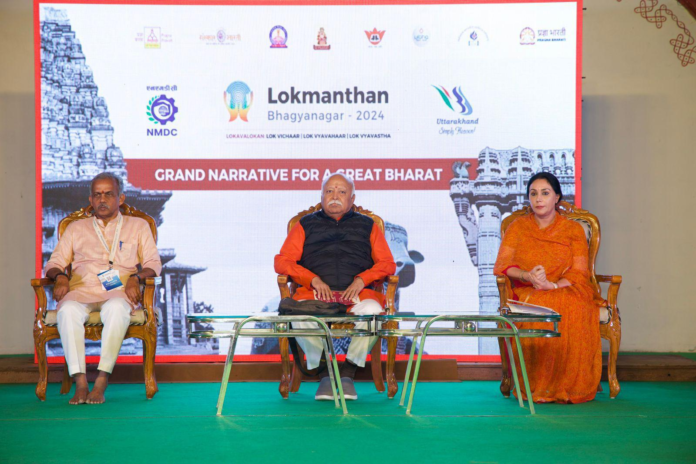
Lokmanthan Bhagyanagar 2024 in Hyderabad took off to a grand start on Thursday. Former Vice President Venkaiah Naidu inaugurated the event at Shilpagram while Telangana Coal and Mining Minister G. Kishan Reddy, Culture Minister Jupally Krishna Rao and T. Hanuman Chowdhary graced the occasion.The Lokmanthan conference will start from Saturday, which will run till November 24. 

A total of 2500 participants will participate in it. The conference will be inaugurated by President Draupadi Murmu. Panel discussions have been organised on family system, environment, civic responsibilities and current topics. Along with this, art exhibitions, traditional cuisine and various cultural programs will also be organised.

Sarsanghachalak Dr. Mohan Bhagwat will be present in the programme on all three days. He will address the programme on November 24. Union Ministers including Nirmala Sitharaman, Gajendra Singh Shekhawat and Rajasthan Deputy CM Diya Kumari are also  participating in the function.

Diya Kumari on Thursday participated in the workshop organised on the topic “Grand Narrative for a Great Bharat” in the Lok Manthan- 2024 programme organised in Bhagyanagar Hyderabad.

This event will further strengthen the contemplation on the glorious future of India and its great cultural stream.

Entry to the programme is free and open to all. The programme will be a win-win for visitors as they will be able to enjoy cultural programs, while also getting an opportunity to listen to knowledgeable and experienced speakers.

The theatre programmes at Shilpapuram will begin with Ashtavadhanam which is being presented by Dr. Madugula Nagphani Sharma. This will be followed by a musical Kali Nritya performance by Kalasankarshini N. Rachana. There will be a musical performance by Armenia Group. Bharat Ki Beti programme presented by Sanskar Bharati will pay homage to the strength and generosity of women in Indian society. There will also be a Jugalbandi performance by Dr. Y. Venkateswara Rao and his group, which is a harmonious combination of various classical music forms.

What is Total in Betting: How to Make a Bet on Stake Website

0

Total betting on Stake lets players predict the overall score, goals, or player stats as over/under values, offering multiple types like game, team, and player totals.

What is Total in Betting: How to Make a Bet on Stake Site

Stake has been widely regarded among the sports bettors in India for having various markets for sports events. Players are able to come across tons of sports events while using Stake betting platform, where they will be able to play on their favorite teams or predict the match score to grab winnings. Among the vast range of markets which will be available to the users at Stake, one of them is known as total markets, which has provided multiple opportunities for users to secure impressive winnings. In this blog, players can know more about the total markets, their types, and how they will be able to play on them.

Understanding the Concept of Total in Betting

First of all, it is necessary for players to understand the concept of total when it comes to playing in sports events. With the help of such markets, players have the opportunity to predict the total score, goals, or any other aspect of the game, and if it comes out to be correct, they will be able to secure impressive winnings. Such types of markets are being widely preferred by users, as they generally have the same risk levels for both outcomes. Let’s take a case where, in a cricket match, the market is given a total score of 180. Players will be able to predict whether the total score will be over 180 or under 180.

Types of Total Bets at Stake

The simplicity of the total market has made it popular among Indian bettors, as they will be able to come across various types of the same at Stake online platform, which are as follows:

  • Game Total: In this outcome, users will have to predict the total score of the game, whether it will be over the given level or under the same.
  • Team Total: Such markets are mostly available in cricket games, where players can predict whether the score of the team batting will be above or below a given level.
  • Players Total: If any player is able to perform well during the game, gamblers can also predict their total score to be over or under a given level.
  • Alternative Totals: There are a few total lines available for the users with unequal odds, and in such events, players have the opportunity to either take a high risk or secure low winning, depending on their choice.

Therefore, Stake players will be able to choose from any of the available total markets and start playing on them.

How to Make a Total Bet on Stake?

Stake has a simple and user-friendly interface, which will help users to play on the total bets by following the steps given below:

  1. Go to the official Stake site for Indian users and log in to your existing account or create a new one.
  2. As players are logged in to their account, they will be able to make deposits by heading over to the deposit section.
  3. Select among methods like Paytm, UPI, PhonePe, Google Pay, etc., to proceed with adding funds to your account.
  4. Once the transaction is completed, players will be redirected to their account at Stake, and funds will be reflected.
  5. Navigate to the sportsbook of the site and select among any of the available sports events.
  6. Look for the total markets and choose the outcome according to your needs.
  7. Players can now enter the amount at the same to confirm their wagers on the sports event.

They can now wait for the event to either come to an end or cash out their funds when it is taking place live to grab winnings, if possible.

Stake has been widely regarded among the sports bettors in India for having various markets for sports events. Players are able to come across tons of sports events while using Stake betting platform, where they will be able to play on their favorite teams or predict the match score to grab winnings. Among the vast range of markets which will be available to the users at Stake, one of them is known as total markets, which has provided multiple opportunities for users to secure impressive winnings. In this blog, players can know more about the total markets, their types, and how they will be able to play on them.

Understanding the Concept of Total in Betting

First of all, it is necessary for players to understand the concept of total when it comes to playing in sports events. With the help of such markets, players have the opportunity to predict the total score, goals, or any other aspect of the game, and if it comes out to be correct, they will be able to secure impressive winnings. Such types of markets are being widely preferred by users, as they generally have the same risk levels for both outcomes. Let’s take a case where, in a cricket match, the market is given a total score of 180. Players will be able to predict whether the total score will be over 180 or under 180.

Types of Total Bets at Stake

The simplicity of the total market has made it popular among Indian bettors, as they will be able to come across various types of the same at Stake online platform, which are as follows:

  • Game Total: In this outcome, users will have to predict the total score of the game, whether it will be over the given level or under the same.
  • Team Total: Such markets are mostly available in cricket games, where players can predict whether the score of the team batting will be above or below a given level.
  • Players Total: If any player is able to perform well during the game, gamblers can also predict their total score to be over or under a given level.
  • Alternative Totals: There are a few total lines available for the users with unequal odds, and in such events, players have the opportunity to either take a high risk or secure low winning, depending on their choice.

Therefore, Stake players will be able to choose from any of the available total markets and start playing on them.

How to Make a Total Bet on Stake?

Stake has a simple and user-friendly interface, which will help users to play on the total bets by following the steps given below:

  1. Go to the official Stake site for Indian users and log in to your existing account or create a new one.
  2. As players are logged in to their account, they will be able to make deposits by heading over to the deposit section.
  3. Select among methods like Paytm, UPI, PhonePe, Google Pay, etc., to proceed with adding funds to your account.
  4. Once the transaction is completed, players will be redirected to their account at Stake, and funds will be reflected.
  5. Navigate to the sportsbook of the site and select among any of the available sports events.
  6. Look for the total markets and choose the outcome according to your needs.
  7. Players can now enter the amount at the same to confirm their wagers on the sports event.

They can now wait for the event to either come to an end or cash out their funds when it is taking place live to grab winnings, if possible.

Cybersecurity in Indian Online Casinos

0

Top of the iceberg are conventional concerns about the protection of personal data and the security of financial transactions. The scene of online gaming in India has changed remarkably within the past several years. Sites like India24bet have been attentively examining the difficulties of sensible security policies.

The Issue with the Family Billing System

In this article, we will discuss a topic that keeps security professionals up at night: the practice of family members sharing casino accounts. Multiple members of the same family will frequently use the same gadget or even share accounts in Indian families. This is not an unusual occurrence. Western security paradigms are just not designed to deal with the security nightmare that is created as a result of this. In the event that an account consistently logs in from a variety of places or displays diverse behavioral patterns, what are some ways to identify potentially suspicious activity? There is a possibility that what appears to be fraud in Europe is actually simply a united family in India sharing their amusement.

The Fraud Known as the UPI Trusted Circle

A whole new category of social engineering assaults has emerged as a result of the Universal Payments Interface (UPI) payment system, which was meant to make things safer. Nowadays, con artists are taking advantage of the “trusted circle” notion that exists in Indian society. Before attempting to infiltrate casino accounts, they are developing intricate methods in which they pretend to be someone’s distant relative or family friend. They do this by utilizing cultural understanding to establish confidence with the target individually. Due to the fact that it takes advantage of social connections and respect for family ties, this particular sort of con seems to be particularly successful in the Indian environment.

The Internet Security Deficit in Rural Areas

There is no discussion regarding the significant security concerns that arise as a result of the participation of internet users in rural areas of India in online casinos. The majority of the time, these gamers make use of outdated gadgets, have a little understanding of cybersecurity, and regularly exchange devices within their network. Those who engage in fraudulent activities develop networks of accounts that are connected through cultural events and festivals. This makes it extremely hard to differentiate between legal bonus hunting and fraudulent activity.

The Fallacy of Language Localization as a Security Measure

Localization of security prompts and warnings in different languages is a significant security issue that has to be addressed. When casinos translate their security messaging into a variety of Indian languages, they may inadvertently create gaps in their security measures. There are several technical terminologies that do not have exact equivalents in every Indian language, which results in security instructions that are confusing and can be exploited by con artists who are skilled in their craft. Because of these translation flaws, users may incorrectly perceive security alerts, which is an even more serious problem.

The Conundrum of Technical Support

When it comes to the security of their technical support, Indian online casinos have a particular difficulty. The cultural preference for voice contact over text communication is the reason why many consumers insist on receiving help by phone. In the context of customer service encounters, this is an ideal opportunity for con artists who are well-versed in the ways in which they may abuse the cultural standards of politeness and respect that are prevalent in India. By employing social engineering, they are able to circumvent security measures by utilizing this information.

The Risk of a Digital Literacy Gap

There is a significant deficit in digital literacy among Indian casino patrons, which results in the formation of peculiar security patterns that appear to be fraudulent but are not, and vice versa. This is a fascinating phenomenon. It’s possible that you’ll have a customer who is proficient in technology placing quick and intricate wagers alongside someone who needs assistance with simple navigation. Because of this, establishing a baseline for user behavior in order to monitor security is extremely challenging or perhaps impossible.

The Nightmare That Is Protection During the Festival Season

Something that you have most likely not given any attention to is as follows: It is important to note that Diwali and other big Indian festivals present a significant security risk for online casinos at these times. When certain occasions come around, there is a significant increase in the number of new accounts and betting activity. Isn’t that a fantastic way to do business? In addition, this is the time when hackers are most inventive. When individuals are at festivals, they are more inclined to relax their guard and make snap judgments about where to place their bets. They are aware of this fact. Due to the fact that regular security patterns do not apply during certain times, security teams are needed to fully redesign their detection systems.

The Challenge of Securing Devices Used in Public Spaces

Internet cafés and computing equipment that are shared are still commonplace in several regions of India. The security of online casinos is therefore presented with a new and distinct issue. In the event that users often access their accounts from public devices, what measures may be taken to ensure the security of the accounts? In this particular setting, the conventional methods of device fingerprinting and location-based security measures are completely ineffective.

The Future: Technology Meets Tradition

Securing online casinos in India goes beyond data security and fraud prevention. An interesting conflict between cutting-edge technology and ancient cultural customs. Today’s security issues are only the start.

India’s online gambling industry has evolved over the years to become organized and widespread in India, thanks to its online proliferation. More Indians from tier-2 and tier-3 cities will gamble online, creating new security patterns. Traditional cybersecurity methods won’t work for them. We’ll need security technologies that can distinguish between joint family account sharing (common in India) and account theft.

I find it fascinating how Indian internet casinos use cultural differences to improve security. That tight-knit family that causes authentication issues? Family members notice strange account activity fast, making it a natural fraud detection mechanism. Festivals that attract scammers? They’re helping casinos improve seasonal security.

Silicon Valley and European tech centers won’t drive online casino security in India. Our digital habits, family structures, and cultural practices will mold it here. Security that complements our culture is ideal.

The conclusion? Indian internet casinos are establishing new security requirements as well as integrating global ones. The world is learning that good cybersecurity isn’t simply about fancy technology. Understanding how individuals celebrate holidays and share electronics with family is crucial to protecting them.