
Home Blog Page 303

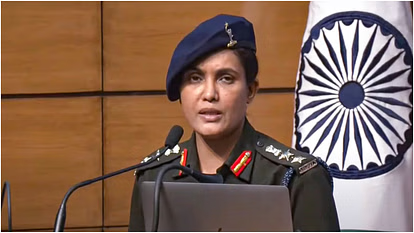
Colonel Sophia Qureshi: This First Woman To Lead An Indian Army Contingent Abroad Is Now The Face Of Operation Sindoor…

0

By Anjali Solanki

Colonel Sophia Qureshi, a name synonymous with courage, leadership, and breaking barriers, has once again etched her name in the annals of Indian military history.

Addressing the nation at a high-level press briefing in New Delhi alongside the Foreign Secretary, Col. Qureshi detailed the success of Operation Sindoor, a daring cross-border strike that has captured global attention. Her poised and commanding presence at the briefing was not merely a procedural appearance it was a testament to the evolving face of India’s military leadership and the indelible mark of a woman who has consistently defied the odds.


In 2016, at the age of 36, Col. Qureshi made history as the first Indian woman officer to lead an Army contingent in a multinational military exercise. Commanding a 40-member Indian team during Exercise Force 18 in Pune, she stood out as The First Woman To Lead An Indian Army Contingent Abroad. She also stood out as a leader who earned universal respect for her strategic acumen and unflinching resolve. The exercise, a complex coordination of military prowess and diplomacy, showcased her ability to navigate high-stakes environments with finesse. Her leadership during the event was a defining moment, proving that gender is no barrier to excellence in the Indian Armed Forces

An officer of the Corps of Signals, Col. Qureshi’s career has been marked by her ability to thrive in challenging and high-pressure settings. From managing critical communication networks to leading troops in volatile regions, she has commanded both men and missions with a rare blend of precision and empathy. Her journey in the Indian Army reflects a relentless pursuit of excellence, earning her decorations and admiration from peers and superiors alike. Yet, it is her ability to lead by example whether in the field or at the podium that sets her apart as a role model for aspiring officers, particularly women.
The recent Operation Sindoor, a meticulously executed cross-border strike, has further cemented Col. Qureshi’s reputation as a trailblazer. While details of the operation remain classified, her address to the nation underscored its strategic importance and the Indian Army’s unwavering commitment to national security. Standing alongside the Foreign Secretary, she articulated the operation’s objectives with clarity and authority, embodying the synergy between military precision and diplomatic finesse. Her presence at such a high-profile briefing was a powerful reminder of how far India’s military leadership has progressed in embracing diversity and meritocracy.

Col. Qureshi’s journey is not just a personal triumph but a beacon of change in a traditionally male-dominated institution. Her rise through the ranks challenges stereotypes and inspires a new generation of women to pursue careers in the armed forces. Beyond her tactical expertise, she represents a shift in the perception of leadership—one where competence, courage, and compassion take precedence over convention. Her story resonates far beyond the barracks, serving as a clarion call for gender equality and empowerment across all spheres.
As India celebrates the success of Operation Sindoor, Col. Sophia Qureshi stands tall as a symbol of progress. Decorated, battle-ready, and unrelenting, she is redefining what it means to lead in uniform.

From the multinational stage in 2016 to the national spotlight in 2025, her legacy is one of breaking barriers and building bridges. Col. Qureshi is not just a commander she is a visionary, a trailblazer, and an enduring role model for a nation on the rise.

What Is the Meaning Behind Operation Sindoor? 26 Tourists Killed by Terrorists — Why the Army Chose This Name for Its Retaliation

0

Operation Sindoor…Wanna know what it stands for and why an army operation has been named after the name ‘Sindoor.’ On April 22, a brutal terrorist attack in the Baisaran Valley of Pahalgam claimed the lives of 26 innocent tourists. Just 15 days later, the Indian Army launched a precise and powerful airstrike targeting nine terrorist camps located in Pakistan’s Punjab and Pakistan-occupied Kashmir (PoK). These camps were the very locations where plots against India were being hatched and executed.

The name of the retaliation — Operation Sindoor — carries deep emotional and symbolic significance. Here’s why.

The Pain Behind the Name

During the Pahalgam attack, terrorists specifically targeted Hindu tourists. According to eyewitness accounts and survivors, the terrorists separated people based on their religion — asking Muslims to recite the Kalma and killing those who failed to do so and who were Hindus.

One such victim was Shubham, who married Aishwarya just two months back. Second casualty was Lt Vinay Narwal who tied the knot just seven days back to this gruesome incident.

So with this name, a strong message has been given which symbalosis ‘Sindoor Against Sindoor.’

Who Are Colonel Sophia and Wing Commander Vyomika? Know the Stories of These Two Brave Officers

0

Colonel Sophia Qureshi of the Indian Army and Wing Commander Vyomika Singh of the Indian Air Force recently addressed the press, revealing details of India’s successful military action against Pakistan under Operation Sindoor. Their briefing showcased not just the tactical success of the mission but also the incredible capabilities of these two distinguished officers.

Colonel Sophia Qureshi – Army Communications Expert

Colonel Qureshi serves in the Indian Army’s Signal Corps, specializing in military communications. She has a long and distinguished service record:

  1. UN Peacekeeping in Congo (2006): Served as a military instructor under the United Nations mission, playing a key role in protecting women and children from violence.
  2. Operation Parakram (2001–2002): Posted on the Punjab border, she was awarded a citation by the General Officer Commanding-in-Chief for her dedicated service.
  3. Northeast India Flood Relief: Received a citation from the Signal Officer-in-Chief for exceptional communication work during disaster relief operations.

Her strategic role in Operation Sindoor ensured seamless communication between ground and air units during the mission.

Wing Commander Vyomika Singh – Specialist Helicopter Pilot

Wing Commander Vyomika Singh is a veteran helicopter pilot in the Indian Air Force with over 21 years of service. She operates advanced helicopters such as the Chetak and Cheetah in some of the most challenging terrains in the country.

A Childhood Dream to Fly

Vyomika’s journey began in school when her classmates asked the meaning of her name. She discovered that “Vyomika” means “sky traveler” or “one who flies.” That moment ignited a lifelong passion to become a pilot. She joined the NCC and later entered the IAF through the Short Service Commission.

Today, she has logged more than 2,500 flight hours, often in tough conditions like those in Jammu & Kashmir and the Northeast.

  • Arunachal Pradesh Rescue (2020): Led a critical relief operation in mountainous terrain, successfully evacuating stranded civilians.
  • Mount Manirang Expedition (2021): Participated in a tri-service all-women mountaineering mission, scaling the 21,650-feet peak.

Together, Colonel Sophia and Wing Commander Vyomika symbolize the courage, skill, and leadership of India’s armed forces. Their presence in the spotlight is not just a testament to India’s military success but also a powerful statement on the evolving role of women in national defense.

Operation Sindoor: Know What Sindoor Symbolises in India

0

Sindoor: A Symbol of Power, Devotion, and Protection

In Hindu culture, sindoor is not merely a mark of beauty—it symbolises power, devotion, and protection. When the nation launched an operation bearing this name, it sent a clear message: this was not a symbolic act, but a solemn vow of righteousness against evil. On the night the Indian Armed Forces carried out precise strikes on terrorist hideouts, the skies were aligned with the Purva Phalguni Nakshatra—associated with the divine feminine energy, Shakti.

The spirit of the mission was deeply inspired by Goddess Durga, revered as the destroyer of demons. Her grace seemed to guide and empower the operation. This alignment was not mere coincidence, but a spiritual sign—when adharma (unrighteousness) rises, divine power manifests to protect the nation.

When the Stars Aligned: Operation Sindoor as a Symbol of Dharma

Operation Sindoor was not just an exhibition of India’s military strength and strategic prowess—it reflected the depth of the nation’s faith and cultural consciousness. When the spirit of national duty awakens, every weapon becomes a sacred offering, and every soldier fights with the spirit of a divine warrior.

This operation proved that India doesn’t merely defend its borders—it safeguards its soul, its culture, and its dharma with unwavering devotion. It was more than a military triumph; it was a confluence of strength and spirituality—an act of sacred retribution that future generations will remember as a defining moment of spiritual resolve.

Mockdrill: Know What It Is and What Directions Have Been Issued About It and Why…?

0

Mockdrill exercise will be performed in different districts of India on May 7. The ministry of Home’ order comes following the deadly terror attack in Pahalgam on April 22. The government of India is preparing to execute one of the most extensive nationwide civil defence mock exercises in recent history. The exercise, set for May 7, intends to evaluate the nation’s readiness for hostile attacks through various emergency simulations. Let’ know details of this exercise…

Question 1: What directive has the Government of India issued regarding the civil defense mock drill?


Ans: On May 5, the Ministry of Home Affairs issued a directive to conduct civil defense mock drills in 244 designated districts across the country.

The nationwide drill, scheduled for May 7, will train citizens on how to protect themselves during an attack. These drills will be conducted in both urban and rural areas of all states and Union Territories.

Participants will include District Collectors, Civil Defense Volunteers, Home Guards, National Cadet Corps (NCC), National Service Scheme (NSS), Nehru Yuva Kendra Sangathan (NYKS), and students from schools and colleges.

The exercise will focus on teaching people how to stay safe during an attack, testing the effectiveness of warning systems, and assessing the coordination and response of control rooms.

The directive was issued under Section 19 of the Civil Defence Act, 1968, which empowers the central government to enforce civil defense training during times of attack or disaster. The Act also mandates that citizens must comply with civil defense rules during emergencies. Violation of these rules can result in imprisonment for up to three months, a fine of up to ₹500, or both.

Question 2: Which 244 districts will have the mock drill?

Answer: In March 2010, the Directorate General of Civil Defence under the Ministry of Home Affairs classified 259 districts into three categories based on sensitivity.

Due to the current tensions between India and Pakistan, mock drills will be conducted in 244 of these sensitive districts. Although the official list has not yet been released by the government, the following regions are likely to be included:

  • Border states such as Jammu & Kashmir, Rajasthan, Gujarat, and Punjab, which share boundaries with Pakistan.
  • Strategic zones including areas with critical defense installations, power grids, ports, refineries, and essential industries, which could be potential targets.
  • Coastal districts where enemy ships could launch attacks and densely populated urban areas that could suffer heavy damage in the event of an attack.

What is a civil defense mock drill?

Answer: A civil defense mock drill is a simulated emergency preparedness exercise designed to train citizens on how to respond during war, air raids, natural disasters, or other emergencies.

In simple terms, it is a rehearsal. Participants—including civilians, students, volunteers, home guards, police, and local officials—practice what actions to take during a real crisis.

For example: If the drill simulates an air raid, sirens will sound, electricity may be cut, people will move to safer areas, and volunteers will assist the “injured.” While the scenario is not real, it helps participants learn exactly what to do in an actual emergency.

There is no single organization that conducts the drill; rather, around 12 government and non-government organizations work together:

  • Ministry of Home Affairs: The central authority responsible for planning, funding, and issuing orders for the drill.
  • DGFS & CDHG (Directorate General of Fire Services, Civil Defence, and Home Guards): Assist with on-ground implementation and manage treatment of mock casualties.
  • Home Guards: Trained to assist the police and administration in emergencies; they help manage crowds and guide people to safety.
  • Police and Fire Services: Local police oversee the drill’s management, while fire personnel simulate rescue operations like evacuating people from debris.
  • NCC (National Cadet Corps): Student cadets actively participate in the drill, help guide people to safety, and support other drill activities.
  • NSS (National Service Scheme): Primarily composed of college students who raise awareness and assist with crowd control.
  • NYKS (Nehru Yuva Kendra Sangathan): Mobilizes youth participation in the drills.
  • Red Cross Society: Provides first aid and medical assistance to mock casualties; trained to deliver emergency medical services.
  • Schools and Colleges: Students and teachers play a crucial role. Children participate in evacuation and blackout drills, while teachers guide and supervise them.
  • NGOs: Non-governmental organizations help spread awareness and mobilize local communities, especially in rural areas.

Mockdrill: Know When It Was Done Earlier in India and Which Other Nations Conduct Such Exercise?

0

A nationwide civil defense mock drill will be conducted across 244 districts as directed by Union Minister of Home. Sirens will play loud, power will be cut, and people will simulate taking cover in response. This marks the first time since the 1971 war that citizens will be trained in how to protect themselves during an attack.

A high-level meeting was held at the Ministry of Home Affairs on Tuesday, May 6, to review preparations. The meeting was attended by Chief Secretaries of states, Civil Defense Chiefs, and several other senior officials.

In this EBNW Story, we’ll look at when this civil defense mock drill was done earlier

When did the Government of India conducted civil defense mock drills in the past?


Answer: India has fought a total of five wars with China and Pakistan. During the 1962 India-China war and the 1965 and 1971 India-Pakistan wars, the Government of India conducted civil defense mock drills.

During the 1971 war, sirens were sounded and blackouts were implemented as part of the drills to simulate air raids. Citizens were trained on how to protect themselves during aerial attacks. People were instructed to cover their windows with paper, and those who were outside during siren alerts were required to lie flat on the ground and cover their ears.

In 1999, although India and Pakistan engaged in the Kargil conflict, no civil defense mock drills were conducted in preparation. Even in later instances of heightened tensions between the two nations, such drills were not carried out. Therefore, this marks the first time since 1971 that India is conducting a civil defense mock drill.

Do other countries also conduct such mock drills?


Answer: Yes, in anticipation of potential war, several countries conduct similar civil defense mock drills to prepare their citizens for enemy attacks.

Since the onset of the Russia-Ukraine conflict in February 2022, Ukraine has conducted multiple civil defense drills to ensure public preparedness. Similarly, Israel has organized drills to train its citizens on how to respond to attacks from Hamas.

Earn while you learn with IIM Raipur, 50,000 Monthly Stipend for MBA in Public Policy and Governance under CMGGF

0

Raipur, May 6, 2025 – Indian Institute of Management (IIM) Raipur, a leading institution recognized for #BuildingBusinessOwners, is delighted to announce the launch of its two-year MBA in Public Policy and Governance, offered under the prestigious Chief Minister’s Good Governance Fellowship (CMGGF), a flagship initiative by The Government of Chhattisgarh. A total of 36 students will be selected for this prestigious MBA program. Last date to apply is 11 May 2025, for more information visit https://iimraipur.ac.in/mba-ppg/
This unique program is designed to nurture future leaders in public policy by blending academic excellence with practical governance experience, empowering Chhattisgarh’s youth to contribute to the state’s development. The Chhattisgarh Government will fully sponsor the program by covering the entire tuition fee for enrolled students, ensuring accessibility to quality education. It will also provide a generous monthly stipend of ₹50,000 to support the students’ academic pursuits, studies, along with boarding and lodging during academic sessions at IIM Raipur.
Prof. Ram Kumar Kakani, Director, IIM Raipur, expressed his enthusiasm, stating, “At IIM Raipur, we believe that effective public policy is the backbone of inclusive development. Through this pioneering MBA in Public Policy and Governance, offered under the Chief Minister’s Good Governance Fellowship, we aim to equip aspiring leaders with the analytical skills, ethical grounding, and real-world experience needed to navigate complex governance challenges.”
The MBA program offers a comprehensive curriculum that includes classroom sessions at IIM Raipur’s state-of-the-art campus and hands-on training with the Chhattisgarh

Government, equipping students with skills in policy analysis, governance frameworks, leadership, and decision-making to tackle contemporary public administration challenges.
To be eligible, candidates must be domiciled in Chhattisgarh, hold a valid CAT score from 2022, 2023, or 2024, and possess a graduation degree with at least 60% marks (55% for reserved categories) or an equivalent CGPA as per Chhattisgarh State Reservation Policy. The program prepares graduates for impactful careers in government, public sector enterprises, and policy think tanks, enabling them to drive meaningful change in Chhattisgarh and beyond. Upon successful completion of the program, students may avail various opportunities within the Chhattisgarh Government, as well as in private/public sector organizations, consultancy firms, and more.

Putin’s Long Road to Power: From KGB Officer to Russia’s Longest-Serving Leader Since Stalin. Know Rare Facts…

0

When Vladimir Putin was sworn in for his first presidential term on May 7, 2000, few could have imagined that the 47-year-old, relatively unknown leader would go on to dominate Russian politics for more than two decades. Initially recognized for being young, articulate, and sober—a contrast to his predecessor—Putin’s rise appeared modest. As noted by journalist Susan B. Glasser, “If you had asked me or basically anyone whether Vladimir Putin would become the longest-serving Russian leader since Joseph Stalin, the response would have likely been either incredulous silence or uproarious laughter.”

Putin’s journey began with a law degree from Leningrad State University, where he studied under Anatoly Sobchak, a reformist figure of the perestroika era. He then served 15 years in the KGB, including six years stationed in Dresden, East Germany. In 1990, he retired with the rank of lieutenant colonel and returned to Leningrad, becoming prorector of his alma mater before joining Sobchak, now the city’s first democratically elected mayor, as an adviser. Known for his efficiency, Putin rapidly advanced to become first deputy mayor by 1994.

In 1996, Putin moved to Moscow and entered the federal government, rising through administrative ranks under leaders such as Pavel Borodin and Anatoly Chubais. In 1998, President Boris Yeltsin appointed him director of the Federal Security Service (FSB), the successor to the KGB, and later secretary of the Security Council. By 1999, Yeltsin named him prime minister, grooming him as his political heir.

Putin’s popularity surged after his strong military campaign in Chechnya, which appealed to a Russian public weary of Yeltsin’s erratic leadership. His backing of the pro-Kremlin Unity party helped it perform well in the 1999 parliamentary elections. On December 31, 1999, Yeltsin resigned unexpectedly, appointing Putin as acting president. Putin won the March 2000 election with about 53% of the vote, promising to restore national pride and stability.

Rabindranath Tagore: 9 Rare Facts About Nobel Laureate Who Wrote National Anthems for Two Nations

0


Rabindranath Tagore—a name synonymous with poetry, patriotism, and profound wisdom—is often celebrated for being the first non-European Nobel Laureate in Literature. While most of us know him as the author of Gitanjali and the composer of India’s national anthem, there’s much more to this iconic figure than meets the eye. From renouncing knighthood to late-in-life painting exhibitions, here are some lesser-known but fascinating facts about the multifaceted genius who helped shape India’s cultural and intellectual identity.

1. A Visionary Behind Modern India
Rabindranath Tagore, born during the British Raj, is one of the most influential figures in Indian history. A poet, philosopher, composer, and artist, Tagore’s contribution to India’s cultural, spiritual, and intellectual landscape remains unparalleled. His ideas, literature, and political views continue to be studied globally even today.

Rabindranath Tagore: 9 Rare Facts About Nobel Laureate Who Wrote National Anthems for Two Nations

2. His Nobel Prize Was Stolen
Tagore was the first Indian and first non-European to receive the Nobel Prize in Literature in 1913 for his book Gitanjali. The Nobel medal was housed at Visva-Bharati University in Santiniketan but was stolen in 2004. In response, the Swedish Academy later presented two replicas—one in gold and one in bronze—to the university.

3. He Met and Debated with Albert Einstein
Tagore’s intellect was globally recognized. He had a series of profound philosophical conversations with Albert Einstein in the 1930s. These conversations, centered around science, truth, and consciousness, remain iconic examples of East-West intellectual exchange.

4. He Was Knighted, Then Gave It Up
In 1915, Tagore was knighted by King George V for his literary contributions. However, following the Jallianwala Bagh massacre in 1919, he renounced the knighthood as a form of protest against British colonial violence, demonstrating his deep moral conviction.

5. His Artistic Legacy Lives in Museums
There are three museums dedicated to Tagore in India and five in Bangladesh.
In India, notable ones include:

  • Rabindra Bharati Museum, Jorasanko Thakur Bari (his ancestral home) in Kolkata
  • Rabindra Bhavan Museum, in Santiniketan, where he founded Visva-Bharati University

6. A Literary Family: His Sister Was a Novelist
Tagore’s sister, Swarnakumari Devi, was a prominent novelist, poet, and social reformer. She was among the first women in Bengal to gain recognition in literature and music, and played an important role in early women’s movements in India.

7. He Studied in England
Though Tagore didn’t complete formal education in England, he was sent to Brighton for school and briefly attended University College London to study law. However, he soon turned to self-directed studies, immersing himself in Shakespeare, Thomas Browne, and other literary and philosophical works.

8. He Became a Painter at 60
Tagore began painting and sketching at the age of 60, surprising many with his expressive and abstract style. Though he was initially dissatisfied with his artistic skills—once writing to Jagadish Chandra Bose, “Just as a mother lavishes most affection on her ugliest son, so I feel secretly drawn to the very skill that comes to me least easily.”—his artwork eventually gained global recognition and was even exhibited internationally.

9. His Legacy Transcends Borders
Tagore composed the national anthems of both India (Jana Gana Mana) and Bangladesh (Amar Shonar Bangla), making him the only individual to have written national anthems for two countries. His influence stretches far beyond literature, shaping culture, politics, and education across South Asia.

Betting on the Move: How Mobile Apps Reshape Sports Culture

0

Mobile devices have transformed how people in Thailand connect with sports. From watching matches to placing bets, everything now happens on the move. Fans no longer rely on home setups to stay involved. Instead, apps deliver real-time action wherever they are.

Convenience is the key factor. Fans want speed, control, and updates without delay. Lightweight apps like 1xbet download android support this shift by offering quick access with low data use. These apps provide fast installs, clean interfaces, and the essential tools users need to stay active in sports environments.

This article explains how mobile betting apps are changing the way Thai fans follow and interact with sports. It focuses on mobility, personalization, and the influence of app features on everyday habits.

Mobility and Accessibility: The Game Anywhere Era

Smartphones have made sports interaction constant and mobile. Thai users no longer need to sit at a computer or find a local venue to check live scores or odds. The betting experience now fits in a pocket.

With 4G coverage across most regions and rising 5G adoption, connection issues are less of a concern. Users can place bets from stadiums, restaurants, or even while commuting. This shift improves flexibility but also changes behaviour – users check updates more often and act faster on betting decisions.

App design supports this. Compact menus, swipe navigation, and low-lag response make in-app journeys simple. Thai platforms now focus on making apps that run well on both high-end and budget smartphones.

Personalized Engagement and Instant Services

Mobile apps now track user preferences to deliver tailored content. This includes push alerts for match outcomes, bet results, and event recommendations. Thai users enjoy features that align with their interests, especially when focused on specific leagues or local teams.

The ability to set favourites or create watchlists helps users reduce clutter. Instead of browsing through dozens of matches, they see what matters most. This also shortens decision times and encourages regular logins.

Platforms also send smart reminders about bet deadlines or match starts. These messages increase engagement without overwhelming users. As more users manage multiple apps, personalization has become essential to reduce app fatigue and confusion.

The Expanding Role of Mobile Applications

Today’s mobile applications do more than display odds or results. They offer integrated services like cash-out options, multi-match views, and real-time stat feeds. These tools are essential for modern fans who want full control from one screen.

Many apps now include:

  • Mini-streaming features with real-time visual trackers.
  • Instant result banners for live events.
  • Flexible payment tools including QR code support.
  • Customer support chats within the app.
  • Daily reward systems or promo offers for frequent logins.

Thailand’s mobile-first market demands efficiency. These features save time and remove the need to visit multiple websites or apps. Users can manage everything from signup to payout in one place.

Behaviour Shifts Among Thai Sports Fans

Sports betting is no longer tied to one location or fixed hours. Fans follow events throughout the day. They make smaller, faster decisions and use analytics tools to guide choices.

With mobility comes responsibility. Thai users are becoming more aware of app features that support budget limits and time management. They use alerts, limits, and freeze functions to keep control.

Social interaction is also shifting. Fans share screenshots, chat in betting groups, and exchange tips via mobile channels. Apps with shareable slips or leaderboards support this trend, creating a networked betting culture that goes beyond the individual user.

 Final Thoughts

Mobile apps have redefined how sports fans in Thailand interact with their favourite games. From watching live stats to making instant wagers, everything is faster and more personal. Tools that used to require desktop access now fit into everyday mobile routines.

Apps support this change by offering flexible, lightweight solutions. Thai users value control, mobility, and clear tools that keep them engaged and informed.

The sports experience in Thailand is no longer limited by time or place. Mobile apps continue to reshape habits, making betting, tracking, and discussion part of everyday life. The platforms that offer speed, personalization, and balance will shape the future of digital sports culture in Thailand.