
Home Blog Page 224

Pt. Vijay Shankar Mehta Success Formula Through Hanuman Chalisa, Introduces ‘One-Two Ka Five’ Mantra

0

Pt. Vijay Shankar Mehta delivered an inspiring talk, sharing his success formula drawn from the Hanuman Chalisa and introduced his unique ‘One-Two Ka Five’ mantra to motivate students at Mody University in Laxmangarh on Friday.

Mody University of Science and Technology (MUST) hosted a grand Orientation Session 2025 to welcome its first-year students. The event took place at the Swami Haridas Auditorium and was graced by renowned motivational speaker Pandit Vijay Shankar Mehta as the chief guest.

The program began at 10:00 AM with Saraswati Vandana and the university’s Kulgeet. This was followed by a melodious performance by the musical band of Mody School, which set a warm and vibrant tone for the event.

In his inaugural address, University President Prof. (Dr.) Ashutosh Bhardwaj welcomed the students and highlighted the importance of education and the achievements of Mody University. He also felicitated Chief Guest Pandit Vijay Shankar Mehta. Prof. (Dr.) Jitendra Binwal, Chairman of the MUST Management Council, welcomed President Bhardwaj on behalf of the university.

Senior officials including the Dean, Registrar, and academic heads were introduced to the students. Mr. Sanjeev Kumar Agarwal, Vice President (Finance and Administration), provided an overview of the university’s operations. Mr. Praveen Jha, DGM Admissions, delivered the formal welcome address.

Mrs. Shanu Ora, Head of SEFS, shared department-specific information, followed by Dr. Amit Khare, who outlined the objectives of the Career Development Cell (CDC) and the Talent Skill Development Center (TSDC). Dr. Surendra Rajpurohit, Joint Dean of the International Department, spoke about global academic opportunities available at Mody University.

Chief Guest Pandit Vijay Shankar Mehta delivered an inspiring lecture, emphasizing life values, self-confidence, and spirituality. He engaged students in a lively dialogue session and shared his “One-Two-Five” success formula along with key teachings from the Hanuman Chalisa.

In the afternoon session, Prof. (Dr.) Vinod Mann, Chief Warden, spoke on the theme “Home Away from Home”. Dr. Rajiv Mishra, Tapovan Manager, discussed the role of spirituality in student life. Mrs. Rupal Arora, a psychologist, shared insights on mental health and stress management. Mrs. Anita Kaushik, AGM Sports, introduced the university’s sports facilities, and Mr. Akshay Jain, Library In-Charge, explained the library’s resources and services.

The event concluded with Abhivyakti 2025, a colorful cultural program in which new students showcased their talents with enthusiasm and creativity
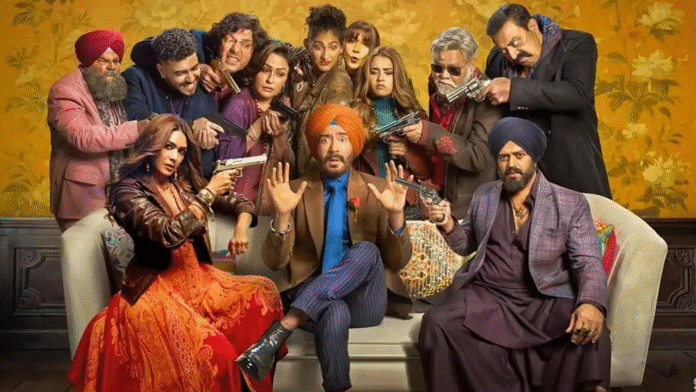
Ajay Devgan Returns With A Bang In “Son Of Sardar 2”: A Cross-Border Wedding, Transgender Twist and Comedy Keeps Audience Hooked…

0

Ajay Devgn returns as Jaswinder “Jassi” Singh Randhawa in Son of Sardar 2, released today, August 1, 2025. The sequel arrives 13 years after the original Son of Sardar (2012), and while it carries forward the spirit of comedy, it introduces new themes, characters, and emotional depth.

Son of Sardar 2, released today, brings back Ajay Devgn’s quirky charm in a fresh setting, shifting from Punjab to the UK and Scotland. The film blends comedy, romance, and cross-border drama with new characters like Mrunal Thakur’s Rabia, a Pakistani wedding dancer, and Deepak Dobriyal’s standout role as a transgender character. While the humor is more situational and emotionally grounded than the slapstick of the original, the film still leans on exaggerated scenarios and predictable twists. The music adds flavor, and the film’s light-hearted take on Indo-Pak relations gives it a warm, festive vibe.

Compared to Son of Sardar (2012), the sequel feels more modern and inclusive, tackling themes like identity, divorce, and cultural clashes with a softer tone. Gone are the feuding families and action-heavy sequences; instead, we get a comedy of errors set around a wedding, with Ravi Kishan playing a conservative father and Chunky Pandey adding comic relief. Though not groundbreaking, Son of Sardar 2 delivers enough laughs and heart to entertain fans of the original, offering a breezy, family-friendly watch.

The Golden Pulse of India: Western Rajasthan’s Dunes, Dynasties, and Divine Drama

0

If India were imagined as a magnificent tapestry woven with the vibrant threads of tradition, music, color, and history, Western Rajasthan would be its most dazzling, lively, and soulful gem. Spread across the golden sands of the Thar Desert, vast arid landscapes, and borderlands, this region is not merely a place on the map—it is a living, breathing canvas drenched in the hues of folk culture, timeless beauty, and vibrant traditions. The folk melodies carried by every breeze, the colorful handicrafts, and the stories etched in ancient forts captivate the heart of every traveler, making this land an unforgettable cultural celebration.

A Land Where the Desert Sings

Western Rajasthan is where the desert doesn’t just stretch—it sings. The golden dunes of Jaisalmer, often called the “Golden City,” shimmer under the sun like molten gold. Here, camel caravans move rhythmically across the sands, and ancient forts rise like mirages from the earth. The Sonar Quila (Golden Fort), built entirely of yellow sandstone, glows at sunset, casting a spell on every traveler. But the magic doesn’t end in Jaisalmer. Travel eastward and you’ll find Bikaner, a city of intricate havelis and regal architecture. Its Usta art—delicate floral and geometric patterns painted on walls and ceilings—is a testament to the region’s artistic finesse. The Junagarh Fort, with its blend of Mughal and Rajput styles, stands as a proud reminder of Bikaner’s royal legacy.

Jodhpur: The Blue Symphony

Further south lies Jodhpur, the “Blue City,” where indigo-painted houses cluster around the mighty Mehrangarh Fort. The city’s color isn’t just aesthetic—it’s symbolic. Blue was traditionally associated with Brahmins, but over time, it became a cooling hue in the desert heat. Walking through Jodhpur’s narrow lanes feels like stepping into a dreamscape where history and daily life blend seamlessly. Jodhpur is also a hub of rural artistry. Villages like Salawas and Chopasni are known for dhurrie weaving and pottery, offering visitors a chance to witness craftsmanship passed down through generations.

The Golden Pulse of India: Western Rajasthan’s Dunes, Dynasties, and Divine Drama

Barmer: Where Music Meets the Horizon

In Barmer, the desert finds its voice. This district is home to legendary musical communities like the Langas and Manganiyars, whose soulful tunes echo across the dunes. Their songs, often passed down orally, tell tales of love, valor, and devotion. The melodies are haunting, the rhythms hypnotic—and they form the heartbeat of Rajasthan’s folk identity. Barmer’s rustic charm lies in its simplicity. Villages like Shiv and Pataudi offer a glimpse into authentic desert life, where hospitality is heartfelt and traditions are deeply rooted.

The Golden Pulse of India: Western Rajasthan’s Dunes, Dynasties, and Divine Drama

More Than a Destination—A Soulful Experience

Western Rajasthan is not just a tourist destination—it’s an experience that lingers long after the journey ends. It’s in the warmth of a villager’s smile, the swirl of a Kalbelia dancer’s skirt, the aroma of bajra roti cooked on a clay stove, and the intricate patterns of a handcrafted leather bag. This region has transformed itself into a cultural tourism powerhouse, drawing travelers not just for its sights but for its soul. The Rajasthan government’s initiatives, including partnerships with UNESCO and the development of rural tourism hubs, have further elevated its global appeal.

A Realm of Timeless Wonder

To visit Western Rajasthan is to step into a realm where time slows down, and every moment is steeped in tradition. It’s where the past isn’t forgotten—it’s celebrated. The desert may seem barren at first glance, but look closer, and you’ll find it teeming with life, color, and stories waiting to be told. Whether you’re a history buff, a culture enthusiast, or a seeker of soulful experiences, Western Rajasthan welcomes you with open arms and a song in the wind.

Where Is Our Humanity? Gaza Starves While the World  Watches

0

By Vibha Sharma

Introduction: A Man-Made Tragedy  

In the summer of 2025, Gaza—home to roughly 2.1 million people—is experiencing what  humanitarian groups warn may be the worst food crisis seen anywhere in recent history.  According to the latest IPC analysis, nearly one in five Gazans—about 500,000 people—are  living under famine-like conditions.  

Blockade Brings Collapse  

Since March 2, 2025, Israel imposed a complete blockade on Gaza, halting all humanitarian  and commercial imports. The WFP’s supported bakeries ran out of flour and cooking oil  within weeks, and by late April, community kitchens were forced to shut down due to  depleted food stocks. During the blockade, prices skyrocketed—flour rose as much as  3,000% in many parts of the territory.  

A Humanitarian Catastrophe  

UN-affiliated agencies now say two of the three famine threshold criteria have been  exceeded: severe reductions in food intake, high acute malnutrition, and rising deaths among  children. Over 70,000 children under five and more than 17,000 pregnant or breastfeeding  women face acute malnutrition requiring urgent treatment. Recent reports cite at least 154  confirmed starvation-related deaths, including 89 children, and many more likely unrecorded.  

Hospitals and nutrition centers are collapsing. Therapeutic feeding and basic medical care can  only assist a fraction of those in need, leaving severely ill infants and toddler’s untreated  

Politics Vs. Humanity  

Although the Trump administration publicly acknowledged severe hunger in Gaza and  outlined plans for U.S.-supported food distribution centers, legislative efforts to limit military  support to Israel failed in the U.S. Senate. Meanwhile, Israeli authorities deny that starvation  is a policy objective, insisting aid is delivered—but critics argue logistics and restrictions  render it ineffective. 

Aid Barriers Despite Available Supplies  

Tens of thousands of tons of food and nutritional supplies await entry into Gaza—but remain  stranded at border crossings, blocked by political disputes, security checks, and bureaucratic  delays. UN agencies emphasize there’s sufficient food sitting just outside Gaza to feed  people—yet there’s no safe, uninterrupted route to those suffering inside.  

Why Immediate Action Is Non-Negotiable  

Experts warn that without urgent and large-scale humanitarian access, famine will become  irreversible. Chronic famine risks, such as stunted growth, cognitive impairment, and  weakened immunity among young children, are rapidly becoming a reality. Local food  production is collapsing—agricultural lands are destroyed, wells disabled, and livestock  populations dramatically reduced—deepening the long-term crisis .  

Conclusion: Our Moral Imperative  

Gaza’s starvation is entirely avoidable—and entirely man-made. Continuing to watch without  demanding action makes us complicit in a tragedy that is unfolding in plain sight. The world  must insist on unrestricted humanitarian access, open borders, and adherence to international  standards of human dignity. 

(Writer of this article is Vibha Sharma, who holds a Master’s degree in Political Science from Kanoria PG Mahila Mahavidyalaya)

Operation Mahadev: India’s Precision Strike Against Pahalgam Terror Plotters

0

By : TANISHKA VERMA

Introduction

On April 22, 2025, India witnessed one of the most brutal terror attacks in recent years. The serene tourist destination of Pahalgam in Jammu and Kashmir was turned into a site of horror when armed terrorists killed 26 civilians—only Hindu men—after isolating them based on religion. In a powerful and calculated response, India launched Operation Mahadev, a surgical counter-terror operation aimed at bringing the perpetrators to justice.

Background: Pahalgam Terror Attack

The attack was carried out by five armed terrorists associated with The Resistance Front (TRF), a Pakistan-backed proxy of Lashkar-e-Taiba. It took place in the Baisaran Valley of Pahalgam, targeting innocent tourists. The scale and brutality of the attack shocked the nation and prompted immediate action from security and intelligence agencies.

Intelligence and Preparation

Following the attack, Indian agencies launched a comprehensive intelligence-gathering mission. Signals intelligence, drone surveillance, and human sources indicated that key suspects had taken shelter near Mahadev ridge in the Dachigam forest area, on the outskirts of Srinagar.

Over the next 14 days, coordinated efforts by the Indian Army, Jammu and Kashmir Police, CRPF, and intelligence units monitored movements and intercepted communications. By mid-July, actionable intelligence confirmed the presence of the Pahalgam attackers in the area.

 Execution of Operation Mahadev

On July 28, 2025, Indian security forces launched Operation Mahadev, named after the Mahadev mountain ridge near the operation zone. Conducted in the Lidwas forest area, the operation involved a swift and stealthy joint assault by Para Commandos and local police units.

In the intense encounter that followed, three PAKISTANI terrorists were eliminated:

• Suleiman Shah alias Hashim Musa, the mastermind of the Pahalgam attack and a former Pakistani special forces operative.

• Hamza, an Afghan national linked to Lashkar-e-Taiba.

• Jibran alias Yasir, also a trained militant from Pakistan.

Operation Mahadev: India's Precision Strike Against Pahalgam Terror Plotters

Forensic Evidence and Confirmation

After the operation, weapons recovered from the slain terrorists—including one M4 carbine and two AK-47 rifles—were flown overnight to the Central Forensic Science Laboratory (CFSL) in Chandigarh. Ballistic tests confirmed that these weapons matched those used in the Pahalgam massacre.

In addition to forensic proof, eyewitness accounts and seized identity documents—including Pakistani voter cards—provided further confirmation of their involvement.

Significance and Impact

The success of Operation Mahadev was widely hailed as a turning point in India’s counter-terror strategy. For the families of the Pahalgam victims, the operation brought a sense of justice and closure. For the security establishment, it demonstrated the strength of India’s intelligence and rapid-response capabilities.

Operation Mahadev: India's Precision Strike Against Pahalgam Terror Plotters

Home Minister Amit Shah lauded the operation in Parliament, calling it a “clear and just answer to those who believe they can escape justice after killing innocents.” He also linked the mission to Operation Sindoor, India’s earlier cross-border strike on terror camps in Pakistan-occupied Kashmir, calling both missions part of a coordinated national response.

Conclusion

Operation Mahadev was more than just a counter-terror mission—it was a message. A message that India will pursue justice relentlessly, with precision and without delay. By eliminating the key masterminds behind the Pahalgam attack, the operation reinforced national resolve and sent a strong signal to terror networks operating beyond the border.

Northern Command chief hails troops for Op Mahadev success :

Sources

– [Ministry of Home Affairs, India]

– [India Today, The Hindu, The Print, Times of India]

– [Central Forensic Science Laboratory reports]

– [Eyewitness and media coverage from July 2025]

SIR: Special Intensive Revision- The Draft Roll That’s Ignited Controversy, Court Battles, And Citizen Outrage..

0

In the sweltering summer of 2025, as Bihar prepared for its upcoming Assembly elections, a quiet revolution was brewing—not in the streets, but in the dusty registers of democracy. The Election Commission of India had launched a massive exercise called the Special Intensive Revision, or SIR, to clean up and update the state’s voter rolls. It wasn’t just a bureaucratic formality. It was a mission to ensure that every eligible citizen had a voice—and that no ghost or duplicate voter haunted the ballot.

The Beginning: A Knock at Every Door

Starting on June 24, thousands of Booth Level Officers (BLOs) fanned out across Bihar’s towns and villages. They carried forms, lists, and a sense of duty. Their task? To meet every household, verify voter details, and collect documents. People filled out forms, handed over Aadhaar cards, voter IDs, and even old land records. Some brought out faded copies of the 2003 electoral roll, hoping it would prove their legacy in the land. By July 25, the numbers were in: over 7.24 crore voters had submitted their forms. But not everyone made the cut. Around 65 lakh names were flagged for deletion—due to death, migration, or duplication.

The Reveal: Draft Roll Day

On August 1, the Election Commission unveiled the SIR Draft Voter Roll. It was like opening a giant ledger of democracy. The draft was published online, and political parties received copies to scrutinize. Citizens rushed to check if their names were still there. Some sighed in relief. Others frowned in confusion. A few were missing—and they wanted answers.

The Fix: Claims and Objections

But the story didn’t end there. The Commission had built in a safeguard: a Claims and Objections window from August 1 to September 1.

If your name was missing, you could file Form 6 to be added. If someone had been wrongly deleted, you could raise a claim. If your name was there but your age was wrong, you could request a correction. Behind the scenes, BLOs and officials worked tirelessly to verify each claim. Camps were set up at Block Development Offices to help people gather documents. Volunteers helped the elderly, the illiterate, and those from marginalized communities.

The Storm: Controversy Brews

But not everyone was happy. Opposition parties cried foul, alleging that lakhs of voters—especially from certain communities—had been unfairly removed. Petitions reached the Supreme Court, which reminded the Commission: “Inclusion must be the priority. Democracy thrives when every voice is heard.”

The Finale: September 30 Beckons

As the clock ticks toward September 30, the Election Commission is racing to resolve every claim and finalize the voter roll. The final list will decide who gets to vote in Bihar’s next big election—and who doesn’t

Extramarks Launches ‘Extra Intelligence’: A New Era in AI-Powered Education

0

In a landmark move for global education, Extramarks Education has unveiled Extra Intelligence, a cutting-edge AI-powered suite designed to revolutionize how schools teach, assess, and support students. The launch positions Extramarks as one of the first edtech firms to integrate artificial intelligence meaningfully across the entire school ecosystem — from classrooms to after-school learning.

Transforming Teaching with AI

At the heart of Extra Intelligence is the Teacher Assistant, a tool that empowers educators to personalize digital lessons with real-world context, custom examples, and interactive content. Teachers can also generate collaborative group activities instantly, fostering teamwork and engagement with AI as a co-creator.

Smarter Assessments, Faster Feedback

A major breakthrough comes in the form of AI-evaluated assessments. Teachers can now conduct traditional pen-and-paper tests that are automatically graded by AI — including long-form subjective answers. This innovation drastically reduces grading time and enhances precision, freeing educators to focus on improving student outcomes.

Real-Time Classroom Insights

Live classes — both online and in-person — are now equipped with AI-based engagement tracking. The system monitors student participation, attentiveness, and disruptions, providing teachers with actionable insights to adapt their delivery in real time.

24/7 Student Support

For students, Extra Intelligence acts as a round-the-clock AI Co-Pilot, offering instant doubt resolution during video lessons and step-by-step guidance while solving complex problems. This ensures independent, confident learning beyond school hours.

Global Reach with Local Relevance

The platform also introduces curriculum mapping and multilingual support, allowing schools to align content with any syllabus and deliver lessons in regional languages like Marathi, Tamil, Arabic, and more. This makes quality education accessible and inclusive across geographies. The global launch event, held virtually on July 28, brought together educators, policymakers, and innovators from around the world. Extramarks will begin rolling out these features across its partner schools in a phased manner over the coming months.

Registered Post to Be Discontinued from September 1 Making A 171-Year-Old Service to Become History

0

If you are planning to send a letter via registered post, it may be your last chance. The Indian Postal Department has decided to discontinue the registered post service—operational since the British era—and merge it with the Speed Post service. A circular has already been issued to postmasters nationwide, instructing them to make all necessary amendments by July 31. From September 1, 2025, registered post will be officially discontinued, leaving speed post as the only option for sending important documents and parcels.

A Service Dating Back to 1854

Registered post was introduced in 1854 during British rule, under the India Post Office Act implemented by Lord Dalhousie. Prior to that, in 1766, Warren Hastings had initiated Company Mail under the East India Company. For over 171 years, registered post offered a cost-effective and reliable method for sending documents and goods.

Why the Change?

According to the Postal Department, evolving times call for streamlined services. Merging registered post with speed post is expected to simplify operations, improve resource utilization, and provide better facilities to customers. Government offices, courts, and institutions have been asked to update their rules accordingly by July 31.

Advantages of the Merger

  • Better Tracking: Speed post offers real-time tracking, which was limited in registered post.
  • Improved Efficiency: Operating a single service will reduce administrative workload and improve resource use.
  • Faster Delivery: Speed post ensures quicker delivery, though it comes at a slightly higher cost than registered post.

With this historic shift, an era of traditional postal services comes to a close, making way for faster and more efficient communication.

Elena Rybakina Becomes First Kazakhstani to Break into WTA Top 10. Know Who She Is and Her Credentials…

0

Elena Andreyevna Rybakina (born 17 June 1999) made history as the first player from Kazakhstan to break into the WTA top 10 rankings in women’s singles. Currently ranked world No. 3, she is also the country’s top-ranked player and a trailblazer for Kazakhstani tennis on the global stage.

Born in Russia, Rybakina switched her federation to Kazakhstan in June 2018 and quickly rose through the ranks. She became the first Kazakhstani to win a Grand Slam title with her triumph at the 2022 Wimbledon Championships. In total, she has secured nine WTA Tour-level singles titles, including two WTA 1000 titles at the 2023 Indian Wells Open and the 2023 Italian Open.

As a junior, Rybakina reached a career-high ranking of No. 3. Her WTA breakthrough came in 2019 with a title win at the Bucharest Open and a top 100 debut. In 2020, she led the tour with five finals appearances and later reached the semifinals of the Tokyo Olympics. Her 2023 season was equally impressive, featuring a run to the Australian Open final and her climb to a career-high world No. 3 ranking.

Rybakina is known for her powerful serve and aggressive baseline game, with high-speed groundstrokes that make her a formidable opponent on all surfaces.

Rybakina did not receive individual training until she was a junior, instead practicing in a group of about eight players until the age of 15, and then in a smaller group of four until she turned 18. She typically played tennis for only about two hours a day, dedicating an additional three hours to fitness training. Her limited time on court was partly due to attending a regular academic high school, rather than a sports-focused institution, which required her to balance tennis with schoolwork.

World Lung Cancer Day 2025: ‘Breathe Better, Live Longer’ Is the Formula to Stay Healthy

0

In a country where the air we breathe is often clouded by smoke, dust, and pollution, lung cancer is quietly becoming one of India’s fastest-growing health threats. But unlike many diseases, lung cancer doesn’t always come with obvious warning signs—or affect only smokers. From bustling metros to quiet villages, millions of Indians—especially women, children, and non-smokers—are unknowingly exposed to risks like passive smoking, toxic air, and indoor pollution. Yet, there’s hope. With growing awareness, better healthcare, and simple lifestyle changes, we can turn the tide on this silent epidemic. This World Lung Cancer Day, let’s shift the focus from fear to empowerment. Let’s talk about prevention, early detection, and how every Indian can take steps to protect their lungs—and their life.

The Indian Reality: Pollution & Passive Smoke

  • Air pollution contributes to rising lung cancer cases, especially in urban areas like Delhi, Mumbai, and Kolkata.
  • Passive smoking—especially in homes and public spaces—puts women, children, and non-smokers at serious risk.
  • Indoor air pollution from cooking fuels and incense sticks adds to the burden, especially in rural India.

Breathe Easy: Lung Health Care Tips

Here’s how you can protect your lungs and reduce your cancer risk:

Quit Smoking: Even one cigarette a day increases risk. Quitting is the single most powerful step you can take.

Create Smoke-Free Spaces: Make your home and workplace smoke-free. Protect loved ones from passive smoke exposure.

Improve Indoor Air Quality: Use clean cooking fuels (LPG, electric), ventilate rooms, and reduce incense or chemical sprays.

Wear Masks in High-Pollution Areas: Especially during smog season or near traffic-heavy zones.

Eat Lung-Friendly Foods: Include antioxidant-rich foods like turmeric, garlic, green tea, and leafy greens.

Get Regular Check-Ups: Early detection saves lives. If you have persistent cough, breathlessness, or chest pain—don’t ignore it.

Exercise & Breathe Deep: Daily physical activity and breathing exercises like pranayama strengthen lung capacity.

A Positive Shift Is Happening

  • More Indians are quitting smoking than ever before. Awareness about air pollution is growing, with cities investing in cleaner technologies. Medical advances mean better treatment outcomes and longer survival for lung cancer patients. Lung cancer may be one of the deadliest diseases, but it’s also one of the most preventable and treatable—especially when caught early. In India, where environmental and lifestyle factors pose unique challenges, awareness is our greatest weapon. Whether it’s quitting smoking, improving indoor air, or simply speaking up about symptoms, small changes can save lives. And when communities, healthcare providers, and policymakers come together, we can build a future where clean air and healthy lungs are a right—not a privilege. This World Lung Cancer Day, let’s commit to breathing better, living smarter, and caring deeper—for ourselves, our families, and the generations to come.

Because lung cancer doesn’t have to be a death sentence.
It can be a wake-up call—and a turning point