Home Blog Page 177

World’s First Museum Dedicated to MF Husain to Open in Qatar

0

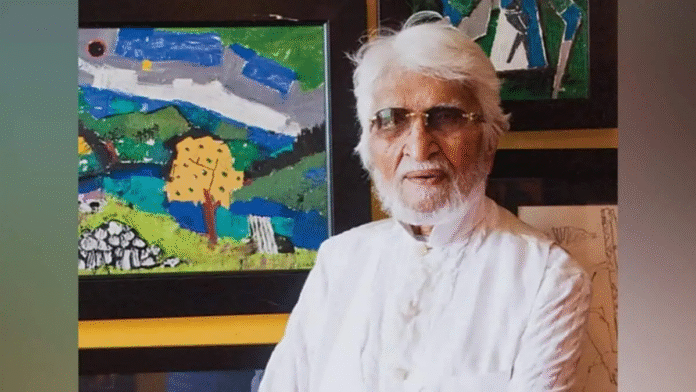
MF Husain (Photo: Instagram/@artindiamagazine)


The world’s first museum dedicated to legendary Indian painter Maqbool Fida Husain will open in Doha, Qatar, on November 28, the Qatar Foundation announced on Wednesday. Titled “Lawh Wa Qalam: M F Husain Museum”, the institution will trace Husain’s artistic journey from the 1950s until his death in 2011.

World’s First Museum Dedicated to MF Husain to Open in Qatar

Among the highlights will be “Seeroo fi al ardh”, Husain’s final masterpiece presented as a unique 20-minute installation show. The museum will showcase a permanent collection of his works, including paintings, films, tapestries, photography, poetry, and installations, presented through multimedia storytelling.

“Maqbool Fida Husain was one of the world’s most legendary modernists, an artist whose vision resonated across cultures, including here in Qatar, where he lived and worked during his life,” said Kholoud M Al-Ali, Executive Director of Community Engagement and Programming, Qatar Foundation.

The galleries will also display a series of paintings commissioned by Sheikha Moza bint Nasser, Chairperson of Qatar Foundation, inspired by Arab civilisation. Husain completed more than 35 of these works before his passing in 2011.

Covering over 3,000 square meters, the museum’s design mirrors a sketch made by Husain himself, reflecting his vision of the building as an artwork in its own right. The architecture embodies his lifelong pursuit of experimentation across disciplines.

“It is an honor to present his work within a dedicated museum of this scale — a space where audiences can engage deeply with his life, his art, and his enduring global legacy. Conceived as a space for inspiration and creativity, the Lawh Wa Qalam: M F Husain Museum reflects Qatar Foundation’s commitment to fostering art and culture,” Al-Ali said.

Husain, celebrated as India’s most prominent modernist painter, spent his later years in Qatar and London. In 2010, he was granted honorary nationality by Qatar, where he lived until his death in 2011.

Who Was Pandit Chhannulal Mishra, Padma Vibhushan Awardee and Eminent Classical Vocalist Passes Away at 89

0

Renowned Hindustani classical vocalist and Padma Vibhushan awardee Pandit Chhannulal Mishra passed away early Thursday morning at the age of 89. He breathed his last at 4:15 a.m. at the residence of his daughter, Namrata Mishra, in Mirzapur. His last rites will be performed today at Manikarnika Ghat in Kashi.

A Legend in Classical Music

Pandit Chhannulal Mishra was one of the foremost exponents of Hindustani classical music, celebrated for his mastery in Khayal, Thumri, Dadra, Bhajan, Kajri, and Chaiti. His iconic song, “Khele Masane Mein Holi…”, remains a favorite among classical music enthusiasts.

Born on August 3, 1936, in Hariharpur, Azamgarh, Uttar Pradesh, music was in his blood. His grandfather, Gudai Maharaj Shanta Prasad, was a noted tabla player. Chhannulal began learning music from his father Badri Prasad Mishra at the age of six and later trained under Ustad Abdul Ghani Khan of the Kirana Gharana and Thakur Jaidev Singh.

He studied classical music in Muzaffarpur, Bihar, before settling in Varanasi nearly four decades ago, where he became a revered name in Indian classical circles, both nationally and internationally.

A Personal Life Marked by Tragedy

Pandit Mishra is survived by four daughters and a son. His wife Manorama Mishra and elder daughter Sangeeta Mishra tragically passed away within four days of each other during the COVID-19 pandemic in April 2021.

He had been ailing for the past seven months and was recently hospitalized. Diagnosed with Acute Respiratory Distress Syndrome (ARDS) and suffering from diabetes, hypertension, osteoarthritis, and an enlarged prostate, he was discharged from BHU’s Sir Sundarlal Hospital on September 27 and had returned to his daughter’s home.

Honored by the Nation

Pandit Chhannulal Mishra was the recipient of some of India’s highest civilian honors:

  • Sangeet Natak Akademi Award (2000)
  • Padma Bhushan (2010)
  • Padma Vibhushan (2021)

He was a proposer for Prime Minister Narendra Modi during the 2014 Lok Sabha elections in Varanasi. It is said that he was initially reluctant, but was later persuaded by Amit Shah. Upon agreeing, he reportedly told Modi:

“Take care of the Ganga and music in my Kashi.”

Tributes Pour In

Prime Minister Narendra Modi

“I am deeply saddened by the passing of Pandit Chhannulal Mishra. He dedicated his life to Indian art and culture and brought classical music to the masses. It was my privilege to receive his blessings. Om Shanti.”

Uttar Pradesh Chief Minister Yogi Adityanath

“Pandit Chhannulal Mishra devoted his entire life to Indian classical music. He was an inspiration for generations of singers.”

Legacy

Pandit Chhannulal Mishra wasn’t just a classical singer — he was a cultural ambassador, a guru, and a custodian of Indian musical traditions. His contribution to preserving and popularizing Hindustani music has left an indelible mark on India’s cultural heritage.

Mahatma Gandhi’s Diet Schedule: Uncooked Food, Fresh Fruits, Milk, Yoghurt…

0

Born on October 2, 1869, in Porbandar, Gujarat, Mahatma Gandhi — the Father of the Nation — is globally admired not only for his philosophy of non-violence but also for his simple and disciplined lifestyle. Gandhiji was highly conscious of his health and well-being. A lifelong vegetarian, he followed a carefully balanced diet grounded in nature, ethics, and self-restraint.

In his 1949 book “Diet and Diet Reform,” Gandhiji emphasized that food is not merely a source of nutrition, but a vital part of one’s spiritual and physical discipline. He advocated for raw and natural foods, minimal cooking, and mindful eating. His diet primarily consisted of uncooked foods, fresh fruits, dried fruits, green vegetables, milk, and yogurt — all consumed in moderation.

In today’s fast-paced world, where fast food and processed snacks dominate, Gandhiji’s diet offers a timeless model for clean, conscious living. Following his dietary principles can aid in weight management, improved digestion, and stronger immunity, while lowering the risks of obesity, diabetes, and heart disease.

On the occasion of Gandhi Jayanti, let’s take a closer look at:

  • What Gandhiji ate on a daily basis
  • How his diet can benefit us today
  • Key considerations before adopting his approach

What Was Gandhiji’s Diet Plan?

A: Gandhiji followed a minimalist and plant-based diet. He believed that eating meat involved violence, and he practiced strict vegetarianism throughout his life. His daily schedule was highly disciplined — he would wake up at 4 a.m. and walk approximately 5 kilometers every morning.

His typical diet included:

  • Fruits: Bananas, apples, oranges
  • Dried fruits: Almonds, walnuts
  • Vegetables: Carrots, spinach, bottle gourd, pumpkin
  • Dairy: Milk or yogurt
  • Grains: Wheat, millet, and rice
  • Sweeteners: Jaggery or honey instead of refined sugar

He practiced weekly fasting, during which he would consume only fruits or a liquid diet. Gandhiji believed that fasting helped detoxify the body and bring mental clarity. Other principles he followed:

  • Eat slightly less than your appetite
  • Chew thoroughly and eat mindfully
  • Have dinner before sunset

Q: What Are the Benefits of Following Gandhiji’s Diet?

A: Gandhiji’s diet promotes simplicity, moderation, and natural nutrition, offering several science-backed health benefits:

  1. Detoxification: A clean, natural diet helps flush out toxins.
  2. Weight Loss: Calorie intake is naturally limited due to unprocessed foods.
  3. Immunity Boost: Fruits and vegetables are rich in vitamins A and C, which enhance immune function.
  4. Better Digestion: Whole, plant-based foods improve gut health.
  5. Cellular Cleansing: Fasting triggers autophagy, a process where the body removes damaged cells — reducing risks of cancer and diabetes.
  6. Mental Clarity: Eating light and natural keeps the mind sharp and focused.

Q: What Should You Keep in Mind Before Adopting Gandhiji’s Diet?

A: Gandhiji’s diet was aligned with circadian rhythms — the natural cycles of the body and environment. While it offers multiple benefits, it may not be suitable for everyone, especially those with existing conditions like diabetes or thyroid disorders. Here’s how to start safely:

  • Consult your doctor before making significant changes, especially if you have a medical condition.
  • Begin gradually: Start by increasing the quantity of fruits in one meal.
  • Slowly incorporate vegetables, whole grains, dairy, and dried fruits.
  • Replace sugar with jaggery or honey.
  • Try a 12–16-hour fast (e.g., stop eating after 7 p.m.) and observe how your body responds.

Final Thoughts

Mahatma Gandhi believed that self-restraint and mindful living are essential for personal and societal well-being. His diet was not just about food—it was about discipline, ethics, and harmony with nature. In an age of overconsumption, following Bapu’s principles can offer a healthier, more sustainable way of life.

Elon Musk: Meet First Person In World Whose Net Worth Is $500 Billion

0

Elon Musk achieved a net worth of $500 billion on October 1, 2025, according to Forbes’ Real-Time Billionaires List. He Surpassed Larry Ellison by $150 billion. The milestone resulted from a 3.3% rise in Tesla shares to $459.46, valuing his 13% stake at $191 billion, alongside contributions from his 42% ownership in SpaceX at $147 billion and xAI at $50 billion.

Musk’s wealth has increased by $245 billion since January 2025, driven by investor optimism in Tesla’s AI autonomy and robotics advancements. Know 10 points about this man who is redefining businesses across:

Accomplishments of Elon Musk

1. Co-Founding and Selling Zip2

In 1996, Elon Musk co-founded Zip2, an online business directory and mapping service launched during the early days of the internet. The company provided licensed city guides to newspapers, helping them integrate digital maps and business listings on their websites.

Zip2 brought digital convenience to traditional print media, which had yet to fully embrace the web. In 1999, Compaq acquired Zip2 for $307 million, marking Musk’s first major business success. He personally earned $22 million from the deal, giving him both the capital and credibility to pursue even more ambitious ventures.

2. Founding X.com (Later PayPal)

After selling Zip2, Musk founded X.com in 1999, a pioneering online payment platform aiming to disrupt traditional banking with secure digital transactions. Despite internal conflicts, X.com gained rapid popularity for its ease of use.

X.com later merged with Confinity, a rival company with its own payment service called PayPal. The merged entity adopted the PayPal brand and soon became the leader in online payments. In 2002, eBay acquired PayPal for $1.5 billion, with Musk receiving $180 million from the sale. This exit further shaped the digital finance landscape and established Musk as a major tech innovator.

3. Founding SpaceX

In 2002, Musk founded SpaceX (Space Exploration Technologies Corp.) with a vision to reduce the cost of space travel and ultimately establish a human settlement on Mars. Initially met with skepticism, the company faced repeated technical and financial setbacks.

Despite early failures, SpaceX achieved historic milestones:

  • In 2012, Dragon became the first private spacecraft to dock with the International Space Station (ISS).
  • In 2020, Crew Dragon became the first privately built spacecraft to carry astronauts to the ISS.

SpaceX continues to innovate with Starship, a fully reusable rocket designed for interplanetary travel and large-scale payload delivery.

4. Transforming Tesla into a Global EV Leader

Musk joined Tesla Motors in 2004 as an early investor and chairman, eventually becoming CEO in 2008. Tesla’s mission is to accelerate the world’s transition to sustainable energy through electric vehicles (EVs).

Under Musk’s leadership, Tesla introduced several groundbreaking EV models:

  • Roadster (2008): A high-performance electric sports car.
  • Model S (2012): A luxury sedan that redefined what EVs could do.
  • Model 3 (2017): An affordable, mass-market EV.

Despite production challenges and financial hurdles, Tesla emerged as the world’s most valuable carmaker, becoming a symbol of the global clean energy movement.

5. Launching Tesla Energy Products

In 2015, Musk expanded Tesla’s mission with Tesla Energy, launching products like:

  • Powerwall: A home battery system that stores solar energy for use during outages or at night.
  • Powerpack & Megapack: Scalable battery storage solutions for commercial and utility use.

These innovations aim to enable a full transition to renewable energy by integrating solar power with efficient storage solutions. Tesla Energy has helped position the company as a major player in the global shift toward sustainable energy infrastructure.

6. Founding The Boring Company

In 2016, Musk founded The Boring Company to tackle urban traffic congestion through underground tunnel systems. Frustrated by slow commutes, Musk proposed an innovative solution using cost-effective tunneling technologies.

The company’s first operational project, the Las Vegas Loop, transports passengers in Tesla vehicles through underground tunnels beneath the Las Vegas Convention Center. While other proposed tunnels are still in planning stages, the concept holds promise for revolutionizing urban transportation.

7. Founding Neuralink

Also in 2016, Musk co-founded Neuralink, a neurotechnology company developing brain-computer interface (BCI) devices.

Neuralink’s goals include:

  • Treating neurological disorders like paralysis and epilepsy.
  • Enabling direct communication between humans and machines.
  • Enhancing cognitive abilities, potentially merging humans with AI.

The company has shown promising results in animal trials and is working toward human testing. Neuralink’s work has sparked both excitement and ethical debate about the future of human-computer integration.


8. Developing the Hyperloop Concept

In 2013, Musk introduced the concept of the Hyperloop — a high-speed transportation system where pods travel through low-pressure tubes at speeds over 700 mph.

Instead of building it himself, Musk published an open-source white paper encouraging others to develop the technology. Several companies have since taken on the challenge. If realized, the Hyperloop could dramatically cut travel times and provide a sustainable alternative to air and rail travel.

9. Open-Sourcing Tesla Patents

In a bold move in 2014, Musk announced that Tesla would open-source its electric vehicle patents, allowing other companies to use them in good faith without fear of lawsuits.

Musk argued that accelerating the adoption of sustainable transport was more important than maintaining a competitive edge. This move fostered collaboration and innovation within the automotive industry and underscored Musk’s commitment to combating climate change on a global scale.

10. Acquisition and Transformation of Twitter (Now X)

In 2022, Musk acquired Twitter for $44 billion, motivated by concerns over free speech and content moderation. After taking ownership, he introduced major changes, including:

  • Rebranding Twitter to “X”
  • Implementing a subscription model
  • Expanding monetization for creators
  • Allowing long-form content

Musk’s long-term vision is to turn X into an “everything app” — integrating social media, messaging, payments, and more into a unified platform. While the changes have sparked controversy, they reflect Musk’s drive to rethink and disrupt established digital platforms.

Final Thoughts

Elon Musk’s accomplishments span multiple industries — from space and transportation to finance and neuroscience. His willingness to challenge conventions, take risks, and envision a radically different future has made him one of the most influential entrepreneurs of the 21st century.


UPI Transaction Stays Free As of Now…! See What RBI Governor Says…

0

RBI Transactions Remain Free — But For How Long?

Imagine this: you’re standing at a roadside tea stall, sipping your evening chai, and as you reach into your pocket—no cash. No worries, right? You just scan the QR code, and boom—payment done in a second. That’s UPI magic for you. It’s so seamless now, you probably haven’t carried physical money in months. Not just you—rickshaw pullers, fruit vendors, and even the guy selling momos down the lane, everyone has a scanner.

But here’s the twist in the tale: while we’ve been enjoying this convenience for free, the question that’s quietly looming in the background is—for how long?

So far, there’s no official proposal in front of the Reserve Bank of India (RBI) to charge users for UPI transactions. Which means, yes, UPI remains free… for now.

But here’s what RBI Governor Shaktikanta Das recently reminded us:

“I never said UPI can stay free forever. What I said was, there are costs—someone has to pay them.”

He didn’t say users will be charged, but he definitely hinted that the free ride might not last forever. His point? It’s not about who pays, but that someone must, for the model to be sustainable.

Let’s be honest—UPI has changed the game. It’s fast, easy, and cheap. In fact, in August 2025 alone, over 20 million UPI transactions were processed—a whopping 34% increase year-on-year! That’s not growth. That’s a revolution.

And it all began accelerating post-COVID, when everything from office work to classrooms moved online. That shift nudged even the most cash-loving folks toward digital payments. Today, we don’t even think twice before scanning a QR code—for anything from a ₹5 toffee to a ₹5,000 shopping spree.

But what makes all this possible? Subsidies. Yes, the government has been covering the cost of UPI transactions to keep it free for end users like us. Because let’s face it—start charging even ₹1 per transaction, and the impact could ripple through every corner of society. Many people rely on UPI exclusively, and even small charges could be a big deal.

Of course, if charges do come into play, there’s a silver lining for the “delayers”—you know, those friends who never pay you back on time. “UPI not working,” “Network issues,” “Next week pakka”—we might hear those excuses even more often.

But till then, let’s not overthink it.

Just enjoy the perks while they last.
Maybe treat yourself to a nice dessert—paid online, of course.
Because for now, UPI is still sweet and still free.

Ayudh Pooja: Know What It Is and What Is Its Modern Day Relevance of Ayudha Poojadh pooja

0

Ayudha Pooja is an integral part of the Navratri festival, especially celebrated with great enthusiasm in the southern states of Karnataka, Tamil Nadu, and Andhra Pradesh. Traditionally, this day marks the victory of good over evil—when Maa Durga defeated the demon Mahishasura after a fierce nine-day battle.

Ayudh Pooja: Know What It Is and What Is Its Modern Day Relevance of Ayudha Poojadh pooja

Beyond its mythological roots, Ayudha Pooja holds deep spiritual and philosophical significance. It teaches us to express gratitude and reverence toward the tools, instruments, and technologies that aid us in our daily lives—whether at work, in learning, or in creative expression.

Why is Ayudha Pooja still relevant today?

In today’s fast-paced, technology-driven world, we often take the tools and resources we use for granted. From computers and software to machines and mobile devices, we rely on them more than ever—but rarely pause to acknowledge their value.

Think back to your childhood—those times when resources were limited. Maybe your father refused to buy a new school bag because the old one still worked, or your mother didn’t give in to that one Barbie set you cried for. You may have felt upset then, but those small life lessons taught us to value what we have and use it wisely until it no longer serves its purpose.

Contrast that with today, where consumerism often leads us to constantly chase the newest upgrade. For example, someone might buy a new car, barely use it, and already start planning the next upgrade—forgetting the value of the previous one altogether. The moment a want is fulfilled, we move on, and the object often loses its significance.

Ayudha Pooja reminds us to pause and reflect—to respect and appreciate the tools that make our lives easier. This respect goes beyond material possessions—it extends to our intellect, skills, and the people who support us.

So this Navratri, whether or not you traditionally celebrate Ayudha Pooja, take a moment—just for yourself—to be grateful. Grateful for the resources you have, the tools you use, and the people who stand by you. Gratitude is timeless, and Ayudha Pooja is a beautiful reminder of that.

Yashasvi Jaiswal in TIME’s 100 Rising Stars List: The Only Cricketer to Feature

0

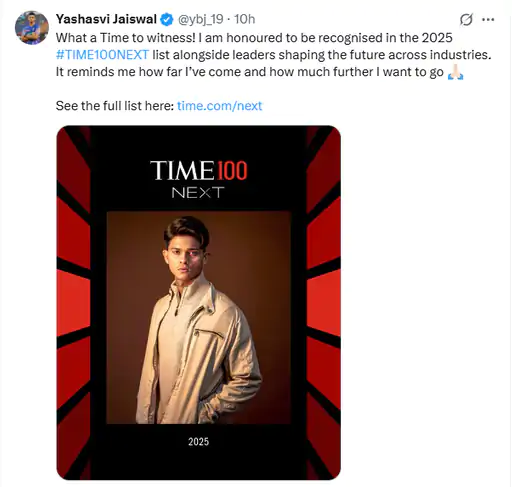
Indian opener Yashasvi Jaiswal has been named in TIME magazine’s prestigious ‘2025 TIME100 Next’ list, which recognizes 100 rising stars shaping the future across various fields globally. At just 23, Jaiswal is the only cricketer to feature in this year’s list.

Currently in Ahmedabad for the upcoming India vs West Indies Test series, Jaiswal expressed his pride and gratitude in a post on social media platform X (formerly Twitter).

“What a wonderful time! I’ve been included in the 2025 TIME100 Next list alongside leaders shaping the future. I’m proud of this. It reminds me of how far I’ve come—and how much further I want to go,” he wrote.

Jaiswal is part of India’s squad for the two-match Test series against the West Indies starting October 2. On Wednesday, he participated in Team India’s practice session at the Narendra Modi Stadium, where the first Test will be held.

Only Five Athletes Worldwide Featured

Out of the 100 names in this year’s TIME list, only five athletes were selected, highlighting Jaiswal’s inclusion as a major milestone. The other four sportspersons featured are:

  • Lamine Yamal (Spanish footballer)
  • Paige Bueckers (American basketball player)
  • Taylor Fritz (American tennis star)
  • Atthaya “Jino” Thitikul (Thai professional golfer)

Indian Athletes in TIME100 Next: A Brief History

Launched in 2019, the TIME100 Next list has previously featured Indian sprinter Dutee Chand, who became the first Indian to make the list. In the same year, Ben Stokes became the first cricketer ever included. In 2022, Indian women’s cricket captain Harmanpreet Kaur was also honored.

Hurun Rich List 2025: Mukesh Ambani Reclaims Top Spot, Shah Rukh Khan Joins Billionaire Club

0

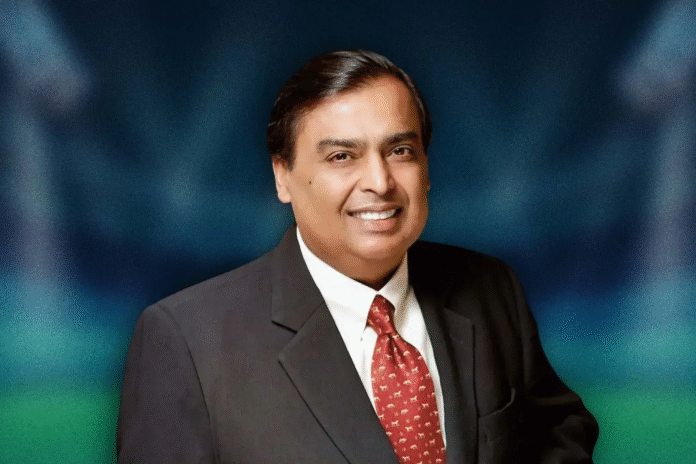
Mukesh Ambani has once again topped the M3M Hurun India Rich List 2025 with a staggering wealth of ₹9.55 lakh crore, regaining his position as India’s richest individual. He is followed by Gautam Adani, whose wealth stands at ₹8.14 lakh crore.

This year, India saw 358 billionaires, up by 24 from last year. The list features 1,687 individuals with wealth above ₹1,000 crore, spread across 91 cities. Notably, 284 new entrants joined the list, while 139 dropped off.

Among the biggest highlights is Bollywood superstar Shah Rukh Khan, who has officially entered the billionaire club with a net worth of ₹12,490 crore. This makes him the richest actor in the world, surpassing international celebrities such as Taylor Swift, Jerry Seinfeld, and Arnold Schwarzenegger.

Another standout is Chennai-born Aravind Srinivas (31), founder of AI-focused company Perplexity, who debuted with ₹21,190 crore, becoming the youngest billionaire on the list.

Roshni Nadar of the HCL Group remains the youngest person in the Top 10. Meanwhile, the Bajaj family’s wealth jumped by 43% to ₹2.33 lakh crore, moving them up four spots to sixth position.

According to Hurun, the Top 10 richest individuals now hold 27% of the list’s total wealth, with the base of wealthy individuals expanding rapidly. In the last five years, the number of people with wealth above ₹1,000 crore has more than doubled, and the list now spans 91 cities compared to just 10 at its inception.

The combined wealth of all individuals on the list is ₹167 lakh crore—nearly half of India’s GDP. The report also highlights the growing global footprint of Indian billionaires, with names emerging from Silicon Valley, London, Dubai, and the Gulf.

Mumbai leads with the most entries (451), followed by Bengaluru (116), Hyderabad (102), Chennai (94), and Pune (66). Sector-wise, pharmaceuticals top the list, followed by industrial products, chemicals, software, and a fast-growing biotech segment.

US Government Shuts Down Again; Know When It was Shut Down Last Time…

0

Do you know US Government shuts down yet again, but when was the last time it happened? Here we bring in special researched piece which speaks volumes on when was the last time when the US Government had shut down:

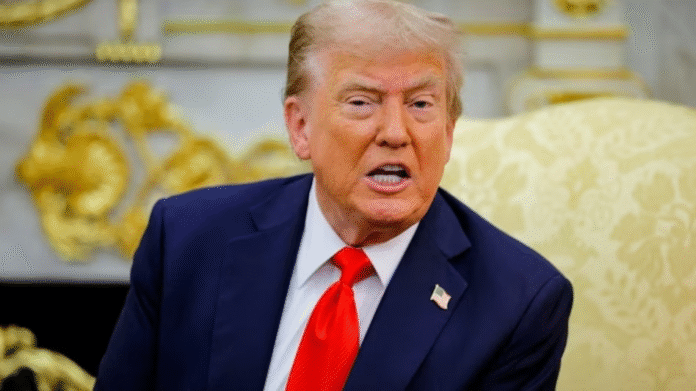
The US government has gone into shutdown mode yet again, as the lawmakers failed to agree on a new funding bill before the deadline. While essential services like public security, national security, and healthcare keeps going. Thousands of federal employees are now forced to see unpaid days or furloughs until Congress sort things out.


This time the fight is over budget cuts and subsidies. Democrats want to secure permanent funding while Republicans are pushing back. The deadlock has brought the world’s biggest economy to another halt. But when was the last time it happened? The most recent and the longest shutdown in the history of United States was from 22nd December, 2018 to 25th January, 2019, lasting 35 days.

Back then the issue was Trump’s demand for billions to build a wall on the US- Mexico border, this let down nearly 8 lakh federal workers unpaid and cost the economy in billions. Not mentioning the unimaginable chaos it caused to services like national parks, tax refunds and small business loans.
Today’s shutdown might have a different trigger but the history has repeat itself with the same leader creating the same drama yet again.

    International Coffee Day: A Cup Which Holds More Than Just Caffeine…

    0


    Let’s admit it, everyone has a different coffee personality

    Espresso for the workaholic

    Latte for the soft dreamer

    Cappuccino for the balanced soul

    Black coffee for the gym bra

    Mocha for the playful one

    Cold brew for the edgy, modern guy

    But beyond these preferences, coffee carries moments that become memories.

    Remember
    * That first coffee sip on a Monday morning when you literally try to survive the weekend party flashbacks.
    * That strong coffee shot one night before the exam when you are about to go through the syllabus for the first time, yes coffee helps.
    *That late night coffee dates with your friends, roasting each other on every sentence as well as on their taste in coffee and maybe ranting about your life all at once.
    *That barista duty at home when you are the little Raju in the house taking orders from “Chai na peene wale fufaji ka beta ordering: kum meethe ki banana”


    Those endless 3-4 coffees from the office coffee machine actually becomes your Chavanpraash at work.


    But most of all, coffee with parents and siblings at home feels different, that little joy and that little gossips from rounds the corners, hit differently


    Above all, the first coffee date with someone special which eventually decides if there’s a next date or never-again phase.
    Maybe that’s why coffee shops today are becoming third space after home and office – a place to connect, pause and simply be.
    Because in the end coffee is more than just caffeine, a comfort in a cup, a beautiful escape from the outside chaos, memories brewed and sometimes the beginning of a new chapter that starts with just four words “Lets grab a coffee.”