Roop Chaudas also known as Choti Diwali and Naraka Chaturdashi is celebrated with devotion and joy across India in diverse styles. Mythologically, it marks the day when Lord Krishna, along with Goddess Satyabhama and Goddess Kali, defeated the demon Narakasura, symbolizing the triumph of good over evil.
Observed a day before Diwali, Choti Diwali is the second day of the five-day festival and holds deep cultural and spiritual significance. Like all Indian festivities, it’s also a time to share love and blessings with family and friends.
If you’re looking for warm and heartfelt messages to wish your loved ones, here’s a beautiful collection of Chhoti Diwali wishes, messages, and quotes to make their day brighter!
Happy Roop Chaudas Chhoti Diwali Wishes and Messages for Family and Friends
Send these warm greetings to light up hearts this festive season:
It’s time for delicious mithai, bright lights, and warm wishes. Happy Roop Chaudas!
May the divine light illuminate your life. Happy Chhoti Diwali!
Wishing prosperity and happiness to you and your family on this special occasion.
May your Choti Diwali be filled with love, laughter, and light.
Choti Diwali reminds us of the victory of good over evil. Celebrate it with joy!
May the diyas brighten your life and dispel all darkness.
Wishing you a sparkling Chhoti Diwali filled with enthusiasm and cheer.
May Lord Krishna’s blessings guide your path always. Happy Naraka Chaturdashi!
May this Choti Diwali fill your life with peace, progress, and prosperity.
Beautiful Chhoti Diwali Wishes to Share
The day to enjoy lights and laughter is here! Happy Chhoti Diwali!
May your life shine like silver, shimmer like gold, and sparkle like a diamond!
Let the cheer and joy of Choti Diwali stay with you forever.
May this festive season bring happiness, good health, and success your way.
Wishing you and your loved ones a celebration filled with joy and harmony.
Heartfelt Messages for Naraka Chaturdashi
May this Choti Diwali bring joy, health, and wealth into your life.
Let the diyas you light be the lamps of contentment and peace.
May God bless you with prosperity and end all your worries.
May the light of Choti Diwali bring hope, unity, and inner peace to all.
Happy Choti Diwali Quotes
“May the light of Choti Diwali bring you joy, prosperity, and a bright future.”
“On this Choti Diwali, celebrate the triumph of good over evil and embrace new beginnings.”
“Wishing you a sparkling Choti Diwali filled with moments of love, laughter, and endless blessings.”
“As the lights shine bright, may your life be illuminated with hope, happiness, and peace.”
“May your worries burn away, leaving behind happiness and light. Happy Choti Diwali!”
“Let this Choti Diwali mark the start of new dreams and brighter days ahead.”
Make This Naraka Chaturdashi Special
Share these heartfelt Choti Diwali greetings and remind your loved ones how much they mean to you. Celebrate the festival of lights, love, and positivity — and let this Choti Diwali bring new energy, joy, and togetherness to your life.
In a proud moment for India’s defence community, the Indian Air Force (IAF) has achieved a remarkable milestone surpassing China to become the third most powerful air force in the world.
According to the latest report by the World Directory of Modern Military Aircraft (WDMMA), the IAF now holds a TruVal rating of 69.4, edging past China’s 63.8. Only the United States and Russia currently stand ahead, solidifying India’s position among the global elite of air power. This leap reflects India’s rapid strides in modernizing its air fleet, expanding its operational capabilities, and strengthening its strategic reach.
Over the years, the IAF has introduced cutting-edge technologies and advanced aircraft like the Rafale and Tejas fighters, along with powerful surveillance and missile systems a testament to India’s growing self-reliance in defence.
Experts say this advancement isn’t just about rankings; it’s a shift in global air power balance. In the Indo-Pacific region, where geopolitical tensions continue to shape security strategies, India’s stronger air force now plays a vital role in maintaining regional stability.
The IAF’s rise also symbolizes India’s determination to invest in innovation, indigenous production, and joint operations that align with its “Make in India” defence vision.
From dominating the skies during humanitarian missions to executing complex combat operations, the Indian Air Force continues to embody courage, discipline, and precision.
As the tricolour soars higher, this achievement isn’t merely about numbers it’s about resilience, modernization, and national pride. The IAF’s ascent marks a new era where India doesn’t just defend its skies it commands them.
Imagine living not just longer, but healthier — where growing older doesn’t mean slowing down. Scientists in Japan may have just taken the first big step toward making that a reality.
Researchers at Osaka University have uncovered a discovery that could reshape our understanding of aging. Their focus: a tiny protein called AP2A1 and a compound known as IU1 — both playing surprising roles inside our cells.
Researchers from Osaka University have discovered that the protein subunit AP2A1 may play a role in the unique structural organization of senescent cells.
There are countless products on the market that claim to restore a youthful appearance by reducing wrinkles or tightening the jawline. But what if aging could be reversed at the cellular level? Researchers in Japan may have uncovered a way to do just that.
A recent study published in Cellular Signaling by scientists at Osaka University identifies a key protein that regulates the transition between “young” and “old” cell states.
As the body ages, senescent cells—older, less active cells—accumulate in various organs. These cells are significantly larger than younger ones and display structural changes, including altered organization of stress fibers, which are essential for movement and interaction with their environment.
AP2A1, a key player in the cell’s transport system, helps regulate what enters and exits the cell. But as we age, its function shifts, disrupting the cell’s inner structure. When scientists reduced AP2A1 levels in aging cells, those cells began to behave more like younger, healthier ones — hinting that certain aspects of aging might be reversible.
The team also examined IU1, a compound that boosts the cell’s natural cleaning mechanisms — proteasomes and autophagy, which remove damaged or toxic waste. By enhancing these processes, IU1 helped cells clear out harmful proteins more efficiently, potentially reducing muscle weakness and slowing cellular decline.
Though the research is still in its early stages, these findings could open the door to new therapies that delay or even reverse age-related damage — improving not just lifespan, but healthspan, the number of years we stay active and disease-free.
Experts believe that with further testing, this could lead to treatments that help people not only live longer but live better.
Imagine a future where diseases like Alzheimer’s or heart failure can be delayed — where our cells stay youthful for decades longer. Immortality may still be a fantasy, but science is getting closer to making aging something to manage, not fear.
Perhaps one day, birthdays will measure experience, not decline.
According to US investment bank Morgan Stanley, Indian households now hold a staggering $3.8 trillion worth of gold — equivalent to 88.8% of the country’s GDP.
“This implies a positive wealth effect on the household balance sheet, given the uptrend in gold prices,” economists Upasana Chachra and Bani Gambhir wrote in a recent note. They added that families are also benefiting from “lower interest payments amid monetary policy easing and increased disposable income due to tax cuts.”
That’s quite the golden start to India’s festive season — even as record prices have taken some sheen off the precious metal.
Gold Rush in Festive Time
In Delhi’s bustling Lajpat Nagar, jewellery markets are overflowing with shoppers ahead of Diwali. Shops have stayed open late into the night, with flower-adorned entrances and glowing signboards luring customers in.
Gold prices — now above $1,440 (₹1.32 lakh) per 10g — have surged nearly 60% this year, while silver has climbed 70%. Yet, Indians are still crowding jewellery stores, especially for Dhanteras and Diwali, considered highly auspicious for buying gold and silver.
“People fear missing out — prices could rise even further,” said jewellers “As a result, I have more customers this year.”
Still, with budgets under strain, jewellers are adapting. “People aren’t saying they won’t buy — just that they’ll buy less,” they say. To keep sales alive, many are offering lightweight jewellery and micro gold coins as small as 25mg, selling for about $35 (₹3,000).
Investment Over Ornamentation
A clear trend has emerged — buyers are increasingly viewing gold as an investment rather than adornment.
According to the World Gold Council (WGC), jewellery’s share of total gold demand in India dropped from 80% in 2023 to 64% in Q2 2025, while investment demand — mostly in bars, coins, and ETFs — jumped from 19% to 35%.
“ETF assets under management have risen over 70% this year,” said Kavita Chacko, head of research at WGC, noting that digital gold and bullion investments are surging too.
RBI’s Golden Strategy
It’s not just retail investors driving demand. The Reserve Bank of India (RBI) has been a key player, raising gold’s share in its foreign exchange reserves from 9% to 14% in 2025.
“The RBI has been a major pillar of global gold demand over the past three years,” said bankers explaining that the central bank is diversifying its reserves to reduce dependence on the dollar and hedge against geopolitical uncertainty.
Outlook: Demand Shines Through
Despite record prices, analysts expect gold demand to stay resilient through the festive and wedding season.
“The affluent classes will continue to buy, though it’s a setback for lower-income families,” said economists. “Demand will hold up in value terms, even though volumes may fall.”
Still, for many, the soaring prices are a deterrent. Lovelina, a bride-to-be shopping in Lajpat Nagar, said, “I’m having to think twice before buying. I might wait for prices to dip before completing my wedding purchases.”
For now, India’s love affair with gold remains unbroken — even if the shine comes at a higher price this Diwali.
Before Diwali, people across India celebrate Choti Diwali, also known as Naraka Chaturdashi, which marks the second day of the five-day Diwali festival, following Dhanteras. The day symbolizes the victory of good over evil and is celebrated with devotion, light, and joy.
The Legend Behind Chhoti Diwali
According to Hindu mythology, the day commemorates Lord Krishna’s victory over the demon king Narakasura, who ruled Pragjyotishpur (present-day Assam region, south of Nepal).
Narakasura had defeated several deities, imprisoned 16,000 daughters of gods and kings, and even stolen the earrings of Aditi, the mother of all gods. On the day before Naraka Chaturdashi, Lord Krishna defeated Narakasura, freed the captives, and restored Aditi’s earrings.
When Krishna returned home after his victory, people celebrated his triumph with lights and joy — and thus, Choti Diwali was born.
Rituals and Traditions of Chhoti Diwali
On Naraka Chaturdashi, devotees worship Lord Krishna, Lord Hanuman, Yamraj, and Goddess Kali to cleanse their souls of sins and negativity. Traditional puja samagri includes oil, flowers, sandalwood, and coconuts, along with prasada made of sesame, poha, ghee, and sugar.
The day is known by different names across regions —
Kali Chaudas, Bhoot Chaudas, or Roop Chaudas in some states
Abhyang Snan in Maharashtra, where people take a ritual oil bath early in the morning
In some regions, Choti Diwali and the main Diwali are celebrated on the same day.
Common Rituals Observed on Chhoti Diwali
Taking an oil bath during Brahma Muhurat (early morning hours)
Wearing new clothes
Decorating homes with flowers and lights
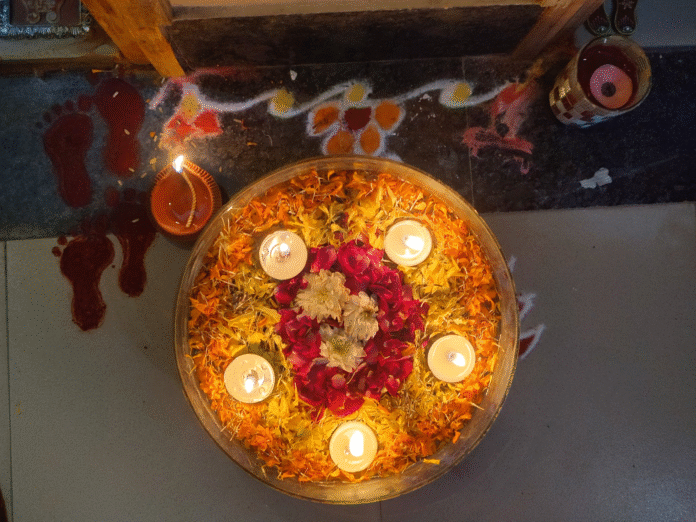
Making colorful rangolis at the entrance
Lighting diyas (earthen lamps) to welcome positivity and prosperity
Top 10 Wishes, Messages, and Quotes to Share
May this Choti Diwali light diyas and add colors of happiness to your life. Happy Chhoti Diwali!
May the Almighty bless you with good health, wealth, and happiness. Happy Naraka Chaturdashi!
May sparkling diyas bring joy, peace, and prosperity to your family. Happy Chhoti Diwali!
Let the light of diyas fill your life with endless joy and positivity.
May good triumph over evil, love over hate, and joy over despair — today and always.
May Lord Rama bless you with virtues and success. Happy Chhoti Diwali 2023!
May the diyas’ glow bring wealth, happiness, and success to your home.
This Diwali, let us burst the ego, anger, envy, and negativity within us. Happy Chhoti Diwali!
Sending you warm wishes and bright lights on this Choti Diwali.
May this Diwali bring prosperity to your business and more opportunities to grow together.
The festival of lights begins today with Dhanteras, marking the start of the five-day Diwali celebrations. Shopping will continue throughout the day, with six auspicious muhurats (times) for purchasing gold, silver, utensils, and other festive essentials.
In the evening, devotees will worship Lord Dhanvantari, the divine physician and god of Ayurveda, along with Kubera (the god of wealth) and Goddess Lakshmi. Afterwards, a lamp (Yam Deepak) will be lit outside the house in the southern direction to honor Yamraj, the god of death. According to the Skanda Purana, lighting this lamp is believed to protect one from premature death.
Health Is the True Wealth — The Worship of Dhanvantari
Though Dhanteras is popularly associated with wealth and prosperity, its deeper meaning celebrates health as the greatest form of wealth. According to the Vishnu Purana, a healthy body is considered the truest form of prosperity, for material riches hold little joy without good health.
Lord Dhanvantari, regarded as the god of Ayurveda, emerged from the churning of the ocean (Samudra Manthan) on the day of Trayodashi—carrying a pot of nectar (amrit) and divine medicines. Hence, he is worshipped on Dhanteras for health, healing, and longevity.
In the Puranas, Dhanvantari is also revered as an incarnation of Lord Vishnu, who bestowed the knowledge of Ayurveda and the nectar of immortality upon the world.
Why Buying Gold and Utensils Became a Tradition
Gold holds a sacred place in Indian culture and spirituality. The Hiranyagarbha Sukta of the Rigveda mentions that creation began from the womb of Hiranyagarbha, meaning “golden womb.” Gold, therefore, is seen as a symbol of the Sun, the source of energy and life in the universe.
A popular legend also connects gold with protection from death. It is said that when a prince named Hem was fated to die four days after his marriage, his devoted wife created a wall of gold ornaments and lamps to block Yamraj’s path. Moved by her devotion, Yama spared the prince’s life. Since then, buying gold on Dhanteras is considered auspicious and protective.
Dhanteras in Jain Tradition
In Jainism, Dhanteras is observed as Dhanya Teras or Dhyan Teras. On this day, Lord Mahavira began deep meditation (sadhana) leading to his attainment of nirvana on Diwali. Hence, the day is celebrated as one of introspection, meditation, and spiritual wealth in Jain tradition.
Dhanteras, therefore, is not only about glittering gold and festive shopping — it is a celebration of health, prosperity, and spiritual well-being, reminding everyone that true wealth lies in both the body and the soul.
Sanganeri print washable blanket covers are a new initiative by Indian Railways that combine traditional Indian textile art with modern hygiene standards for train travel. Here’s a simple breakdown:
Sanganeri-Print Washable Blanket Covers: What They Are
They are blanket covers used in AC train coaches, printed with Sanganeri designs — a centuries-old woodblock printing technique from Sanganer, near Jaipur, Rajasthan.
The covers are:
Washable and reusable, designed for easy cleaning and long life.
Made from soft, durable cotton or blended fabric, suitable for frequent washing.
Decorated with traditional floral and nature-inspired motifs printed using natural dyes.
Sanganeri-Print Washable Blanket Covers: Why Indian Railways Introduced Them
Hygiene improvement: Passengers have often complained about reused or stained blankets. These covers help keep blankets clean and fresh since they can be washed frequently.
Cultural promotion: They showcase India’s textile heritage, specifically the Sanganeri art form, giving each coach a touch of regional craftsmanship.
Sustainability: Using natural dyes and washable materials reduces waste from disposable linens.
Sanganeri-Print Washable Blanket Covers: Pilot Project
The first trial has been launched on the Jaipur–Ahmedabad Asarva Superfast Express, with plans to expand the concept nationwide if it succeeds. Other trains might feature different regional prints — for example, Bagru prints from Rajasthan or Kalamkari from Andhra Pradesh.
In short, these covers are eco-friendly, hygienic, and culturally rich fabric covers that make train travel more comfortable while celebrating Indian craftsmanship.
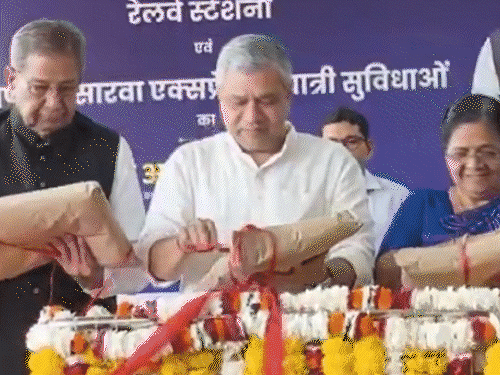
Railway Minister Ashwini Vaishnaw on Friday inaugurated a pilot project at Jaipur’s Khatipura Railway Station, introducing washable blanket covers featuring traditional Sanganeri woodblock prints on the Jaipur–Ahmedabad Asarva Superfast Express.
Crafted using natural dyes and eco-friendly materials, the initiative aims to enhance hygiene and passenger comfort by reducing visible stains and addressing long-standing complaints about reused linens in AC coaches.
The project also seeks to promote India’s rich textile heritage, showcasing the timeless artistry of Rajasthan’s Sanganeri craft.
If the pilot proves successful, Indian Railways plans to expand the concept nationwide, featuring regional textile prints across routes — a move that could add cultural identity and aesthetic appeal to the six lakh linen packets supplied daily by the railways.
It’s that time of year when gold glitters the brightest — and this Dhanteras, it’s not just shining, it’s soaring. The yellow metal has shattered all previous records, touching an astonishing ₹1.32 lakh per 10 grams, nearly 65% higher than last year.
Yet, despite the price shock, Indians are doing what they’ve always done — buying gold. Because for most households, it’s never just metal; it’s emotion, investment, and tradition rolled into one.
Jewellery stores across India are buzzing once again — with some shoppers picking up tiny coins and others trading old pieces for new designs. “Everyone’s a buyer this year, just a little smarter,” says Manav Modi, Analyst at Motilal Oswal. Buyers are adapting to the price surge with lightweight designs, lower karat options like 18K and 14K, and gold exchange schemes to manage costs.
Behind this golden rally lies a storm of global factors — geopolitical tensions, central bank hoarding, inflation jitters, and expectations of rate cuts. Together, they’ve fuelled gold’s stunning rise, making it one of 2025’s best-performing assets.
Analysts now predict the next milestone could be ₹1.5 lakh per 10 grams by next Diwali if the momentum continues.
Meanwhile, jewellers are ensuring the festive sparkle doesn’t fade, rolling out free gold coin offers, fixed-rate bookings, and cashback deals. Younger buyers are also finding creative ways to join the celebration — using credit card points and digital wallets to secure their share of the glitter.
Yes, gold may be expensive this Dhanteras. But in India, its shine isn’t defined by price — it’s defined by prosperity, faith, and sentiment. And as families queue up outside jewellery stores once again, one thing remains certain: no matter how high it climbs, gold never loses its sparkle in Indian hearts.
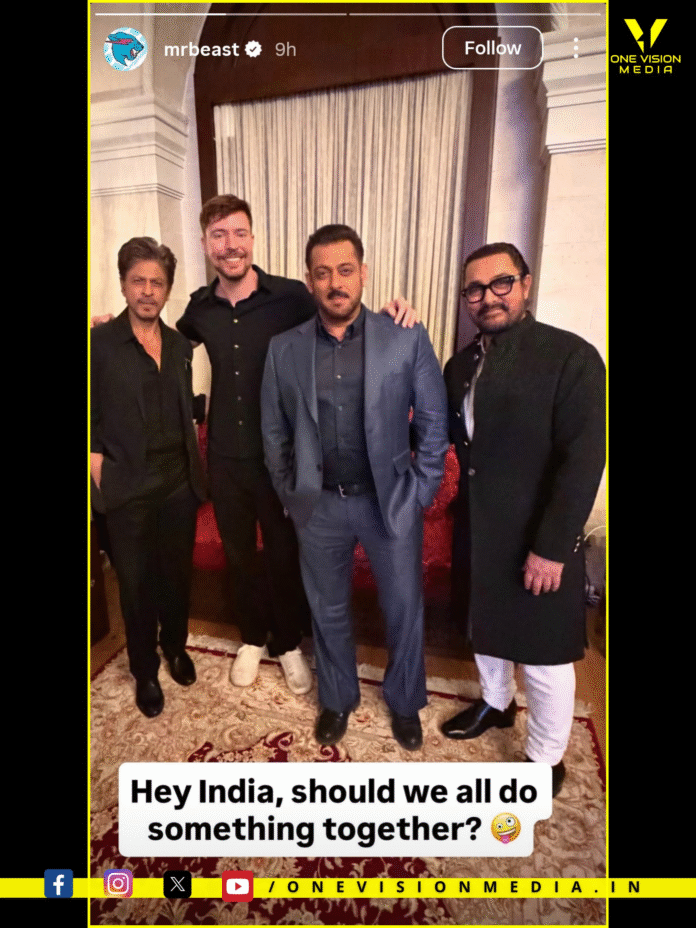
The internet officially broke this week — and no, it wasn’t because of one of MrBeast’s million-dollar challenges. It was because of a single photo. A frame so legendary that it made every Bollywood fan pause mid-scroll: MrBeast posing with Shah Rukh Khan, Salman Khan, and Aamir Khan.
The viral photo was snapped at the Joy Forum 2025 in Riyadh, Saudi Arabia, where YouTube’s biggest creator shared the spotlight with Bollywood’s most iconic trio. Dressed sharply in an all-black suit, MrBeast looked right at home — almost like the “fourth Khan.” SRK and Salman oozed charisma in classic tuxedos, while Aamir sported a sleek Indo-Western ensemble. Together, the four stars lit up the internet like never before.
But what truly sent fans into a frenzy was MrBeast’s playful caption:
“Hey India, should we all do something together?”
Within minutes, social media exploded. Timelines filled with wild theories, hilarious memes, and fan wishlists. “After Ambani, only MrBeast can unite the Khans,” one user quipped. Another wrote, “If this collab happens, the internet might actually melt.”
The three Khans, who have ruled Bollywood for over three decades, are rarely seen together — which made the photo even more special. Once rumored rivals, the superstars have long since evolved into warm friends, occasionally making cameo appearances in each other’s films and showing mutual respect at public events.
And now, with MrBeast in the mix, fans can’t stop wondering: could this be the biggest East-meets-West collaboration ever? Whether it’s a global YouTube challenge, a charity initiative, or even a blockbuster crossover, one thing’s certain — this picture has given fans a taste of cinematic magic.
A Belgian court has approved the extradition of Mehul Choksi, a fugitive Indian diamond businessman and a key accused in the ₹13,850 crore Punjab National Bank (PNB) fraud case. Choksi, once a high-profile jeweller, is now one of India’s most wanted economic offenders. His deportation, if completed, would mark a major win for Indian investigative agencies. But who exactly is Mehul Choksi, and why is he so important?
A Key Player in India’s Biggest Bank Fraud
Mehul Choksi is the former promoter of Gitanjali Gems, once one of India’s leading jewellery companies. Along with his nephew Nirav Modi, Choksi is accused of defrauding Punjab National Bank by illegally obtaining credit through fake Letters of Undertaking (LoUs). The total scam is estimated at ₹13,850 crore, making it one of the biggest banking frauds in Indian history.
Fled India, Acquired Foreign Citizenship
Sensing trouble, Choksi fled India in early 2018, just days before the scam came to light. Prior to fleeing, he had acquired citizenship of Antigua and Barbuda in 2017 through its citizenship-by-investment program. He has since used his foreign citizenship and alleged health issues to avoid returning to India, despite multiple summons and arrest warrants.
Latest Arrest in Belgium
In April 2025, Belgian police arrested Choksi in Antwerp while he was allegedly attempting to flee to Switzerland. His arrest was made based on extradition requests from Indian agencies, and was supported by two arrest warrants issued by Indian courts in 2018 and 2021.
On October 17, 2025, a Belgian court ruled that Choksi’s arrest was valid and approved his extradition to India. However, he still has the right to appeal the decision. If no appeal is made—or if his appeal is rejected—the extradition process will move forward.
Tried to Mislead Belgian Authorities
Reports suggest that Choksi obtained a Belgian F-type residency card in November 2023, allegedly using fraudulent documents and with help from his wife, Priti Choksi, a Belgian citizen. He reportedly hid his Indian and Antiguan citizenship to mislead Belgian authorities and delay deportation.
Previous Arrest in Dominica
This is not the first time Choksi has been caught. In May 2021, he was arrested in Dominica after allegedly fleeing from Antigua. He spent 51 days in jail, claiming he was kidnapped and assaulted. Though India attempted to extradite him, he was later sent back to Antigua after legal intervention.
India’s Challenge Ahead
While the Belgian court ruling is a positive step for Indian authorities, legal experts and whistleblowers warn that extradition may still face delays. Hariprasad SV, whistleblower in the PNB scam, said, “Choksi has deep pockets and will use every legal loophole, just like Vijay Mallya. It won’t be easy for India, but this is a hopeful sign.”
If deported successfully, Mehul Choksi could finally face trial in India after nearly seven years on the run—a case that symbolizes the country’s battle against high-profile economic fugitives