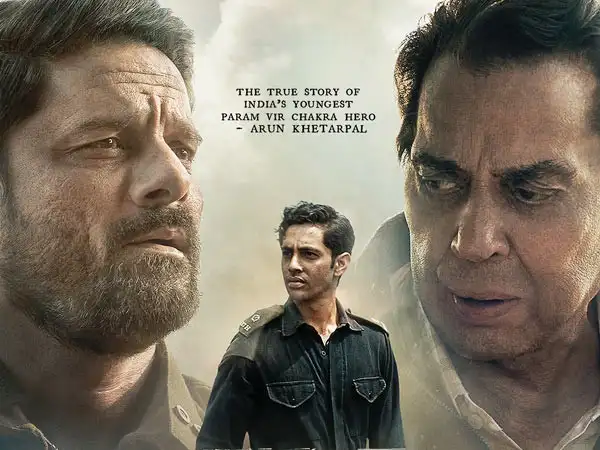
Veteran actor Dharmendra has passed away, and in an emotional coincidence, the makers of his last film, “Ekkis,” revealed his look from the film on Monday along with a voice note in his own voice, leaving fans deeply moved. Sharing the poster on Instagram, the team wrote, “Fathers raise sons. Great men build nations. Dharmendra ji is an emotional force as the father of a 21-year-old immortal soldier.”
The poster also carries Dharmendra’s voice in the background, saying, “This is my eldest son, Arun, and he will always be 21.” The emotional line has made his fans remember him with even greater affection.
Directed by Shriram Raghavan, “Ekkis” is a war drama based on the true story of Second Lieutenant Arun Khetarpal, India’s youngest Param Vir Chakra awardee, who displayed extraordinary courage in the 1971 Indo-Pak War. Amitabh Bachchan’s grandson, Agastya Nanda, plays Arun Khetarpal, while Dharmendra appears as his father in what becomes one of his final screen portrayals. This will be Agastya Nanda’s first theatrical release, following his debut in Zoya Akhtar’s “The Archies” on Netflix.
Veteran Bollywood actor Dharmendra passed away on Monday morning in Mumbai at the age of 89. The veteran actor, who had worked in over 300 films over his storied career, had been ailing for a month. His last rites were conducted at the Pawan Hans crematorium. Dharmendra would have turned 90 on December 8 this year.
He came as an outsider from a village in Punjab and made Hindi cinema his own, acting in over 300 films which included both mainstream blockbusters and underrated gems, Dharmendra was among those few actors whose stardom was not impacted by the rise of Rajesh Khanna and Amitabh Bachchan. As he often said, he received few awards in his career but the massive love of his fans more than made up for it. He balanced Sholay — arguably the most iconic Hindi film over decades — with a Satyakam; audience will always remember his comic turn in Chupke Chupke. His career spanned decades and generations.
Veteran actor, #Dharmendra affectionately known as Bollywood’s ‘He-Man’ and ‘Dharam Paaji,' passed away today at the age of 89. His passing leaves behind an unmatched legacy of over six decades.#Newspic.twitter.com/iqE7oXfXJL
The heart of Indian cinema has lost one of its brightest lights. Dharmendra ji wasn’t just an actor, he was an emotion, a timeless presence who brought charm, warmth, and strength to every frame. From his effortless humor to his unshakable grace, he taught generations what it… pic.twitter.com/1nSAj0aYdl
You stood tall, not just in stature, but in spirit. Dharmendra ji, thank you for showing us strength can be kind. Om Shanti 🙏 pic.twitter.com/aruEYqtcHk
The high-profile wedding at Jagmandir on Sunday—set like a jewel in the middle of Lake Pichola—became the talk of not just Rajasthan but all of North India. Netra Mantena, daughter of American billionaire businessman Ramaraju Mantena, married American-born Vamsi Gadiraju in a ceremony that blended regal Rajasthani splendour with global glamour.
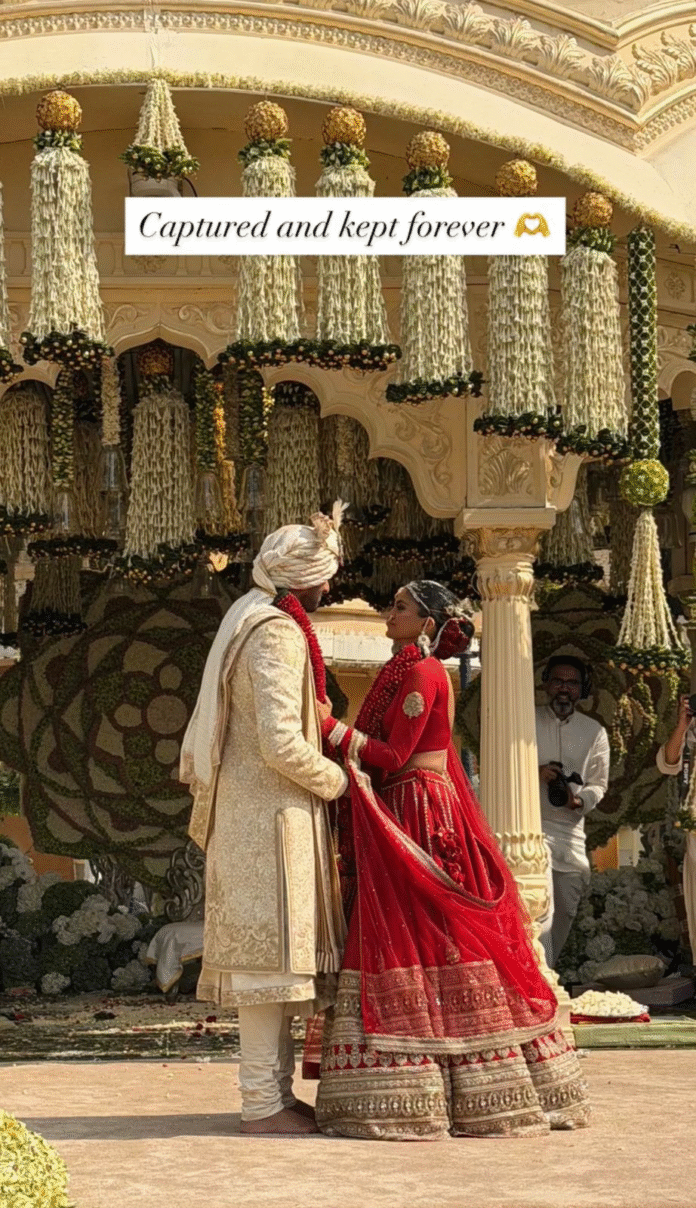
The bride made a striking entrance in a red lehenga, while the groom arrived in a golden sherwani, embracing an elegant Rajputana look. Decorated boats ferried guests from the Lake Palace and The Leela Palace to Jagmandir, which glowed under thousands of lights, flowers, and traditional Rajasthani artworks. The island palace, transformed into a fairytale setting, radiated heritage charm. The temple near the main mandap was also adorned with special decorations for the occasion.
As dusk settled, both Jagmandir and the City Palace lit up in a spectacular play of colours. The celebrations soared further at the grand reception at The Leela Palace, where Hollywood star Jennifer Lopez delivered a power-packed performance. Globally acclaimed DJ Black Coffee, who flew in from South Africa exclusively for the wedding, added an international flavour to the night with his signature beats.
The event drew an eclectic mix of Hollywood, Bollywood, and business-world personalities. Social media buzzed as celebrated names from films and fashion mingled with top industrialists, all soaking in the Mewari grandeur.
Security arrangements were as extraordinary as the guest list. Over 300 personnel, multiple CCTV cameras, and specialised surveillance teams were deployed to ensure seamless management throughout the festivities.
Among the star attendees, the most talked-about guest was US President Donald Trump’s son, Donald Trump Jr. Arriving with his girlfriend and dressed in a pristine white Jodhpuri suit, he embraced the local Rajputana aesthetic. His grand entry instantly became a social media sensation, with photos from the venue going viral within minutes.
From the flower-canopied bridal entry to the varmala ceremony set to traditional Rajasthani folk music and a live violin ensemble, every element of Netra and Vamsi’s wedding celebrated Rajasthan’s majestic heritage—elevated by a global touch. On a chilly Udaipur night, Jagmandir truly turned into a palace of love, marking one of the most memorable—and talked-about—weddings of 2025.
A grand reception for the wedding of American billionaire Rama Raju Mantena’s daughter, Netra Mantena, is underway at the City Palace in Udaipur. The celebrations began at 7:30 pm at the Zenana Mahal, where Hollywood star Jennifer Lopez took the stage alongside DJ Black Coffee, electrifying the royal setting with their performance.
Earlier in the day, the wedding rituals were held at the iconic Jag Mandir Palace situated in the middle of Lake Pichola. The ceremonies were performed according to South Indian Hindu traditions.
Among the high-profile guests was Donald Trump Jr., son of former US President Donald Trump, who arrived wearing a white Jodhpuri suit and was accompanied by his girlfriend. Guests were ferried to Jag Mandir by boat from Hotel Leela and Lake Palace between 10 and 11 am.
The festivities in Udaipur have been underway since November 21 for the wedding of Netra Mantena and Vamsi Gadiraju. The traditional wedding procession took place a day earlier, during which the groom arrived riding Jaipur’s famous elephant, Babu.
Inside the Royal Wedding
The bride made a striking entry at Jag Mandir in a red lehenga, accompanied by her brothers.
The mandap and the nearby temple were adorned with flowers imported from abroad.
The couple exchanged garlands in a beautifully decorated pavilion.
Every ritual was meticulously photographed to preserve the grandeur of the ceremony.
Guests from around the world flew in for the lavish celebrations.
Trump Jr. was seen interacting with guests and posing for photos throughout the ceremonies.
Latest Updates
Jennifer Lopez and DJ Black Coffee performed at the reception at Hotel Leela Palace.
Wedding rituals were conducted according to South Indian Hindu customs.
Trump Jr. posed for photos with guests.
The temple near the mandap at Jag Mandir was beautifully decorated.
Traditional performances began at Jag Mandir.
Floral décor for the mandap included flowers imported from abroad.
The bride and groom exchanged garlands.
Trump Jr., dressed in a white Jodhpuri suit, arrived with his girlfriend.
The bride reached Jag Mandir in her red wedding attire.
Trump’s son danced with Ranveer Singh in Udaipur a day earlier, where Madhuri Dixit performed Ghoomar and Nora Fatehi entertained the guests with Bollywood numbers.
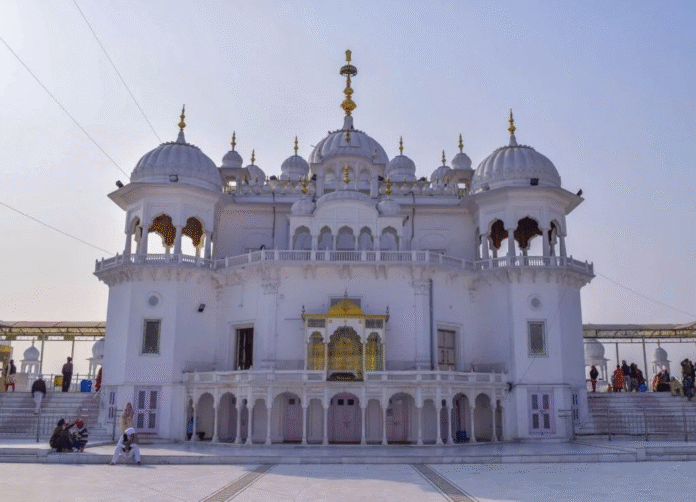
Anandpur Sahib—often referred to simply as Anandpur, meaning “City of Bliss”—is one of the most sacred places in Sikhism. Located on the edge of the Shivalik Hills near the Sutlej River, it holds immense religious, cultural, and historical significance. It is the city where the ninth Guru, Guru Tegh Bahadur, lived and where Guru Gobind Singh spent many years. Most notably, it is the birthplace of the Khalsa Panth, founded here during Vaisakhi in 1699.
The city is also home to Takht Sri Kesgarh Sahib, one of the five Sikh Takhts, making it a major pilgrimage centre. Every spring, it hosts Hola Mohalla, one of the largest Sikh festivals, drawing devotees from around the world.
Location
Anandpur Sahib lies on National Highway 503, connecting Kiratpur Sahib and Chandigarh to Nangal, Una, and Kangra (Himachal Pradesh). The city sits close to the Sutlej—the longest of Punjab’s five rivers.
A rare 19th-century photograph titled “The Sikh Town of Anundpore, Punjaub” by Francis Frith captures its early landscape.
History
Foundation
Anandpur Sahib was founded in June 1665 by Guru Tegh Bahadur, who established a settlement called Chakk Nanaki, named after his mother, Mata Nanaki. It evolved into a dharamshal—a spiritual retreat with tented encampments, clay hutments (known as bungas), orchards, gardens, and a gurgling stream near the present-day Gurdwara Bhora Sahib.
In 1675, Guru Tegh Bahadur was executed in Delhi by the Mughal emperor Aurangzeb for refusing to convert to Islam. Following his martyrdom, the Sikh community renamed the town Anandpur, and his son Gobind Rai—later Guru Gobind Singh—became the tenth Guru.
With growing Sikh numbers near the Guru’s residence, Anandpur expanded quickly, drawing attention from surrounding hill chiefs and the Mughal administration.
Birth of the Khalsa (1699)
On Vaisakhi day in 1699, Guru Gobind Singh summoned Sikh congregations from across the region and founded the Khalsa Panth. This moment transformed the Sikh community into a unified martial order. The event triggered hostility from Mughal forces and local hill rulers, leading to multiple battles.
Major Battles
First Battle of Anandpur (1700) The Mughal army, led by Painda Khan and Dina Beg, attacked with 10,000 soldiers. Guru Gobind Singh killed Painda Khan in direct combat, causing the Mughal army to retreat.
Second Battle of Anandpur (1704) Mughal generals Saiyad Khan and Ramzan Khan failed to subdue the Sikhs. Aurangzeb then sent Wazir Khan and Zaberdast Khan. A prolonged siege from May to December 1704 cut off supplies, leading many Sikhs to desert. Some later returned and died fighting alongside the Guru in 1705.
A promise of safe passage was deceitfully broken. During the escape, the Guru’s two younger sons—Zorawar Singh (8) and Fateh Singh (5)—along with their grandmother Mata Gujari, were captured. The children were executed by entombment, and Mata Gujari passed away shortly after.
After Anandpur fell, the city changed hands multiple times—eventually coming under Patiala State and later being settled by the Sodhi families, leading to the formation of four sarkars (estates).
Modern Developments
Urban Transformation and Virasat-e-Khalsa
The Virasat-e-Khalsa Museum, designed by Israeli architect Moshe Safdie and commissioned in 1999, has become a major landmark, drawing global attention and tourism. Its creation reflects Anandpur’s shift toward large-scale commemorative architecture.
Heritage Conservation
Many original 17th- and 18th-century structures have been lost due to neglect, urbanisation, and repeated reconstruction. Historical forts, such as Anandgarh Qila, have been demolished or drastically remodelled, often encased in marble.
Key observations:
Vernacular hutments (bungas) and natural landscapes associated with the Gurus have largely disappeared.
The original Chak Nanaki and Akal Bunga structures were lost during the era of Maharaja Ranjit Singh.
By the 20th century, nearly all major shrines had been rebuilt, especially during the Singh Sabha movement.
Modern Kar Sewa drives have replaced many heritage features—including natural springs, stone steps, and ancient masonry.
As of 2025, only a small section of 19th-century Nanakshahi brick survives, preserved behind glass in Quila Anandgarh Sahib.
Anandpur today is a thriving pilgrimage city but has minimal physical heritage from the Guru period.
Landmarks
Anandpur’s distinct urban identity is shaped by:
The monumental centre around Takht Kesgarh Sahib
Five historical forts (mostly reconstructed)
The Khalsa Heritage Museum
Dense overlapping residential and commercial clusters
A cityscape where building heights peak near the sacred centre
Gurdwaras
Anandpur is rich in Sikh shrines, many tied to the lives of Guru Tegh Bahadur, Guru Gobind Singh, and key historical events. Though their forms have changed over time, they remain vital sites of devotion and collective memory.
Special Olympics Bharat : In a continued effort to build a more inclusive and compassionate society—where every young individual contributes towards a progressive community—Sapta Shakti Army Women’s Welfare Association (AWWA), in collaboration with Special Olympics Bharat, will host a Special Athletics Meet at Jaipur Military Station on 25–26 November 2025.
State Games Athletics 2025 is being organised for young athletes with special intellectual abilities from across Rajasthan. This maiden initiative by Special Olympics Bharat and Sapta Shakti AWWA aims to promote participation, confidence, and sportsmanship among these young athletes. A total of 232 enthusiastic participants from various districts have confirmed their participation in seven track and field events, including track races, javelin throw, and shot put.
The Athletics Meet will also serve as the selection platform for the Rajasthan state team that will compete at the National Special Athletes Meet in Delhi, part of the preparations for the Special Olympics World Summer Games 2027 (USA).
The event will be inaugurated by Ms. Diya Kumari, Hon’ble Deputy Chief Minister of Rajasthan, in the presence of Mrs. (Dr.) Mallika Nadda, President, Special Olympics India; Lt Gen Manjinder Singh, Army Commander, Sapta Shakti Command; and Mrs. Barinder Jit Kaur, Regional President AWWA, Sapta Shakti Command.
The Special Athletics Meet reiterates that sports are a powerful catalyst for nurturing an inclusive and supportive ecosystem—one in which individuals with special intellectual abilities are respected, encouraged, and empowered to realise their full potential.
Farah Khan: In 2024, filmmaker and choreographer Farah Khan stepped into a space she never imagined – YouTube and ended up creating one of her most profitable ventures. After finishing the script for her next movie, she realised shooting would take at least a year to begin. With her team urging her to try digital content, and her children preparing for expensive university education, Farah finally took the plunge. What started as a casual experiment soon became a turning point in her career.
Why food, why Dilip, and why it worked
Unsure of what format to adopt, Farah picked the simplest starting point: food. She teamed up with her cook, Dilip, whose natural humour and charm became the heartbeat of her channel.
She wrote punchlines for him, added her own wit, and created chaotic, heartwarming cooking vlogs. By her second vlog, she had earned the Silver Play Button, and soon her channel surged to 2.5 million subscribers.
Dilip’s popularity skyrocketed so quickly that he now features in brand ads including one with Shah Rukh Khan and Farah proudly shared that she has even raised his salary because of their shared success.
YouTube earnings bigger than blockbusters
What shocked everyone is Farah’s income revelation. Speaking to Soha Ali Khan, she shared that her YouTube earnings in one year are “massive”, more than what she has ever made annually, including during her biggest film successes. This is a stunning comparison, considering she directed blockbusters like Main Hoon Na (₹89 cr), Om Shanti Om (₹152 cr), Happy New Year (₹383 cr), and Tees Maar Khan (₹101.8 cr). Her Shah Rukh Khan films alone total ₹624 crore in box-office collections, yet YouTube has outperformed them in personal income.
A space with no gatekeepers
More than money, Farah values the freedom YouTube gives her. No producers dictating cuts, no OTT executives controlling guests, no hierarchies labelling celebrities as A-list or tacky. “It’s my channel, my rules,” she says and audiences clearly love this unfiltered version of her. From choreographer to filmmaker to digital creator, Farah Khan has reinvented herself once again and this time, the internet is her biggest blockbuster yet.
Gujarat has witnessed an extraordinary wildlife revival: the return of a tiger to its forests after being declared extinct in the state decades ago. The unexpected presence was first detected nearly nine months ago inside Dahod district’s Ratanmahal Wildlife Sanctuary, a landscape that borders Madhya Pradesh’s Jhabua and Kathiwada regions areas known for healthy tiger populations. Initial pugmarks and field signs raised curiosity, but months of camera-trap evidence have now confirmed that the big cat is not simply wandering through; it is actively claiming territory and adapting to its new habitat.
The tiger that chose Ratanmahal
What makes this comeback remarkable is the tiger’s behaviour. Rather than passing through, it has begun marking its territory, moving confidently across the sanctuary’s rugged hills and dense forest patches. Experts believe the tiger is around four to five years old and likely dispersed naturally from neighbouring Madhya Pradesh through long-standing forest corridors. The sanctuary’s terrain, prey availability, and undisturbed cover appear to have provided the ideal conditions for the tiger to settle, making this the first long-term tiger presence Gujarat has recorded in decades.
A sanctuary on high alert and high hope
Following the discovery, the Forest Department intensified monitoring throughout the sanctuary. Enhanced patrolling, additional camera traps, fire prevention measures, and careful management of water and prey resources have all become part of the region’s daily conservation routine. Ratanmahal, known primarily for its sloth bears, is now under round-the-clock observation as officials balance ecological protection with local safety.
What this means for Gujarat’s conservation future
The tiger’s unexpected return has revived conversations about the state’s ecological identity. Gujarat already hosts the Asiatic lion and a strong leopard population; now, with this tiger’s arrival, it briefly holds all three major big cats once again. Conservationists are cautious but optimistic, suggesting that this could mark the beginning of a new chapter in the state’s wildlife history if the habitat continues to remain favourable.
A roar that rewrites the past
For a species believed to be gone forever from Gujarat’s forests, this silent yet powerful comeback is a reminder that nature often finds its way back when given a chance. As the tiger moves through Ratanmahal’s shaded ridges and deep valleys, Gujarat watches with anticipation hopeful that this lone wanderer might be the start of a renewed legacy.
Justice Surya Kant is set to assume office as the 53rd Chief Justice of India on 24 November 2025, succeeding Justice B. R. Gavai. His appointment is historic as he will be the first person from Haryana to hold the highest judicial office in the country.
From humble Haryana roots to the Supreme Court
Born on 10 February 1962 in Petwar, a small village in Hisar district of Haryana, Surya Kant grew up in modest circumstances. His father was a Sanskrit teacher; his mother, a homemaker. As a child, he studied in a village school with no benches students sat on the floor. Even while in school, he helped with farm work to support his family. He graduated from Government Post Graduate College, Hisar in 1981, and went on to earn his LL.B. from Maharishi Dayanand University, Rohtak, in 1984.
A steady legal climb
Justice Kant began his legal career in 1984, practicing at the District Court in Hisar. Just a year later, he shifted to Chandigarh to work in the Punjab & Haryana High Court, specializing in constitutional, service, and civil
At just 38 years old, he became the youngest Advocate General of Haryana on 7 July 2000, and a year later, was designated a senior advocate. In 2004, he was appointed a permanent Judge of the Punjab & Haryana High Court. In 2007, he was nominated to the Governing Body of the National Legal Services Authority (NALSA) for two terms terms (2007-2011)
Academic excellence and judicial leadership
Never one to set aside learning, Justice Kant completed his LL.M. in 2011 via distance education from Kurukshetra University, graduating First Class First. He became Chief Justice of the Himachal Pradesh High Court on 5 October 2018. On 24 May 2019, he was elevated to the Supreme Court of India. As of 12 November 2024, he also serves as the Chairman of the Supreme Court Legal Services Committee.
Personal life & values
Justice Kant comes from a close-knit family. According to his profile, he is one of five siblings. He is married to Savita Sharma, a retired college lecturer and principal, and they have two daughters, both pursuing postgraduate law education. Notably, he refused to accept dowry when he married a testimony to his strong moral principles.
What Drives Him
Colleagues and observers describe Justice Surya Kant as a jurist of “deep learning” and “measured wisdom.” He has shown a special sensitivity to public resource protection, land acquisition, compensation rights, and reservation policies. His background growing up in rural Haryana, studying by the dim light of lamps, and working through adversity gives him a grounded understanding of the struggles ordinary citizens face. As he steps into his role as Chief Justice, many hope his life story will influence a more accessible, empathetic, and principled judiciary. Justice Surya Kant’s journey from a modest village school to the Supreme Court’s top post is a powerful reminder that perseverance, integrity, and commitment to learning can shape not just a career, but the future of a nation’s justice system.
Op Drishti, a first-of-its-kind advanced surgical eye camp in Jammu & Kashmir, was organised at the Command Hospital, Northern Command, Udhampur from November 18–22, 2025. Conducted in collaboration with the expert ophthalmic team from Army Hospital (Research & Referral), New Delhi, the mega camp surpassed expectations by screening more than 2,000 patients and performing over 400 free eye surgeries, including complex cataract, glaucoma, and retinal procedures. Beneficiaries included serving personnel, dependents, Veer Naris, and civilians from remote districts such as Doda, Rajouri, Poonch, Kishtwar, Ramban, and Udhampur.
The surgeries were led by Brigadier SK Mishra, Head of the Ophthalmology Department at Army Hospital (R&R), who is renowned for operating on two former Presidents of India.
During the virtual closing ceremony, Defence Minister Rajnath Singh praised the Northern Command and Armed Forces Medical Services (AFMS) for delivering critical medical support to the people of J&K. Chief of Army Staff General Upendra Dwivedi also addressed the gathering, appreciating the successful execution of this large-scale healthcare outreach. J&K Lieutenant Governor Manoj Sinha attended the ceremony, while Lt Gen Pratik Sharma, GOC-in-C Northern Command, was present on-site.
On November 20, Union Minister Dr Jitendra Singh visited the camp, interacted with patients, and reviewed the hospital’s state-of-the-art ophthalmology facilities. He commended the Indian Army for its humanitarian services, highlighting its crucial role in providing free medical camps and specialised eye care to citizens in peace as well as during crises.
The eye camp transformed lives across the region. • Surinder Singh (72) from Poonch regained vision after 2–3 years of blindness worsened by trauma from Pakistan’s shelling during Operation Sindoor. • Abdullah Shafeeq (56), a retired soldier from Mendhar, helped mobilise conflict-affected residents to benefit from the camp. • Rajkumari Devi (96) experienced restored eyesight after years of visual impairment.
Op Drishti was conceptualised by Defence Minister Rajnath Singh following a request from LG Manoj Sinha. Acting promptly, the Chief of Army Staff directed AFMS leadership to create a fully equipped specialised surgical eye camp in Udhampur, ensuring world-class ophthalmic care reached underserved populations of Jammu & Kashmir.