Home Blog Page 133

Japan’s PM Sanae Takaichi Faces Sumo Tradition Dilemma. Know What It Is And Its History…

0

Japan’s first female Prime Minister, Sanae Takaichi, finds herself at the centre of a national debate as the Fukuoka Grand Sumo Tournament nears its finale. The question dividing public opinion: Will she step into the sacred dohyo (sumo ring) to present the Prime Minister’s Trophy — a role long reserved for men under Shinto custom?

Her decision could become a defining symbol — either of respect for centuries-old tradition or a step toward modern gender equality in Japan.

Historic Role and Early Challenges

Sanae Takaichi assumed office in October 2025, becoming Japan’s first female Prime Minister after securing victory in the Liberal Democratic Party leadership race.

Known for her conservative stance, focus on national security, and economic revival, Takaichi has so far projected continuity. Now, however, this cultural crossroads tests how Japan’s first woman leader balances reverence for heritage with the evolving demands of modern society.

The Religious Roots of Exclusion

The exclusion of women from the dohyo stems from Shinto religious beliefs that consider the sumo ring a sacred space. According to ancient custom, women are barred due to notions of ritual impurity associated with menstruation.

This unwritten rule has long prevented women from entering the ring — as wrestlers, referees, or presenters. Despite decades of debate and calls for reform, the Japan Sumo Association (JSA) maintains the ban as a matter of cultural preservation rather than discrimination.

Past Controversies and Reform Efforts

The tradition has faced scrutiny multiple times:

  • 1990: Chief Cabinet Secretary Mayumi Moriyama was denied entry to the ring.
  • 2000: Osaka Governor Fuse Ohta was forced to hand over a trophy from a walkway.
  • 2018: Female medics were asked to leave the ring while aiding a collapsed mayor — prompting national outrage and an apology from the JSA.

In 2019, an advisory panel was formed to re-evaluate the rule, but no reforms were implemented.

Key Facts

  • Sanae Takaichi became Japan’s first female Prime Minister in October 2025.
  • Women are banned from entering the sumo ring under Shinto purity beliefs.
  • The JSA last reviewed the ban in 2019, but retained it.
  • A 2018 incident involving female medics reignited national debate on gender equality.

Balancing Modernity and Tradition

Whether Prime Minister Takaichi chooses to step into the dohyo or remain outside carries immense political and cultural weight.

Entering would break a centuries-old taboo, making a powerful statement for gender inclusion. Staying out, on the other hand, would honour traditional norms, aligning with her conservative base and respect for Shinto customs.

With sumo’s popularity rising again — especially after the recent promotion of homegrown yokozuna Onosato — the spotlight on this moment is brighter than ever.

Japan now watches closely to see whether its first female leader will challenge the boundaries of tradition or uphold its sacred continuity.
India Grants Land for Bhutanese Monastery in Varanasi

0

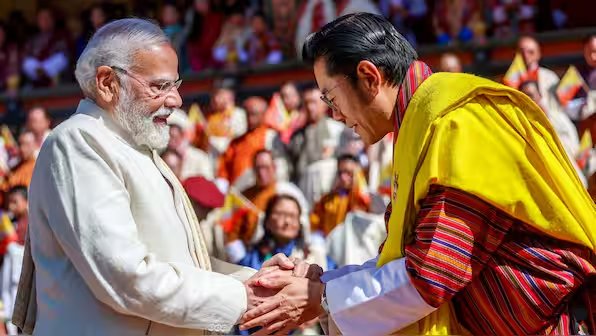
In a gesture symbolising deep spiritual and cultural bonds, India has granted land in Varanasi for the construction of a Bhutanese monastery and guesthouse. Prime Minister Narendra Modi announced the decision during his visit to Bhutan to mark King Jigme Khesar Namgyel Wangchuck’s 70th birth anniversary celebrations in Thimphu. The initiative marks a new chapter in the centuries-old Buddhist connection between the two Himalayan nations.

A Sacred Centre Along the Ganga

The proposed monastery will be established near the banks of the Ganga River in Varanasi, India’s spiritual capital. It will serve as a hub for spiritual learning, meditation, and cultural exchange, providing Bhutanese monks and pilgrims a dedicated space in the holy city.

Bhutanese Prime Minister Tshering Tobgay described the project as “a bridge of faith connecting the spiritual heart of India with the soul of Bhutan.”

Part of India’s ‘Neighbourhood First’ Policy

Prime Minister Modi said the land grant reflects the spirit of India’s “Neighbourhood First” policy and the nations’ shared Buddhist heritage. The initiative aims to strengthen people-to-people ties and promote religious tourism, reinforcing faith-based diplomacy and cultural cooperation.

New Bilateral Projects and Agreements

The announcement coincided with several new Indo–Bhutan developments:

  • India extended a ₹4,000-crore line of credit to Bhutan for developmental projects.
  • The 1,020 MW Punatsangchhu-II Hydropower Project was inaugurated.
  • Work on the Punatsangchhu-I Project will resume soon.
  • Three new agreements were signed in renewable energy, mental health research, and medical capacity-building.

Key Facts

  • The Bhutanese monastery will be built near the Ganga River in Varanasi.
  • Land grant announced by PM Modi during his Bhutan visit in November 2025.
  • India extended a ₹4,000-crore line of credit to Bhutan.
  • Punatsangchhu-II Hydropower Project (1,020 MW) inaugurated.

Symbol of Shared Buddhist Heritage

The monastery adds a profound spiritual dimension to India–Bhutan relations, complementing economic and developmental cooperation.

As part of the Global Peace Prayer Festival in Bhutan, supported by India and led by King Jigme Khesar Namgyel Wangchuck, India also sent a sacred relic of Lord Buddha for public veneration — reaffirming both nations’ commitment to peace, faith, and cultural continuity in South Asia

Rani Abbakka Chowta: The Fearless Queen of Ullal Who Defied the Portuguese

0

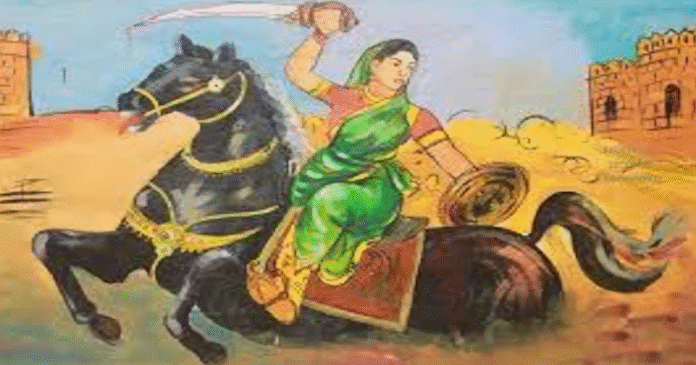
Rani Abbakka Chowta was the first Tuluva Queen of Ullal who valiantly fought against Portuguese colonial forces in the latter half of the 16th century. A follower of Jainism, she belonged to the Chowta dynasty, an indigenous Tuluva royal lineage that ruled parts of coastal Karnataka (Tulu Nadu), India. The dynasty’s capital was Puttige, while the port town of Ullal served as its strategic subsidiary capital.

The Portuguese, seeking to dominate the spice trade, made repeated attempts to capture Ullal due to its vital coastal position. However, Queen Abbakka repelled their attacks for over four decades, displaying unmatched courage and military acumen. Her indomitable spirit earned her the title “Abhaya Rani” (The Fearless Queen). She is regarded as one of the earliest Indian rulers to resist European colonialism and is often hailed as the first woman freedom fighter of India. In Karnataka, she is remembered alongside Rani Kittur Chennamma, Keladi Chennamma, Rani Chennabhairadevi, and Onake Obavva as one of the state’s foremost women warriors and patriots.

Early Life

Born into the Chowta royal family, Abbakka was trained in warfare, administration, and diplomacy from a young age. The Chowtas followed the Aliyasantana matrilineal system of inheritance, where royal succession passed through the female line — a custom that empowered women leaders like Abbakka to rule with authority.

Military Campaigns

Under her command, Ullal became a bastion of resistance. Some of her most notable victories include:

  • 1555: Defeated Admiral Dom Álvaro da Silveira’s naval assault.
  • 1557: Successfully defended Ullal from another Portuguese invasion.
  • 1568: Crushed a combined Portuguese land and naval offensive.

Administration and Trade

Rani Abbakka’s rule strengthened Ullal’s position as a thriving trade hub, dealing in pepper, cardamom, and rice. She maintained diplomatic ties with Arab merchants and the Zamorin of Calicut, forming vital alliances. Her administration was characterized by:

  • Strategic cooperation with Mogaveera maritime communities.
  • Development of coastal trade routes and fortifications.
  • Promotion of local industries and economic self-reliance.

Religious and Cultural Patronage

As a devout Jain, Abbakka renovated several Jain basadis (temples) and supported the translation of religious texts into local languages. Her reign witnessed a flourishing of art, architecture, and cultural exchange through trade networks.

Legacy

Rani Abbakka’s defiance against Portuguese domination remains a landmark in India’s early resistance to colonialism. Her leadership set precedents for:

  • Indigenous naval defense systems.
  • Women-led governance and warfare.
  • The assertion of cultural and political sovereignty.

Modern Commemorations

Her legacy continues to inspire generations through:

  • The annual Veera Rani Abbakka Utsava in Ullal.
  • A commemorative stamp issued by India Post in 2023.
  • The Rani Abbakka Tulu Study Centre at MGM College.
  • Scholarships and awards established in her honor.

Rani Abbakka Chowta remains a symbol of courage, patriotism, and defiance — a queen who stood fearlessly against colonial might long before the dawn of India’s freedom movement.

Thewa Jewellery: The Art of Gold on Glass

0

In the world of high jewelry, where pieces often rely on sheer carat weight or celebrity endorsements, one Indian art form stands apart. It is a masterpiece of light, color, and painstaking precision: Thewa jewelry.

Born in a small corner of Rajasthan and kept secret for over 250 years, Thewa has transcended its royal origins to become an international sensation, celebrated not for its size, but for its mesmerizing technique.

1. Thewa: Origin and Legacy of a Secret Art

Thewa’s story begins and remains centered in one city: Pratapgarh, Rajasthan.

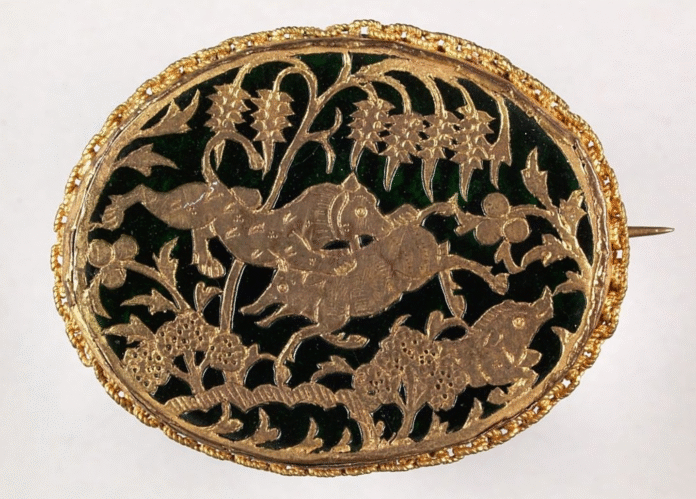
This unique craft originated in the late 18th century (around 1765 AD) under the patronage of the local royal family. Thewa translates literally to ‘setting’ or ‘a pattern on a thick piece of glass’. Historically, the process was so closely guarded that the techniques were passed down only to the family’s sons, and the secrets of the craft were not even shared with the family’s daughters for fear of the technique leaving the household through marriage.

2. The Meticulous Process: Gold as Thin as a Thread

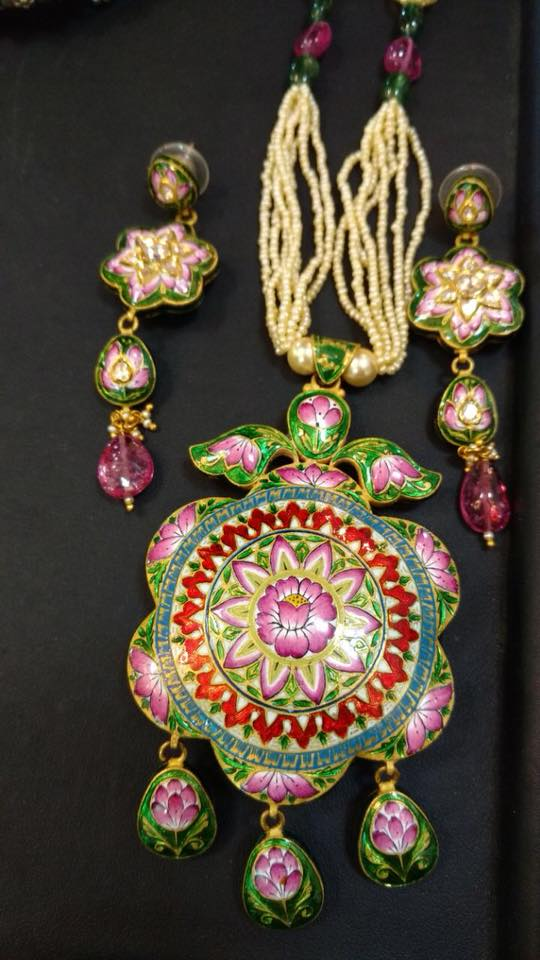
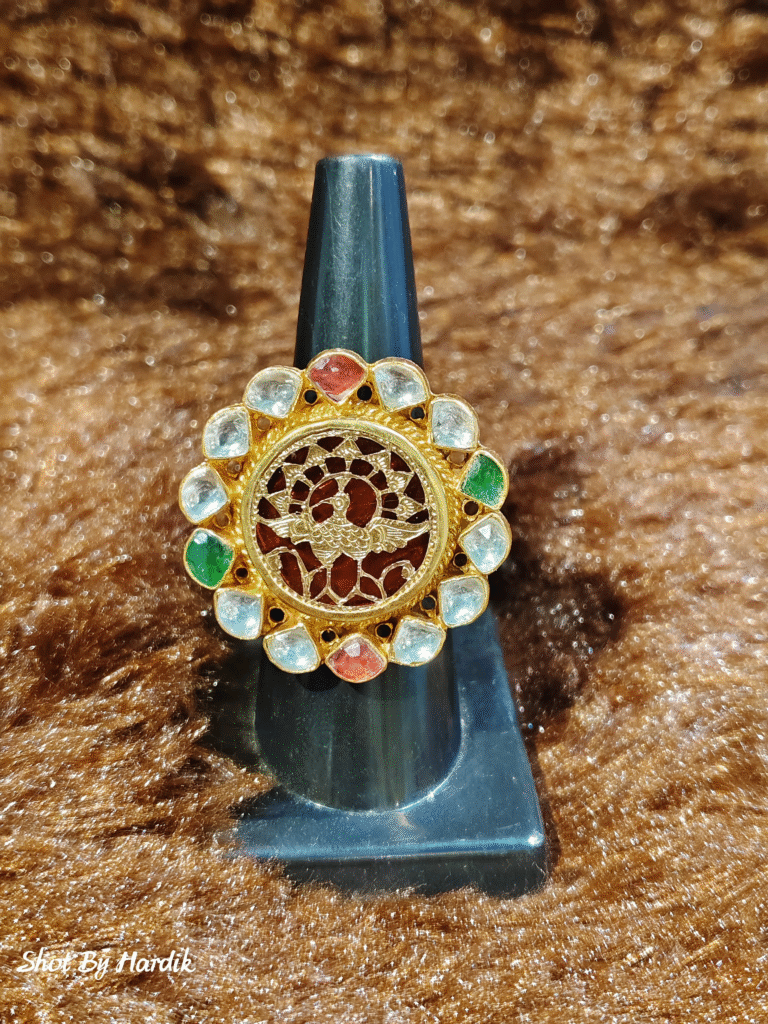
Thewa is the art of fusing intricately worked 23-carat gold sheets onto colorful, usually red, green, or blue, Belgian glass. The beauty lies in the impossible thinness and detailing of the gold foil.

The process is incredibly labor-intensive, requiring a high degree of skill and absolute concentration:

1. Preparation of the Glass: The Belgian glass is cut into the required shape (oval, round, or rectangular) and treated. The color of the glass acts as the backdrop, highlighting the gold work.

2. The Gold Foil: A 23K gold sheet, often no thicker than a single strand of thread (about 40 microns), is taken. The motifs—often depicting scenes from Hindu mythology (like Radha-Krishna or the Ramayana), hunting scenes, or intricate Mughal florals—are etched onto the gold sheet.

3. The Filing (Chitai): The most complex part. The artisan uses extremely fine tools to cut, shape, and file the delicate gold foil, creating a detailed lattice-like pattern.

4. Fusion (Jadaai): The fragile gold sheet is then meticulously pressed and fused onto the hot glass. Because the gold is so thin, it adheres perfectly to the surface, creating a stunning three-dimensional relief where the gold pattern stands out against the colored glass background. The glass provides the strength, while the gold provides the artistry.

This painstaking method means a single, complex pendant can take up to a month to complete.

Thewa Jewellery: The Art of Gold on Glass

3. From Royal Court to Red Carpet: The Global Glory

Thewa’s path to global recognition was cemented by two key factors: royal patronage and international exhibitions.

While initially confined to the royal court, Thewa soon caught the eye of Western connoisseurs. In the late 19th and early 20th centuries, Thewa pieces were exhibited at various world fairs, earning medals and high praise for their originality.

Today, its global appeal is due to its unique duality:

• Antique Appeal: The rich colors, mythological themes, and fine gold filigree give it an immediate antique and cultural depth that mass-produced jewelry lacks.

• Versatility: Modern Thewa artists have adapted the technique to create lighter, more contemporary pieces, such as cuff links, watch dials, and minimalistic pendants, making it accessible for daily wear while retaining its artistic value.

The Indian government recognized the art form’s national importance by issuing a commemorative stamp and honoring Thewa artists with prestigious awards, including multiple National Awards and a Padma Shri, ensuring that this ancestral secret continues to dazzle the world.

The Jeweler’s Perspective

“I have been practicing this art for over thirty years, inheriting the secrets of my father and his father before him. Thewa, this meticulous fusion of 23-carat gold and colored Belgian glass, is not mere jewelry; it is a painstaking dance between fire and foil. Even a single, minimal pendant, cut from a gold sheet thinner than a strand of hair, demands at least ten days of focused effort. We capture a whole story in a speck of glass, ensuring the 250-year legacy continues to shine,” says Hardik Soni, a jeweller.

Thewa Jewellery: The Art of Gold on Glass

“It’s not just jewelry. It’s a dance between fire and foil.”

That’s how master artisan Hardik Soni describes Thewa, the rare and radiant art form born in the royal courts of Pratapgarh, Rajasthan.

We caught up with Hardik in his sunlit workshop, where a single pendant can take up to a month to complete — and where every speck of glass tells a story.

What makes Thewa so unique?

Hardik Soni: “Thewa is unlike anything else. We take 23-carat gold, thinner than a strand of hair, and fuse it onto colored Belgian glass — red, green, blue. The motifs? Scenes from the Ramayana, Radha-Krishna, Mughal gardens. It’s storytelling in gold.”

How long have you been practicing this art?

“Over 30 years. I learned it from my father, who learned it from his. The technique was always passed from father to son — never written down, never shared outside the family. Even daughters weren’t taught, for fear the secret would leave through marriage.”

What’s the most challenging part?

“The chitai — the filing. We use tools finer than needles to carve the gold into lace-like patterns. One wrong move, and the whole piece is ruined. It’s ten days of meditation for a single pendant.”

And yet, Thewa is going global now.
“Yes! From royal courts to red carpets. We’ve shown at world fairs, won national awards, even got a commemorative stamp. Today, we’re making cufflinks, watch dials, minimal pendants — keeping the soul of Thewa, but adapting it for the world.”


In a world chasing carats and celebrity endorsements, Thewa stands apart — not for its size, but for its soul. It’s heritage you can wear. A 250-year-old secret that still shines.

(The writer of this story is Anjali Solanki)

Snake Boat Race of Kerala: Tradition Meets Thrill at the Champions Boat League in God’s Own Country

0


Snake Boat Race! Doesn’t this term sound interesting? For those who are listening to it for the first time should know that the serene backwaters of Kerala transform into an arena of excitement and energy during the Champions Boat League (CBL)—a grand celebration of tradition, teamwork, and tenacity. It’s here that the legendary Snake Boats (Chundan Vallam) glide through shimmering waters with rhythmic precision, their synchronized oars carving waves of passion and pride.

More than just a race, this vibrant festival captures the soul of Kerala’s cultural heritage, drawing spectators from across the world to witness a spectacle of color, music, and community spirit. Whether you’re cheering from the banks or drifting alongside in awe, the CBL offers an unforgettable glimpse into the heart of “God’s Own Country.”

Vallam Kali: A Snake Boat Race

Every year, as Kerala celebrates the harvest festival of Onam, its serene backwaters come alive with the thunderous rhythm of Vallam Kali — the legendary snake boat race that transforms the tranquil waterways into pulsating arenas of energy and excitement. Long, serpent-shaped boats glide swiftly across the shimmering waters, propelled by hundreds of oarsmen rowing in perfect unison to the beats of drums and the roar of cheering crowds. In August and September 2025, three of the biggest Vallam Kali events will once again turn God’s Own Country into a vibrant stage for one of India’s most spectacular cultural celebrations.

What Makes Vallam Kali Special?

The term Vallam Kali literally translates to “boat play,” but this centuries-old tradition is far more than a race. Held during Onam, Kerala’s grand harvest festival, it symbolizes the spirit of unity, devotion, and celebration. The races take place on rivers and lakes brimming with monsoon waters, where the magnificent Chundan Valloms (snake boats) — sleek, 100-foot-long wooden vessels with high, curving sterns — cut through the waves like arrows. Each boat carries more than 100 rowers, their synchronized strokes creating a mesmerizing display of teamwork and rhythm.

Vallam Kali: A Showcase of Communal Harmony

But Vallam Kali is not just a competition; it is a reflection of Kerala’s maritime heritage and communal harmony. Each village takes immense pride in its boat, and months of preparation go into training, rituals, and maintenance. The oarsmen row not merely for victory, but as an act of devotion, often invoking the blessings of deities before setting out.

Blending sport, spirituality, and cultural identity, Vallam Kali captures the very soul of Kerala — a timeless tradition where strength meets spirit, and where the waters themselves seem to dance in celebration.

France’s Bold Food Waste Law: A Lesson the World Still Needs to Learn

0

Nearly a decade ago, France made history by becoming the first country in the world to ban supermarkets from throwing away unsold or near-expiry food. Instead, stores were required to donate edible items to charities and food banks, ensuring that perfectly good food reached those in need rather than ending up in landfills.

This groundbreaking law, passed unanimously by the French Senate, was a response to shocking levels of food waste over 7 million tonnes annually, even as many people struggled with hunger.

Under the law, supermarkets that fail to comply face fines of up to €75,000 (₹68 lakh) or even two years in prison. It was a powerful message: wasting food is no longer just careless, it’s unethical and illegal.

The impact was immediate, food banks across France reported millions of additional meals being distributed every year. Campaigners like Arash Derambarsh, who initiated the petition, hailed it as a victory for both social justice and sustainability.

Fast forward to today, and the world’s food waste problem remains staggering. Globally, over 1.3 billion tonnes of food are wasted every year, while nearly 828 million people go hungry. This contrast makes France’s model more relevant than ever.
Countries like the UK and the US have voluntary programs to reduce waste, but few have taken such firm legislative action.

As climate change worsens and food insecurity rises, it’s time for others to follow France’s lead, making food redistribution mandatory, not optional.

France proved that one law can change habits, protect the planet, and feed millions. The question is how long will other nations wait to catch up?

The Dark Origin of the Pinky Promise: A Sweet Gesture with a Scary Past

0

We’ve all done it, linked our little fingers with a friend’s and sealed a secret, whispering, “Pinky promise!” It’s one of the cutest gestures of trust, right? But what if we told you this innocent act has a terrifying origin story?

The pinky promise, known in Japan as “Yubikiri” (which literally translates to “finger cut-off”), comes with a gruesome backstory.
Centuries ago in Japan, breaking this promise wasn’t just considered rude, it was punishable by the loss of your pinky finger! The belief was that if someone broke their word, they had to cut off their smallest finger as a sign of repentance.
Some historians even link this practice to the Japanese mafia, the Yakuza, who used it as a ritual of loyalty and discipline. Creepy, isn’t it?
Thankfully, time softened the meaning. What began as a blood oath of honor slowly evolved into a simple yet powerful gesture of friendship and honesty.

Today, the pinky promise is a global symbol of trust, especially between children and best friends. From swearing to keep secrets to promising not to tell your crush, it has turned into something sweet and sentimental rather than scary.

Interestingly, the pinky promise isn’t the only strange oath tradition in history.
In ancient Hebrew culture, people would touch someone’s thigh while making a solemn vow, while others wrote their promises with actual blood. Compared to that, the pinky promise doesn’t seem so extreme after all!

So, the next time you lock pinkies with someone, remember behind that adorable gesture lies a piece of ancient history soaked in loyalty, fear, and deep respect for one’s word.

Because once upon a time, breaking a pinky promise could literally cost you a finger.

Samrat Rana: The New Star in India’s Shooting Sky

0

Samrat Rana (born 8 January 2005) hails from Karnal district in Haryana. At just 20 years old, he has already etched his name in history by clinching the gold medal in the men’s 10 m air pistol at the 2025 ISSF World Championships in Cairo, becoming the first Indian ever to win a world title in an Olympic-pistol discipline.

From Karnal, With Grit


Growing up in Haryana’s wheat belt, Samrat was introduced to shooting by his father, Ashok Kumar Rana, who despite having no formal training, became his coach in 2018 and guided his daily practice from a modest home range. The young shooter studied at DAV College, Karnal, and balanced academics with early mornings at the range. His journey from Karnal’s lanes to the world stage reflects the quiet determination of a young athlete who knew that talent must meet opportunity.

The Struggle and Climb


Before the gold glitz, Samrat faced the grind. His senior international exposure began only in 2025, and in the same year he finished 10th at the World Cup in Ningbo, China, a performance that showed promise but not yet the elite result.

Away from big support systems, he and his father created a training environment with limited resources, often making do with what they had. Yet each shot, each practice, built the resilience that carried him off the domestic circuit and into global contention.

The Historic Achievement


At the World Championships in Cairo, Samrat scored a cool 243.7 in the final, edging out China’s Hu Kai by 0.4 points to clinch gold. In the qualification, he topped the charts and then held his nerve in a fiercely contested final against Olympic and World champions.

Along with teammates Varun Tomar and Shravan Kumar, he also spearheaded India’s team gold with a combined tally of 1754 points.

Why It Matters


This win marks a major shift for Indian pistol shooting. Until now, world titles in Olympic-pistol events had eluded the country; Samrat’s triumph signals both a personal breakthrough and the emergence of a new generation.

His story of a father-and-son duo, modest beginnings, provincial roots and a global podium resonates far beyond the range. As he himself said: “I still can’t believe it… I just tried to focus on my technique with every shot.”

In one swift stroke, Samrat Rana moved from “promising youngster” to “national treasure”. The journey ahead is long, but his footprint is already historic.

Prepare Your Immune System for Winter: Tips to Stay Strong and Healthy

0

Boost your immune system this winter with expert tips on nutrition, sleep, hydration, and vaccines. Stay healthy all season long. As the cold weather sets in, it often brings along sneezes, coughs, and bouts of fatigue. Winter can challenge your immune system, making it essential to strengthen your body’s natural defenses. Immunity isn’t built overnight — it’s about consistent, preventive habits that keep you healthy from the inside out.

Prepare Your Immune System for Winter: Tips to Stay Strong and Healthy

Health experts share essential ways to boost your immunity and stay well this winter.

  1. Eat Seasonal, Immune-Boosting Foods

Start with small yet meaningful changes to your diet. Seasonal fruits like oranges, amla, guava, and pomegranate are rich in vitamin C — a powerful antioxidant that helps your body fight infections.
Include foods packed with zinc such as nuts, seeds, and lentils, as zinc plays a vital role in activating immune responses.

  1. Stay Hydrated

Hydration isn’t just for summer. Drink plenty of warm fluids like decaffeinated tea, hot water with lemon and honey, or herbal infusions. Proper hydration keeps mucous membranes moist, reducing the chance of viruses entering the body.

  1. Keep Moving

Regular exercise, even a brisk walk or yoga session, boosts circulation and supports immune cell activity. Aim for at least 30 minutes of moderate activity daily to stay energized and resilient.

  1. Prioritize Quality Sleep

Good-quality sleep — around 7–8 hours per night — allows your immune system to repair and function effectively. Inadequate sleep can make you more susceptible to infections.

  1. Get Vaccinated

Vaccines provide an added layer of protection, especially against influenza and pneumonia. Individuals with chronic conditions such as diabetes, hypertension, or respiratory illnesses should also schedule regular preventive health check-ups.

  1. Practice Preventive Care

Avoid crowded indoor spaces with poor ventilation and maintain proper hand hygiene. These small steps go a long way in reducing your risk of seasonal infections.

A strong immune system is your best ally through the winter months. Eat mindfully, stay active, rest well, and take preventive measures to enjoy the season’s comforts without compromising your health.

India on Track to Become World’s Third-Largest Economy by 2028: UBS

0

India is on course to overtake Japan and Germany to become the world’s third-largest economy by 2028, according to a new report by UBS Global Research. The report attributes this milestone to steady GDP growth averaging 6.5% per year, alongside policy-driven expansion and robust domestic consumption.

UBS also projects that India will emerge as the third-largest consumer market by 2026, reflecting strong demand and a sustained reform momentum.

Growth Outlook and Economic Drivers

UBS Chief India Economist Tanvee Gupta Jain forecasts that India’s real GDP growth will stabilise at 6.4% in FY27 and 6.5% in FY28, supported by:

  • Continued economic reforms and industrial deregulation
  • A major infrastructure and logistics expansion
  • Strengthening manufacturing and technology sectors

The report notes that India’s macroeconomic fundamentals remain stable despite global challenges, aided by sound fiscal management and external balance.

UBS expects the current account deficit to stay around 1.2% of GDP in FY27, within manageable limits, and sees room for one additional 25 bps rate cut before a pause in FY27.

Inflation, Fiscal Trends, and Risks

UBS estimates headline CPI inflation to rise modestly to 4.3% in FY27, mainly due to base effects, remaining below the RBI’s 4.5% projection. Fiscal consolidation is likely to progress gradually, driven by strong tax collections and disciplined spending.

However, the report flags potential headwinds:

  • Sustained high trade tariffs (~50%) could lower GDP growth by 50 bps.
  • U.S. tax measures on offshore payments might reduce growth by 90 bps.
    On the upside, faster AI adoption and deeper structural reforms could lift India’s growth potential to 6.5–7%.

Key Facts

  • India to become 3rd-largest economy by 2028 (after the U.S. & China)
  • Expected GDP growth: 6.5% (FY28–30E)
  • Current account deficit: ~1.2% of GDP (FY27E)
  • Inflation forecast: 4.3% (FY27)
  • Growth enablers: Infrastructure, deregulation, R&D, AI adoption
  • Key Economist: Tanvee Gupta Jain, UBS Chief India Economist

Structural Reform Priorities

UBS underscores the importance of continued reforms in land acquisition, capital markets, and research investment to unlock India’s “new economy” potential. Enhancing productivity, innovation, and labour participation will be vital for sustaining long-term momentum.

Outlook

UBS concludes that India’s path toward becoming the third-largest global economy is anchored in macroeconomic stability, policy reforms, and an expanding middle class. While external risks persist, India’s transformation in energy, infrastructure, and digital sectors positions it as a key global growth driver for the coming decade.