Home Blog Page 106

AI World Can’t Programme Emotional Connection; Human Element of Journalism Remains Irreplaceable…

0

“AI will steal our jobs. AI will destroy our future.” I’ve been hearing these warnings since the day everyone around me learned how to use chatbots. For a long time, they sounded no different from other doomsday predictions—“Robots will rule the world!”—dramatic, exaggerated, and easy to ignore. That changed when I entered IIMC, New Delhi.

At India’s premier institute of journalism, fear suddenly felt real. Among the youth training to become storytellers of society, there was a quiet anxiety about the future. Not merely because the media industry already offers scarce opportunities and modest pay—though that certainly adds to the stress—but because artificial intelligence is now capable of performing tasks that once demanded years of human skill and intellectual discipline.

From writing articles and generating content to designing websites, creating animations, conducting research, and even presenting news, AI does it all—quickly and efficiently. The list of its capabilities is so long that naming them might exhaust the word limit of this very article. Ironically, even this piece could have been written by AI.

So the question arises, why recruit journalists at all? Especially when media houses have already given us a reality check by introducing AI news anchors in the name of cost-cutting. In such a scenario, why should we continue refining our skills? What motivates us to keep going when our competitor appears to be an unbeatable technology?

The answer lies in a shift of perspective.

AI is not our competitor; it is our super-smart assistant. It functions entirely on human commands. And if everything depends on commands, then the real competition is still among humans; those who know how to ask better questions, give sharper prompts, and think more creatively. AI, in that sense, is a power tool. And like any tool, it rewards the one who knows how to use it best.

Recognising this, IIMC organised two AI workshops to familiarise us with different AI platforms and their specialisations. More importantly, we were taught how to interact with them effectively. The goal was simple: to make AI less intimidating and more accessible for Gen Z journalists because fear often stems from the unknown.

Instead of lamenting the changing landscape of the media industry, it is wiser to accept a fundamental truth: change is inevitable. Adaptation is no longer optional; it is essential. Darwin’s theory of “survival of the fittest” holds true even today—those who adapt survive, and those who resist risk being left behind.

That said, it would be impractical and dangerous to depend entirely on technology in journalism. AI generates content by analysing existing information available online. If media relies solely on such tools, communication could fall into a vicious loop: journalists use AI to produce content, and AI, in turn, feeds on the same human-generated material already circulating on the internet.

More importantly, journalism is not just about information; it is about connection. Media exists to communicate with humans and influence human minds. No matter how refined an AI anchor’s voice or expressions become, emotional connection cannot be programmed. An AI cannot walk through crowded streets, listen to grief, anger, or hope, or sit across from someone whose story needs to be told.

In the end, technology may evolve, but the human element of journalism remains irreplaceable. AI can assist, enhance, and accelerate—but it cannot feel, empathise, or truly witness. And that is where journalists still matter.

(This article has been written by Isha Sharma, pursuing a PG Diploma in Journalism at the Indian Institute of Mass Communication (IIMC), New Delhi)


5 Easy Ways to Improve Your Warehouse Logistics Today

0

If you’ve ever waited too long for a package or heard customers ask, “Where’s my order?”, you already understand why smooth warehouse logistics matter. Small inefficiencies can turn into delays, errors, and unhappy buyers. A growing e-commerce brand, a busy retailer, or even a small setup trying to stay organized can benefit from simple logistics upgrades.

These upgrades strengthen your warehouse logistics and make your supply chain faster, lighter, and more reliable. You don’t need big budgets or complex systems to see results. A few smart tweaks can create an instant improvement. In this blog, learn about the actions that can transform your warehouse logistics, making your supply chain faster, lighter, and more dependable.

5 Warehouse Logistics Tips Every Business Should Know

Here are five warehouse logistics tips every business should know to streamline operations, reduce errors, and keep customers happy:

  1. Improve Inventory Visibility With Real-time Tracking

Accurate inventory visibility is one of the biggest pain points for both businesses and consumers. When stock levels aren’t updated in real time, orders get delayed, overselling happens, and customer trust takes a hit. By integrating digital tools that sync across your online store, fulfillment centers, and backend systems, you gain a clearer picture of your logistics performance.

Barcode scanners, RFID tags, or cloud-based dashboards can help you track movement instantly. Better visibility reduces human error and allows you to plan replenishment more effectively, avoiding the cost of storing unnecessary buffer inventory.

  1. Optimize Your Picking and Packing Workflow

One of the easiest ways to improve logistics is to refine how items are picked and packed. Poor workflow layouts can add minutes to each order, which adds up to hours of lost productivity daily. Consider zoning products by popularity, grouping items frequently bought together, or introducing batch picking to reduce travel time within the warehouse.

On the packing side, using standardized materials and organized stations helps workers complete tasks faster and reduces packaging mistakes. This leads to faster order fulfillment, fewer returns, and a more reliable customer experience: something every business, from online sellers to large retailers, can benefit from.

  1. Use Data to Forecast Demand More Accurately

Warehouse logistics don’t improve by guesswork. Using data from previous sales cycles, seasonal patterns, and high-demand periods can help you predict what inventory you’ll need and when you’ll need it. Accurate forecasting prevents both overstocking and stockouts, two challenges that drain profits from businesses of every size.

Tools like demand-planning software or even simple analytics dashboards can help you manage product flow better. When your inventory moves efficiently, your storage costs shrink, orders get processed quickly, and customers stay happy. At the end of the day, smarter logistics equal smoother operations and fewer surprises.

  1. Streamline Your Sorting and Dispatch Operations

Sorting and dispatch are often underestimated, but they play a huge role in warehouse logistics performance. When orders aren’t sorted properly by location, delivery type, or priority, dispatch becomes chaotic. This directly affects delivery timelines, especially for last-mile services.

A structured sorting system ensures packages move quickly from packing to loading without bottlenecks. Using labeling software, color-coded bins can give your logistics a meaningful boost. For businesses shipping high volumes, even a small improvement here can shave hours off daily operations, resulting in faster deliveries and more satisfied customers.

  1. Consider Third-party Logistics (3PL) for End-to-end Support

If your operations are growing faster than your internal resources can handle, partnering with a 3PL provider can instantly elevate your logistics. Third-party logistics companies manage everything from storage and picking to packing, sorting, dispatch, delivery, and even returns. This gives brands, large or small, the freedom to focus on marketing, growth, and customer relationships.

With a reliable 3PL partner, you gain expertise, better cost control, and scalability. It’s one of the most effective ways to upgrade your warehouse logistics without expanding your own infrastructure. For many businesses, outsourcing is the key to long-term efficiency.

Take Control of Your Warehouse Logistics

Strengthening your warehouse logistics doesn’t require a major overhaul; it just takes thoughtful improvements that create smoother, faster, and more reliable movement of goods. No matter if you’re a homegrown e-commerce brand, a mid-sized business, or a large retailer, these practical steps can help you boost productivity.

They also reduce operational stress and create a smoother experience for your customers.  And if managing storage, picking, packing, sorting, dispatch, and returns feels overwhelming, partnering with seasoned experts can make the difference. Brands like DTDC offer end-to-end 3PL support so you can focus on expanding your business while they handle the heavy lifting. Take the next step and upgrade your logistics today.

814th Annual Urs Mubarak of Hazrat Khwaja Gharib Nawaz Concludes Successfully at Ajmer Sharif

0

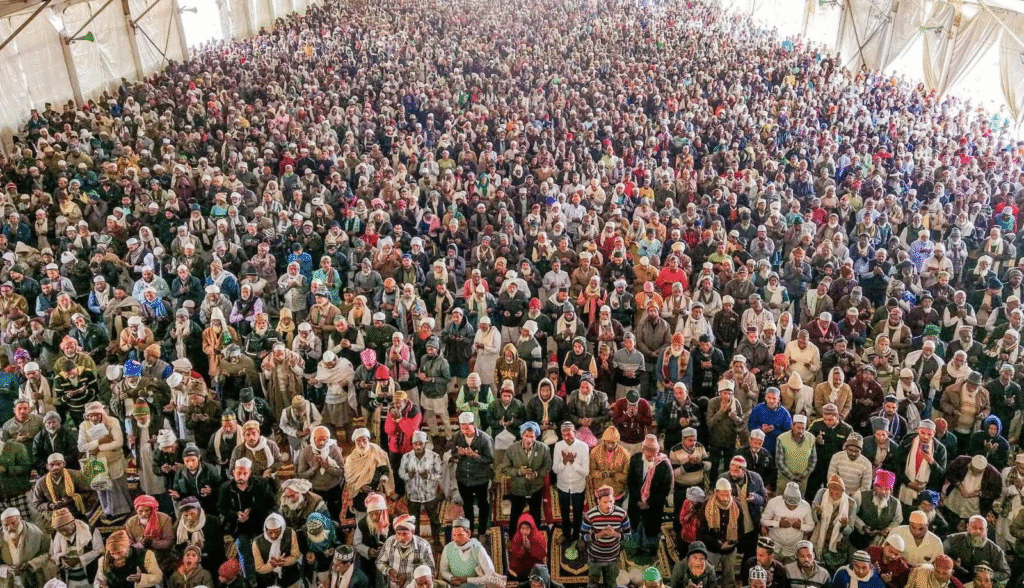
The 814th Annual Urs Mubarak of Hazrat Khwaja Moinuddin Chishty concluded peacefully and successfully at Ajmer Sharif, with the participation of over one million devotees from India and across the world, who gathered in devotion, prayer, and humility.

Speaking on the occasion, Haji Syed Salman Chishty, Gaddi Nashin of Dargah Ajmer Sharif, said:

“We are deeply grateful to the Almighty that the 814th Urs concluded successfully with more than one million seekers gathering at Ajmer Sharif in an atmosphere of peace, love, and devotion that transcended faith, language, nationality, and culture.”

He emphasised that the Urs was not merely a ritual observance, but a living prayer for humanity at a critical moment in world history.

814th Annual Urs Mubarak of Hazrat Khwaja Gharib Nawaz Concludes Successfully at Ajmer Sharif

“For over eight centuries, Ajmer Sharif has remained a spiritual refuge where wounded hearts find solace, divided souls find unity, and humanity reconnects with its shared moral compass,” Chishty said.

Recalling the core teaching of Khawaja Gharib Nawaz, he added:

“The message of Hazrat Khwaja Sahib—‘Love towards all, malice towards none’—is not confined to one community. It is a universal ethic for a world yearning for healing. True spirituality unites; it never divides.”

Prayers for Global Peace and Humanity

Reflecting on global developments in 2025, Haji Syed Salman Chishty said the year had witnessed deeply painful incidents of terror, violence, and rising polarisation, threatening human fraternity and social harmony.

“Every innocent life lost—regardless of faith or nationality—is not a statistic; it is a sacred trust violated. Pain does not belong to one community alone. The suffering of one is the suffering of all humanity,” he said.

814th Annual Urs Mubarak of Hazrat Khwaja Gharib Nawaz Concludes Successfully at Ajmer Sharif

From the spiritual centre of Ajmer Sharif, he offered special prayers:

“We pray for the safety, dignity, and freedom of the Hindu community in Bangladesh, for all minorities and vulnerable communities worldwide, and for families shattered by terror and injustice.”

Message to India and the World

Addressing the people of India and the global community, the Gaddi Nashin said:

“India’s soul has always been anchored in pluralism, coexistence, and spiritual democracy. Ajmer Sharif stands as living proof that diversity is not a weakness—it is our greatest strength.”

He cautioned against the misuse of faith:

“Faith should heal hearts, not harden them. Religion must protect life, not politicise it. True devotion is measured by compassion in action.”

A Call for Hope in 2026

Looking ahead, Haji Syed Salman Chishty called for a renewed global commitment to peace:

“As humanity steps into 2026, we pray that it becomes a Year of Hope—where peace is rooted in justice, dialogue replaces division, education defeats extremism, and service triumphs over selfishness.”

He underlined the shared responsibility of faith institutions and media:

“Words shape minds and narratives shape nations. Faith institutions and media must amplify truth, not fear, and uphold human dignity beyond headlines.”

Concluding his message from the sacred threshold of Ajmer Sharif, he said:

“May hearts soften where hatred has hardened. May dialogue replace discord. May justice walk hand in hand with mercy. May humanity rediscover its shared soul.”

Urs Mubarak to all.

Adani Group to Invest ₹1.8 Lakh Crore in Defence Sector; Focus on AI-Powered Drones and Missiles by 2026

0

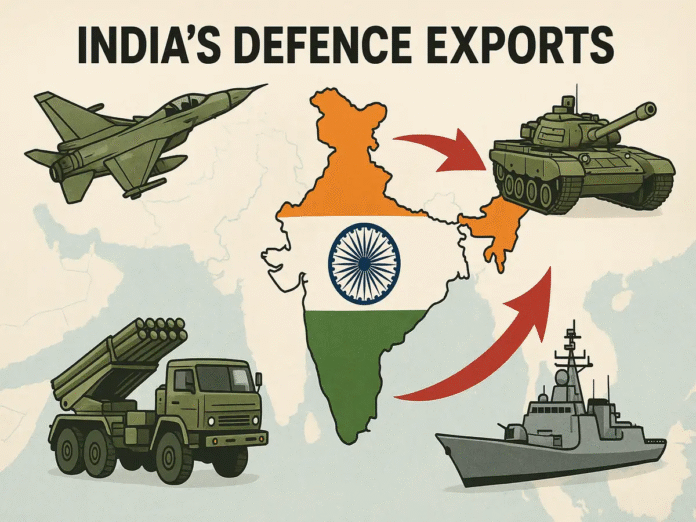
The Adani Group has announced plans to invest ₹1.8 lakh crore in India’s defence manufacturing sector over the next year, with a strong focus on AI-powered drones, autonomous systems, and advanced guided weapons designed for future warfare.

According to a PTI report, military hardware developed by the group has already been deployed in key operations, including Operation Sindoor in 2025.

Focus Areas of Investment

The investment will be routed through Adani Defence and Aerospace, which plans to strengthen capabilities in:

  • Unmanned and autonomous systems across air, land, and sea
  • AI-enabled multi-domain operations
  • Advanced sensors and electronics
  • Precision-guided weapons and missile systems
  • Large-scale MRO (Maintenance, Repair, and Overhaul) and training infrastructure

Adani Systems Inducted Across All Three Services

Adani Defence has emerged as one of India’s largest integrated private-sector defence manufacturers, with several of its systems inducted into the Army, Navy, and Air Force.

  • Drones for Navy and Army: In 2025, Drishti-10 UAVs were inducted for long-range intelligence, surveillance, and reconnaissance (ISR) missions.
  • Counter-Drone Systems: Adani’s counter-drone solutions have successfully cleared trials conducted by all three services.
  • Guided Weapons: The Agnika loitering munitions have demonstrated effectiveness in electronic warfare scenarios.
  • MANPADS: The ARKA shoulder-fired missile system has been developed for tri-service deployment.

In February, Adani Defence and Aerospace, in collaboration with DRDO, also unveiled a vehicle-mounted counter-drone system.

What Are Autonomous Systems?

Autonomous systems are unmanned platforms operating with minimal human intervention, enabled by advanced sensors, secure networks, and intelligent software.

  • Air: Drones conduct reconnaissance, surveillance, communication, and precision support with extended endurance.
  • Sea: Uncrewed vessels carry out maritime surveillance, underwater warfare, and mine-clearing operations.
  • Land: Autonomous vehicles assist in reconnaissance, bomb disposal, and border security.

These systems enhance operational reach while significantly reducing risk to personnel.

Targeting 25% Share in Private Defence Market

By 2026, Adani Defence plans to:

  • Expand drone platforms across air, sea, and land
  • Strengthen precision-strike capabilities
  • Scale up AI-driven defence technologies
  • Establish additional service, maintenance, and training centres

The company aims to capture 25% of India’s private-sector defence market, aligning its expansion with the country’s long-term defence modernisation goals. Reports suggest the investment will also generate significant employment and strengthen India’s indigenous defence ecosystem.

Happy New Year 2026 Wishes, Quotes, Pictures, Posters & Messages (50+)

0

Happy New Year: As we step into 2026, it’s time to welcome new beginnings, fresh hopes, and endless possibilities. A new year brings renewed energy, positivity, and the promise of brighter days ahead. Celebrate this beautiful moment by sharing heartfelt wishes, inspiring quotes, and warm messages with your loved ones.

Happy New Year 2026 Wishes, Quotes & Messages (50+)

Happy New Year 2026 Quotes

  1. “Every new year brings new hope, new dreams, and new possibilities. Welcome 2026!”
  2. “A new year is a fresh page—write a beautiful story in 2026.”
  3. “Let 2026 be the year you grow, glow, and go after your dreams.”
  4. “Every ending leads to a new beginning. Welcome 2026!”
  5. “2026 is not just a new year—it’s a new chance to shine.”
  6. “Start 2026 with hope in your heart and faith in your journey.”
  7. “May your dreams take flight and your goals come true in 2026.”
  8. “A brighter future begins today—Happy New Year 2026!”
  9. “New year, new mindset, new possibilities—Happy 2026!”
  10. “Step into 2026 with courage, kindness, and confidence.”

Happy New Year 2026 Messages

  1. Wishing you a joyful, healthy, and successful New Year 2026 filled with happiness and peace.
  2. May this New Year bring you new opportunities and beautiful memories.
  3. Cheers to new beginnings and fresh starts—Happy New Year 2026!
  4. May 2026 turn your dreams into reality and your efforts into success.
  5. Sending warm wishes for love, laughter, and prosperity in the year ahead.
  6. May the New Year bless you with strength, positivity, and endless hope.
  7. Wishing you peace in your heart and joy in every moment of 2026.
  8. Let go of the past and welcome a brighter, happier New Year.
  9. May 2026 bring good health, happiness, and success to you and your family.
  10. Start the New Year with gratitude and end it with achievements to be proud of.

Happy New Year 2026 Wishes (10)

  1. May the New Year bring you peace, happiness, and prosperity.
  2. Wishing you strength to overcome challenges and courage to chase your goals in 2026.
  3. May every day of the New Year bring new reasons to smile.
  4. Here’s to a year filled with growth, joy, and unforgettable memories.
  5. May your home be filled with happiness and your heart with gratitude in 2026.
  6. Wishing you endless opportunities and bright moments in the year ahead.
  7. May 2026 open doors to success, love, and personal growth.
  8. Sending heartfelt wishes for a joyful and prosperous New Year 2026.
  9. May each day of 2026 be filled with positivity and purpose.
  10. Happy New Year 2026! May it be your best year yet.

Happy New Year 2026 Images

Happy New Year 2026 Wishes, Quotes, Pictures, Posters & Messages (50+)

From Small-Town Govt School to Global Stage: Cycle of Growth Is Ratlam School’s Education Story Now Inspiring The World

0

Can you imagine an extraordinary education story emerging from a government school in a small town and making a mark on the global map? It may sound surprising, but it is true.

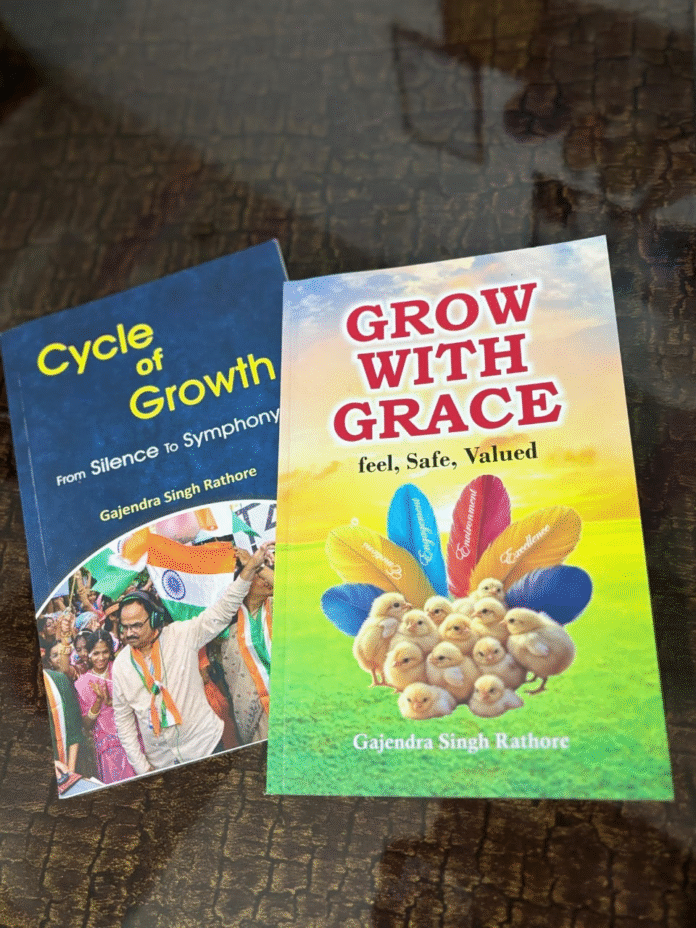
A government school in Ratlam has scripted such a story—one that now resonates globally with the powerful phrase “Silence to Symphony.” This transformation has been driven by a pioneering framework called the “Cycle of Growth,” launched by the school’s Vice Principal, educationist Gajendra Singh Rathore.

A Global Model of Educational Innovation

The journey of this remarkable transformation has been documented in the book “Cycle of Growth,” authored by Rathore, who serves as Vice Principal of Sandipani School (CM Rise Vinoba School). The book narrates how a government school, despite limited resources, evolved into a global model of innovation, ultimately winning the prestigious T4 Education Global Innovation Award.

The book offers deep insights into the strategies, challenges, and innovations that powered this change. Designed as a practical guide, it provides valuable lessons for teachers, principals, policymakers, and students, especially those working in under-resourced educational environments.

One Conversation, One Step at a Time

Summing up his philosophy, Rathore writes:
“True growth begins when teachers, parents, students, and the community move forward with one conversation and one step at a time.”

From Small-Town Govt School to Global Stage: Cycle of Growth Is Ratlam School’s Education Story Now Inspiring The World

This simple yet powerful idea lies at the heart of the Cycle of Growth, which focuses on collective responsibility and consistent effort.

Empowering Marginalised Students

The book also highlights how students from marginalised communities were empowered to create impact-based stories. Many of these students came from families where generations had been engaged in manual labour, and their only perceived future was to join the same workforce.

However, under this new model, they were given something transformative—the courage to dream, to envision a better future, to spread their wings, and to make a meaningful mark on the world.

A Model for Education Reform

The success of the Cycle of Growth demonstrates how vision, leadership, and community collaboration can bring about a sea change in education, even within the government school system.

Kudos to Gajendra Singh Rathore

Congratulations to Gajendra Singh Rathore for creating a powerful and replicable model that has the potential to redefine education development and inspire schools across India and beyond.

I am profoundly impressed by Cycle of Growth – From Silence to Symphony, authored by Gajendra Singh Rathore, a visionary school leader and Vice-Principal of CM Rise Vinoba, Ratlam (Madhya Pradesh, India). The book compellingly chronicles the remarkable transformation of a government school that once served students primarily from the nearby Ambedkar Nagar slum—struggling with low attendance, limited parental engagement, and weak academic outcomes—into an institution of international repute. Within just three years, the school achieved global recognition, including the 2024 World’s Best School Prize for Innovation by T4 Education, along with a USD 10,000 award.

This is not merely a success story; it is a practical blueprint for systemic change in resource-constrained public education. Rathore demonstrates how purposeful leadership, strong team-building, and a deeply embedded culture of appreciation can fundamentally redefine a school’s ecosystem. Central to the narrative is the “Cycle of Growth” model, conceptualized in 2022 from Rathore’s on-ground leadership experience. By positioning teachers as agents of change, the model addresses persistent challenges such as inconsistent student performance and disengagement through continuous professional development and collaborative leadership.

The book offers invaluable insights into team-building and instructional leadership. Rathore’s innovative use of daily “Huddle Spaces”—featuring capsule trainings, role-plays, team-building exercises, and appreciative feedback through classroom walkthroughs—builds trust, boosts morale, and avoids micromanagement. Teachers are empowered to take ownership, collaborate meaningfully, and replicate their enthusiasm in classrooms and communities alike. The result is a motivated, cohesive team driving sustained improvement.

One of the book’s most powerful contributions is its emphasis on the transformative impact of a culture of appreciation. By recognizing teachers through initiatives such as “Teacher of the Month” Google Forms, public acknowledgements, and rewards, the school shifted from apathy to excellence. This ethos extended to students and parents as well, with recognition for perfect attendance and achievements celebrated in meetings, community gatherings, and local festivals—fostering pride, inclusion, and shared responsibility.

Multi-Layered Oppurtunity

Equally compelling are the book’s multi-layered strategies for parental and community engagement. Communication evolved from traditional diaries and phone calls to online PTMs and active WhatsApp groups. Innovative practices—such as integrating community knowledge into NCERT lessons and showcasing student projects at local events—dramatically increased parental involvement and trust.

For students, motivated teachers introduced project-based learning, sports programs to improve attendance, social-emotional learning, and data-driven assessments. These interventions delivered outstanding results, including improved board examination outcomes and prestigious state-level recognition such as Daksh Vidyalaya status.

What truly sets Cycle of Growth apart is its practicality, scalability, and replicability. Rathore’s refusal to accept limitations makes this book a motivational and operational guide for educators worldwide. In an era marked by educational inequities, it offers hope and direction—proving that a strong team can be built anywhere, and a committed team can achieve anything.

This journey is an inspiration for school leaders, teachers, parents, policymakers, and the younger generation alike. I wholeheartedly recommend Cycle of Growth – From Silence to Symphony to anyone seeking to orchestrate meaningful change in education. It powerfully demonstrates that with visionary leadership and collective effort, even the most challenged schools can rise to global standards in a remarkably short time.

Guru Gobind Singh: Life, History, Khalsa Foundation, Battles, and Legacy

0

Guru Gobind Singh, the tenth Sikh Guru, stands as one of the most influential spiritual leaders, warriors, poets, and reformers in Indian history. Known for founding the Khalsa Panth, defending religious freedom, and finalising the Guru Granth Sahib, his life represents courage, sacrifice, and unwavering commitment to justice.

Early Life of Guru Gobind Singh

Guru Gobind Singh was born as Gobind Das (also known as Gobind Rai) in Patna, Bihar, to Mata Gujri and Guru Tegh Bahadur, the ninth Sikh Guru. His birth took place at a time of growing religious intolerance under Mughal rule.

In 1670, the family moved to Punjab and later, in 1672, settled near the Shivalik range in the Himalayan foothills. This region would later shape Guru Gobind Singh’s education, spirituality, and martial training.

Martyrdom of Guru Tegh Bahadur

A defining moment in Guru Gobind Singh’s early life was the martyrdom of his father. Guru Tegh Bahadur was approached by Kashmiri Pandits, who sought protection against forced religious conversions under the Mughal emperor Aurangzeb.

Despite warnings that his life was in danger, Guru Tegh Bahadur stood firm for religious freedom. He was publicly beheaded in Delhi on Aurangzeb’s orders, becoming a symbol of sacrifice for human rights and faith.


Becoming the 10th Sikh Guru

After his father’s martyrdom, Gobind Rai became Guru Gobind Singh on March 29, 1676, at the age of just nine—making him a remarkable child prodigy in Sikh history.

His education continued extensively:

  • Mastery of reading and writing
  • Training in martial arts
  • Expertise in archery and horse riding
  • Knowledge of philosophy, poetry, and warfare

Foundation of the Khalsa (1699)

One of the most transformative events in Sikh history occurred in 1699, during the festival of Vaisakhi.

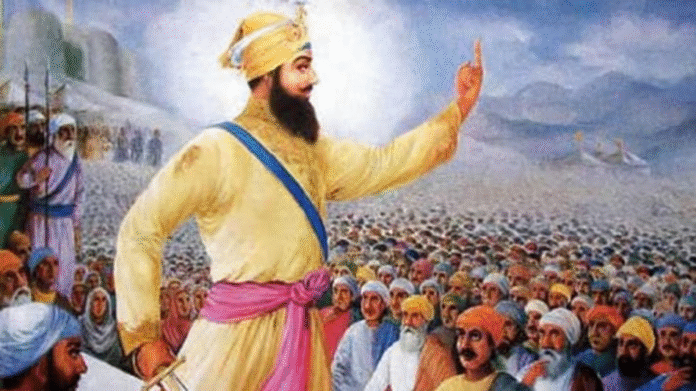
Guru Gobind Singh called upon Sikhs to gather and founded the Khalsa Panth—a disciplined, egalitarian community of saint-soldiers.

Creation of the Khalsa

  • He initiated five devoted Sikhs, known as the Panj Pyare
  • He then asked to be baptised by them, becoming the sixth Khalsa
  • He gave all Khalsa members the surname “Singh” (Lion)

From that moment, Gobind Rai became Guru Gobind Singh, symbolising equality, courage, and unity.

The Five Ks of Sikhism

Guru Gobind Singh established the Five Ks, central to Sikh identity:

  1. Kesh – Uncut hair (spiritual strength)
  2. Kangha – Wooden comb (cleanliness and discipline)
  3. Kara – Steel bracelet (self-restraint and unity with God)
  4. Kacchera – Soldier’s shorts (readiness and moral control)
  5. Kirpan – Sword (defense of righteousness)

Dharma Yudh: His Philosophy of War

Guru Gobind Singh believed in “Dharma Yudh”—a righteous war fought only as a last resort to defend justice and faith.

Despite leading around 13 battles, he:

  • Never attacked places of worship
  • Never took hostages
  • Never fought for political power
  • Fought solely against tyranny and oppression

Major Battles of Guru Gobind Singh (Timeline)

1688 – Battle of Bhangani

His first major battle, fought bravely against hostile hill rulers.

1691 – Battle of Nadaun

A significant battle against Mughal-supported Islamic forces.

1702 – Resistance Against Aurangzeb

Guru Gobind Singh confronted the tyranny of the Mughal Empire.

1705 – Final Battles

He fought his last major battles against Mughal forces, showcasing unmatched resilience.

Supreme Sacrifice of His Family

One of the most heart-wrenching aspects of Guru Gobind Singh’s life is that all four of his sons (Sahibzadas) were martyred:

  • Two were killed in battle
  • Two were executed alive by the Mughals

Despite this unimaginable loss, Guru Gobind Singh remained steadfast in faith and duty.


Assassination and Martyrdom (1708)

Guru Gobind Singh was assassinated in 1708, but before his death, he made a historic declaration:

  • Guru Granth Sahib would be the eternal Guru of the Sikhs
  • No human Guru would succeed him

This decision permanently shaped Sikhism.

Why Guru Gobind Singh Is Loved and Revered

A True Leader

He never sought power or wealth. He even placed himself below his own initiated followers, merging his identity with the Khalsa.

A Master Warrior and Artist

  • Expert in weaponry and archery
  • Legends speak of him stopping a rampaging elephant with a javelin
  • A gifted poet and philosopher

A Multilingual Scholar

He mastered Hindi, Sanskrit, Urdu, Persian, Gurmukhi, and Braj.

Contributor to Arts and Music

He invented musical instruments like Taus and Dilruba, reflecting his love for art and culture.

Legacy of Guru Gobind Singh

Guru Gobind Singh’s legacy lives on through:

  • The Khalsa Panth
  • The Five Ks
  • The eternal authority of the Guru Granth Sahib
  • His message of equality, courage, and resistance against injustice

Conclusion

Guru Gobind Singh was not only a religious leader but a visionary reformer, fearless warrior, poet, and humanitarian. His life teaches that standing for truth may demand sacrifice—but righteousness must never be abandoned.

Salman Khan: Jail, Bail, and Living Under the Shadow of the Law…Prison Cells And Packed Theatre Stories

0

Few stars in Indian cinema have lived a life as publicly scrutinised as Salman Khan. Blockbusters, courtrooms, controversies, health battles, and philanthropy have all coexisted in his journey. Yet, through every storm, one image endures — Salman Khan smiling, meeting fans, returning to sets, and refusing to disappear.

This is the story of how the superstar chose resilience over retreat.

Salman Khan and Early Controversies: The Rise of the ‘Bad Boy’ Image

In the late 1990s and early 2000s, Salman Khan became a constant presence in Bollywood headlines — not just for films, but for confrontations with paparazzi and public altercations. The media labelled him Bollywood’s “bad boy,” a tag that followed him relentlessly.

By 2014, tensions had escalated to the point where some publications reportedly refused to photograph him. Fame, once an asset, had turned into a magnifying glass that never blinked.

The Blackbuck Poaching Case: A Legal Battle That Spanned Decades

The most defining controversy of Salman Khan’s life emerged from Rajasthan in 1998, during the shooting of Hum Saath-Saath Hain. He was accused of killing protected wildlife species, including blackbucks and a chinkara.

The case led to four separate trials under India’s Wildlife Protection Act and Arms Act. Over the years:

  • Two cases were overturned in 2016
  • One resulted in acquittal in 2017
  • One led to a five-year jail sentence in 2018

Salman Khan spent days in Jodhpur Central Jail before being granted bail. Even today, appeals remain pending, making the case a continuing chapter in his life.

Security Threats and Life Under Protection

The year 2018 marked another turning point. Following the blackbuck verdict, Salman Khan received an open threat from gangster Lawrence Bishnoi, linked to the Bishnoi community that reveres blackbucks as sacred animals.

Since then, Salman Khan has lived under heightened security. Public appearances, film shoots, and travel are now carefully planned — a reality far removed from the freedom of his early stardom.

The Hit-and-Run Case: When the Past Returned to the Present

Another long-running legal battle resurfaced in 2015, when Salman Khan was found guilty in the 2002 Mumbai hit-and-run case, involving the death of one person and injuries to four others.

The conviction, which included charges of driving under the influence, resulted in a five-year prison sentence. Months later, the verdict was overturned due to insufficient evidence.

The emotional toll, however, lingered — a reminder that fame does not grant immunity from the weight of tragedy.

Sultan Comment Controversy: When Words Triggered Nationwide Outrage

In 2016, during promotions for Sultan, Salman Khan’s comparison of his physical exhaustion to that of a “raped woman” sparked widespread backlash.

Despite clarifications and an attempt to retract the remark, the controversy escalated. The National Commission for Women intervened, calling his explanation unsatisfactory and summoning the actor.

It was a moment that reinforced a harsh truth: for public figures, words can wound deeper than actions.

Being Human Foundation: Philanthropy Beyond Headlines

Amid legal and public turbulence, Salman Khan quietly focused on building something lasting. In 2007, he founded Being Human – The Salman Khan Foundation, dedicated to healthcare and education for underprivileged communities.

To sustain the initiative, he launched Being Human Clothing, now managed by his sister Alvira Agnihotri Khan. Unlike controversies, this work rarely screamed for attention — yet its impact has touched thousands of lives.

Salman Khan Films and Creative Control Over His Career

In 2011, Salman Khan established Salman Khan Films (SKF), taking greater control over his creative output. The production house backed successful and meaningful projects like:

  • Chillar Party
  • Bajrangi Bhaijaan
  • Dabangg 3

He also contributed as a writer to films like Veer and Dabangg 3, proving that reinvention was as important as survival.

Health Battle: Trigeminal Neuralgia and Silent Suffering

In the same year SKF was founded, Salman Khan underwent surgery in Los Angeles for trigeminal neuralgia, a nerve disorder known for causing extreme facial pain.

For years, he worked through shooting schedules while enduring the condition in silence. The successful surgery brought relief — and revealed another layer of endurance behind his public persona.

Fitness, Discipline, and Work as Therapy

Salman Khan’s rigorous fitness routine has often made headlines, but for him, discipline became therapy. Training, films, and structure offered stability when life outside the gym felt unpredictable.

Work was not an escape — it was survival.

Why Salman Khan Still Smiles Despite Everything

Salman Khan’s smile today is not denial of the past. It is acceptance of it.

It reflects:

  • A man who has faced prison cells and packed theatres
  • A life shaped by mistakes, service, pain, and persistence
  • A star who understands that redemption is not declared — it is lived daily

Salman Khan: Beyond Controversies, a Survivor of His Own Life

Wax statues at Madame Tussauds across the world, top rankings in Forbes India Celebrity lists, and an unmatched fan following tell one story. His battles tell another.

Somewhere between verdicts and victories, Salman Khan learned to stand, wave, and smile — not because life spared him, but because he chose to endure.

In a world quick to judge, Salman Khan remains — flawed, resilient, and unbroken.

Top 5 Cult Styles of Salman Khan That Defined Popular Culture

0

Salman Khan isn’t just a superstar — he’s a trendsetter whose style moments have repeatedly turned into nationwide crazes. From fashion statements to signature moves, here are five cult Salman Khan styles that left a permanent mark on Indian popular culture:

The Suspenders Look – Hum Aapke Hain Koun..! (1994)

Long before fashion influencers existed, Salman Khan made suspenders-over-a-shirt look became an instant sensation cool. Worn casually over a shirt, this simple yet charming look from Hum Aapke Hain Koun..! became a rage among youngsters in the 90s, symbolising innocence, romance, and boy-next-door appeal.

Ripped Jeans & Bare-Chested Swagger – Oh Oh Jaane Jaana (1998)

Salman’s ripped jeans and sculpted physique in Pyaar Kiya To Darna Kya redefined masculine style in Bollywood. The look was raw, rebellious, and aspirational — gyms filled up, and ripped denim became mainstream youth fashion almost overnight

The Turquoise Bracelet – A Timeless Signature

Perhaps the most iconic Salman Khan style element, the turquoise bracelet is more than an accessory — it’s a symbol. Worn consistently on and off screen, it has become inseparable from his identity, inspiring millions of fans to wear replicas as a mark of admiration

Chulbul Pandey’s Sunglasses Swagger – Dabangg (2010)

With Dabangg, Salman unleashed Chulbul Pandey — and with him came a cult style revolution. Hooking sunglasses on the back of the shirt collar became a mass trend, instantly copied across small towns and cities, cementing Salman’s unmatched pop-culture influence.

The ‘Salman Step’ – Quirky, Fearless, Iconic

Salman Khan may not follow classical dance techniques, but his confidence-driven moves created a style of their own. From the hook step of “Hud Hud Dabangg” to “Selfie Le Le Re”, his effortless, quirky dance moves became wedding staples and viral sensations.

Beyond Style: A Cultural Phenomenon

Salman Khan’s influence goes beyond fashion and dance. His dialogues — like “Dosti ka ek usul hai, madam—no sorry, no thank you” — are etched into Bollywood history. His global appeal is reflected in wax statues at Madame Tussauds in London, New York, and Dubai. Ranked among the highest-paid Indian actors by Forbes India, Salman Khan remains a living embodiment of mass stardom.

Salman Khan doesn’t follow trends — he creates cults.

New Income Tax Act 2025 To Take Effect From April 1

0

India’s direct tax framework is set for its most sweeping reform in over six decades with the replacement of the Income-tax Act, 1961, by the Income-tax Act, 2025. The new legislation will come into force from April 1, 2026, and will apply to income earned in the financial year 2025–26 onwards. The move marks a decisive shift towards simplification, clarity, and technology-driven tax administration.

Why the Income-tax Act, 2025 Was Introduced

Over the years, the 1961 Act had expanded into a highly complex law with more than 800 sections, frequent amendments, and overlapping interpretations. To address this, the government undertook a comprehensive rewrite aimed at eliminating obsolete provisions, reducing litigation, and aligning tax law with a modern, digital economy. The new Act seeks to make compliance easier for taxpayers while improving administrative efficiency.

Effective Date and Transition Timeline

Although the Income-tax Act, 2025 received presidential assent in August 2025, it will be operational from April 1, 2026. This means tax returns filed for Assessment Year 2026–27 will still largely follow the 1961 Act. However, procedural and administrative changes linked to the new law will begin influencing compliance systems from the upcoming financial year.

Key Structural and Procedural Changes

The new Act significantly reduces complexity by cutting sections from 819 to 536 and chapters from 47 to 23. The language has been simplified, with extensive use of tables and formulas replacing long textual provisions. A major reform is the introduction of a unified “Tax Year”, replacing the dual concepts of “previous year” and “assessment year”, thereby simplifying tax computation and understanding.

Facts

  • The Income-tax Act, 2025 replaces the Income-tax Act, 1961.
  • The new law becomes effective from April 1, 2026.
  • Number of sections reduced from 819 to 536.
  • A single ‘Tax Year’ concept replaces previous year and assessment year.

While individual tax rates and slabs remain unchanged, the Act supports the revised tax regime with higher rebates and a larger standard deduction, effectively making income up to Rs 12 lakh tax-free. Redesigned income tax return forms, expanded digital and faceless procedures, and clearer provisions aim to reduce disputes and improve certainty. The emphasis on technology and simplified compliance is expected to benefit salaried individuals, professionals, and businesses alike