

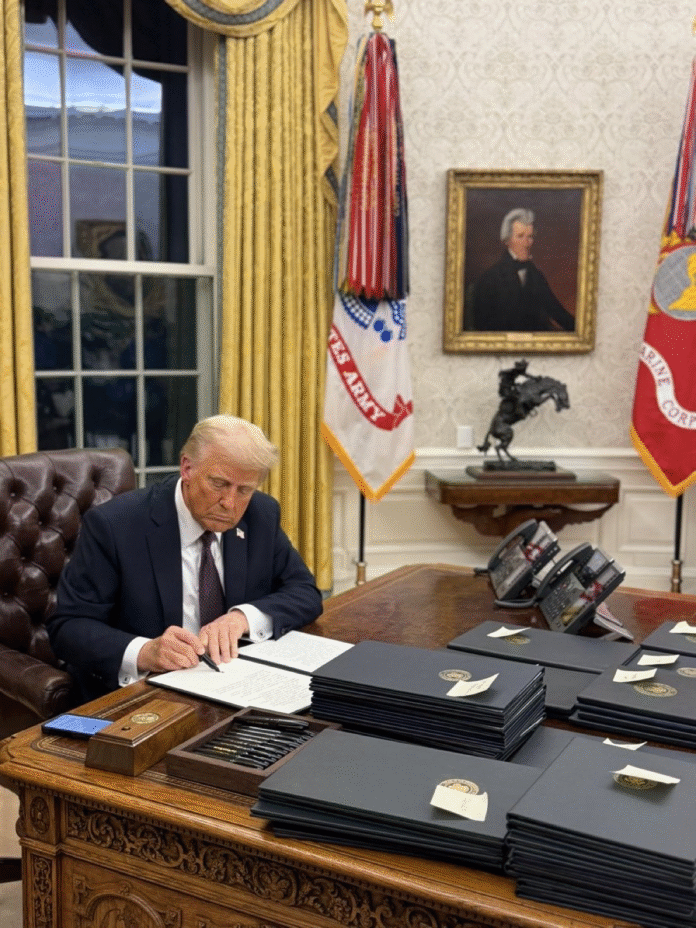
As Donald Trump completes one year of his second term as US President, the central question confronting the world is whether his second year will be as disruptive as the first. Early signals suggest continuity rather than correction. Trump has revived a blunt conception of power, choosing muscle over money as his primary instrument of statecraft. This choice has far-reaching implications, not just for the US, but for a global order that is no longer bipolar, yet not comfortably multipolar either.
Power, money and muscle: a revealing choice
Traditionally, great powers rely on two enduring tools: economic influence (money) and coercive strength (muscle). China, for decades, has leaned heavily on money—patient capital deployment, infrastructure financing, trade integration and manufacturing dominance. The US under Trump has moved decisively in the opposite direction.
Muscle works fast. It shocks, coerces and compels. Money works slowly, shaping incentives and dependencies over time. The contrast reveals deeper cultural orientations: impatience versus patience. But this choice also exposes a structural weakness. The US retains unmatched military muscle but faces fiscal constraints and rising debt. China commands vast financial resources but lacks comparable military reach. India, like most other countries, has neither at scale.
This asymmetry defines today’s geopolitical reality.
Why the “G2” illusion has collapsed
For years, analysts spoke of a “G2” world dominated by the US and China. That idea is now obsolete. The world has effectively become a three-player system: the US, China, and everyone else combined. Economists and political theorists have long warned that three-player systems are the most unstable.
This instability is not new. One of the most intuitive depictions appears in 1984 by George Orwell. Written in 1949, the novel imagines a world divided into three blocs—Oceania, Eurasia and Eastasia—where two are always allied against the third. Alliances shift, enemies change, but conflict is permanent. Technology enables surveillance, control and behavioural conformity. The resemblance to today’s world is unsettling.
The economics of three players: ice creams and horses
Economics offers parallel insights. The American economist and mathematician Harold Hotelling illustrated instability through his famous “ice cream vendors on a beach” model. With two vendors, stability emerges as each occupies half the market. Introduce a third, and equilibrium collapses. Each keeps repositioning to maximise advantage, leaving the system in constant flux.
This idea, known as “minimum differentiation”, holds only in two-player settings. Add a third, and balance becomes elusive.