

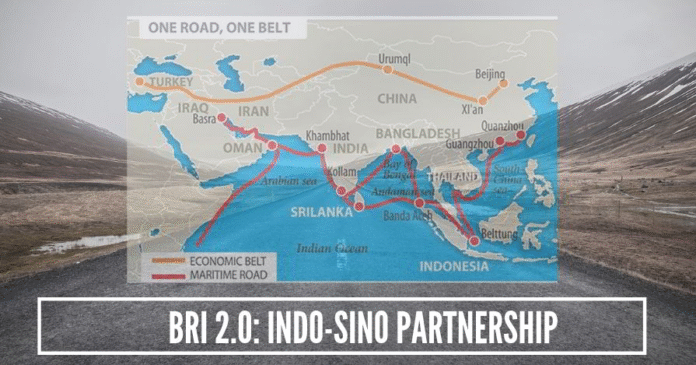
At its inception in 2013, the Belt and Road Initiative (BRI) was predominantly assessed through the lens of “tangible connectivity”—the heavy industrial deployment of high-speed rail networks, deep-sea maritime hubs, and expansive special economic zones. This initial phase, often retrospectively termed BRI 1.0, focused on the “hard” infrastructure gaps of developing nations. However, as we navigate through the early months of 2026, the strategic focus has undergone a fundamental transition toward what the China Institute of International Studies (CIIS) characterizes as the “High-Quality BRI” era. This evolution was definitively codified during the Third Belt and Road Forum in 2023, where President Xi Jinping reoriented the initiative toward “small yet impactful projects” that emphasize rigorous standards, ecological viability, and social welfare outcomes.
Why China has become systemic architect
This shift represents a sophisticated tactical realignment rather than a retreat; it is a move toward a model of functional indispensability, wherein Chinese technological architectures and regulatory protocols become the intrinsic nervous system of ASEAN economies. Within Chinese academic circles, specifically among researchers at the Chinese Academy of Social Sciences (CASS), this current phase is interpreted as the practical implementation of the “Community of Shared Future for Mankind”. In this geopolitical framework, China has moved beyond the role of a traditional lender to become a “systemic architect”. By weaving Chinese technical benchmarks into the foundational layers of Southeast Asian infrastructure, Beijing ensures that regional development is tied to Chinese technological life cycles.
As the World Bank highlights, the enduring value of this transition is found in the streamlining of trade and the reform of institutional frameworks. This evolution is crucial for Beijing as it seeks to invalidate Western “de-risking” strategies by making its integration into Southeast Asia an essential, non-negotiable reality.
Furthermore, the Chinese Ministry of Commerce (MOFCOM) has underscored that the “High-Quality” mandate revolves around the “Three Highs”: elevated standards, long-term sustainability, and significant community impact. This signals a pivot toward environmental, social, and governance (ESG) metrics that were largely sidelined during the initial BRI 1.0 phase. By championing these standards, China aims to mitigate international anxieties regarding “debt-trap diplomacy” while effectively outmaneuvering Western initiatives such as the G7’s Partnership for Global Infrastructure and Investment (PGII). The Asian Development Bank (ADB) posits that this institutional deepening will serve as the primary engine for regional economic growth over the coming decade, as physical assets transition into fully operational and interconnected ecosystems.
Technical Standardization and the Digital Silk Road: Governance via Code
The most effective tool in the BRI 2.0 arsenal is the systematic integration of Chinese technical standards into the national regulatory frameworks of neighboring states. In Beijing’s strategic planning, there is a core belief that while “third-tier firms produce goods, first-tier firms establish standards”. This philosophy is being aggressively deployed through the Digital Silk Road (DSR).
This creates a scenario where local governance becomes inextricably linked to Chinese back-end support. This systemic saturation makes a strategic “de-coupling” virtually impossible in the digital realm, as core architectures become aligned with Chinese standards.
The Ideology of “Standardization Power” (Biaozhun Quan)
The most effective tool in the BRI 2.0 arsenal is the systematic integration of Chinese technical standards into the national regulatory frameworks of neighboring states, establishing a long-term path dependency. To understand the depth of this integration, one must look at the internal Chinese discourse surrounding the concept of “Standardization Power” (Biaozhun Quan). In Beijing’s strategic planning, there is a core belief that while “third-tier firms produce goods, second-tier firms produce technology, and first-tier firms establish standards.” This philosophy, articulated in the China Standards 2035 blueprint, represents a shift from being a “consumer” of global norms to a “creator” of them.
In the context of Southeast Asia, this is not merely a commercial endeavor but a form of “institutional statecraft.” By exporting standards for everything from 5G telecommunications to high-speed rail signaling and cloud computing architecture, China is ensuring that the foundational “operating system” of the region is compatible with its own. This creates what scholars define as a “technical ecosystem of reliance.” When a host country adopts a Chinese technical standard, they are not just buying a product; they are entering a multi-decade lifecycle of maintenance, upgrades, and secondary hardware requirements that only Chinese firms can provide.
The Digital Silk Road (DSR) as a Governance Template
The Digital Silk Road (DSR) serves as the primary vehicle for this standardization. While BRI 1.0 was about the “Hard Silk Road” (bridges and ports), BRI 2.0 is about the “Soft Silk Road”—the data centers, terrestrial fiber-optic cables, and satellite links that manage the flow of information. The DSR is effectively building a “Parallel Internet” governed by a state-centric model of cyber-sovereignty.
In Southeast Asia, this model is particularly attractive to governments seeking to modernize their economies while maintaining control over domestic information flows. China provides a complete ecosystem: hardware, software, and regulatory templates. This creates a symbiotic relationship where the host country achieves digital modernization, and China achieves functional indispensability.
Submarine Cables and Data Sovereignty
A critical component is the “Underwater Silk Road”—the network of submarine fiber-optic cables carrying global data. Chinese firms have become dominant players in this domain, connecting major ASEAN digital hubs directly to Chinese networks.
Control over these systems provides “informational structural power,” allowing influence over regional data flows. While cost advantages make Chinese systems attractive, they often come with embedded regulatory and technological dependencies.
The Fintech Frontier and the mBridge Revolution
BRI 2.0 has expanded into the financial digital space through initiatives like the mBridge project, enabling cross-border digital currency transactions.
This system allows trade settlement outside Western-dominated frameworks, strengthening China’s financial influence and promoting the Yuan in regional trade.
AI and the Standardization of Smart Governance
Chinese AI-driven “Smart City” systems are being adopted across Southeast Asia, shaping governance models in areas like surveillance, traffic management, and emergency response.
These systems embed Chinese technological and ideological frameworks into urban governance, creating long-term structural alignment.
The “China Plus N” Strategy and Supply Chains
China’s “China Plus N” strategy redistributes manufacturing across Southeast Asia while retaining high-value production and control domestically.
This ensures that even when production shifts geographically, dependence on Chinese components and systems remains intact.
Geopolitical Repercussions
BRI 2.0 creates a tension between economic integration and strategic autonomy. While ASEAN nations benefit from infrastructure and trade, increasing dependence on Chinese systems limits policy flexibility.
Conclusion: Navigating the Horizon of 2030
The future of BRI lies not in physical infrastructure alone, but in systemic integration—digital, financial, and regulatory.
For ASEAN nations, the challenge will be balancing the benefits of integration with the preservation of sovereignty, as regional systems become increasingly intertwined with Chinese technological and economic frameworks.

(The writer of this article is Vanshika Choudhary)