

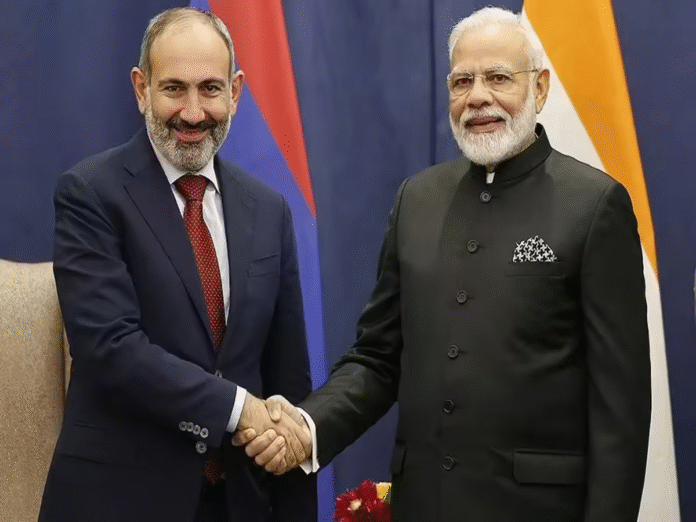
India’s contemporary foreign policy trajectory reflects a marked recalibration toward diversifying partnerships within the Global South. Against the backdrop of evolving global alignments, economic vulnerabilities, and emerging power centres, New Delhi’s outreach to strategically significant yet previously peripheral regions underscores its intent to expand its diplomatic spectrum. The strengthening of partnerships with Armenia in the South Caucasus and Argentina in Latin America reveals an integrated approach to advancing India’s geopolitical, economic, and energy security interests. Both relationships illustrate India’s strategic pursuit of multi-vector diplomacy, consolidating its position as a pivotal actor fostering South–South cooperation amid a shifting global order.
Reframing India–Armenia Defence and Strategic Engagement
India’s engagement with Armenia has deepened substantially in recent years, anchored in mutual security priorities and shared concerns about regional stability. The defence domain has become the linchpin of this partnership. India’s export of high-value military hardware, including multi-barrel rocket launch systems and advanced counter-drone technologies, aligns with Armenia’s defence modernization efforts and demonstrates India’s emergence as a credible supplier in the international defence market. These transactions are more than commercial exchanges; they signify a convergence of strategic interests and reinforce India’s readiness to support like-minded partners facing asymmetric security challenges.
Beyond defence sales, New Delhi has institutionalized political consultations with Yerevan, seeking to establish a sustained dialogue on peace, connectivity, and stability across the South Caucasus. For India, strengthening relations with Armenia serves dual objectives—enhancing its geostrategic footprint in Eurasia and ensuring that its interests are represented in a region historically dominated by external powers. Through targeted diplomatic initiatives, capacity-building assistance, and defence cooperation agreements, India is positioning itself as a stabilizing force and credible stakeholder in Armenia’s security architecture. This alignment not only enhances bilateral trust but also introduces an additional vector for India’s engagement with Eurasian geopolitics, which aligns with its broader policy of counter-balancing regional rivalries and securing routes for trade and energy diversification.
Deepening India–Argentina Cooperation in Agriculture and Energy
India’s expanding engagement with Argentina demonstrates its intent to build long-term economic partnerships rooted in complementarity and resilience. As one of Latin America’s leading agricultural producers, Argentina has emerged as a strategic contributor to India’s food security framework. Bilateral trade in essential agricultural commodities such as soy, sunflower oil, and animal feed has grown substantially, helping India to mitigate vulnerabilities in its domestic supply chain while enabling Argentina to diversify export markets. This cooperation represents a pragmatic dimension of India’s economic diplomacy—leveraging agricultural collaboration to secure essential resources while strengthening South–South interdependence.
The energy component of the India–Argentina relationship is equally significant. With rising global demand for critical minerals, India’s collaboration with Argentina on lithium exploration and procurement represents a forward-looking dimension of its energy security strategy. Argentina’s prominence as a key member of the global “lithium triangle” provides India access to indispensable raw materials required for renewable energy technologies and electric vehicle production. Through investments in joint ventures, research collaborations, and supply chain development, India aims to establish long-term partnerships that can sustain its domestic manufacturing ecosystem and clean-energy transition. The synergy between food and energy trade exemplifies a comprehensive partnership model—one that addresses India’s domestic developmental priorities while reinforcing South–South industrial and technological cooperation.
Connectivity, Multipolarity, and Strategic Autonomy
The parallel development of India’s engagements with Armenia and Argentina aligns with its broader objective of creating a resilient and diversified network of partnerships across the Global South.
By engaging strategically with countries situated along distinct regional axes, India is reinforcing its vision of strategic autonomy while reducing dependency on traditional geopolitical blocs. In the case of Armenia, this involves deepening political and security ties within Eurasia to strengthen India’s connectivity alternatives beyond conventional supply routes. In Argentina’s case, it entails expanding India’s economic footprint across Latin America, contributing to diversified access to markets and critical resources. These twin partnerships also symbolize India’s commitment to advancing a multipolar global order that gives greater agency to emerging economies.
By building sustainable relationships with partners across distinct continents, India reinforces the principle that global governance should reflect equitable participation and collective progress. This multipolarity-oriented diplomacy also strengthens India’s capacity to serve as a bridge between regions, facilitating cooperation, trade, and knowledge exchange among developing nations. The strategic complementarity of these relationships underscores India’s evolving role—not merely as a regional power, but as a global partner advocating inclusive development and shared stability.
Policy Implications and Forward Pathways
The consolidation of India’s relations with Armenia and Argentina offers clear policy implications extending beyond bilateralism. For India’s policymakers, these partnerships represent experimental blueprints for broader South–South collaboration. The defence and strategic cooperation with Armenia sets a precedent for India’s role as a reliable security partner capable of contributing to regional equilibrium without direct intervention. Meanwhile, the agricultural and energy cooperation with Argentina illustrates the potential for interregional supply chains rooted in sustainable growth and technological collaboration.
Going forward, expanding institutional engagement mechanisms such as joint commissions, business forums, and technology dialogues will be critical. India’s focus should remain on integrating these bilateral initiatives into a broader framework of South–South cooperation that enhances trade connectivity and facilitates knowledge exchange in sectors like renewable energy, defence manufacturing, and agri-tech. The sustained success of these relationships also depends on synchronized diplomatic outreach, alignment with domestic policy objectives such as “Make in India” and “Atmanirbhar Bharat,” and proactive engagement with regional organizations such as CELAC and the Eurasian Economic Union. These multilateral linkages can further amplify India’s strategic visibility while offering platforms for policy synchronization and cross-regional cooperation.
Conclusion
India’s evolving partnerships with Armenia and Argentina exemplify a deliberate strategic recalibration designed to advance South–South cooperation and reinforce India’s global stature as a pragmatic and reliable partner. Through defence cooperation with Armenia, India asserts its growing influence in Eurasian stability; through agricultural and lithium partnerships with Argentina, it strengthens its trade diversification and energy security. Together, these engagements mark a decisive transition in India’s foreign policy—from regional balancing to global bridge-building. As India continues to adapt to the complexities of the twenty-first-century order, its diplomacy with Armenia and Argentina will serve as pivotal instruments for both expanding strategic depth and fostering a more balanced and interconnected world economy.

(This article has been written by Vanshika Chaudhary. She is a post graduate in Political Science and has been a college topper)