

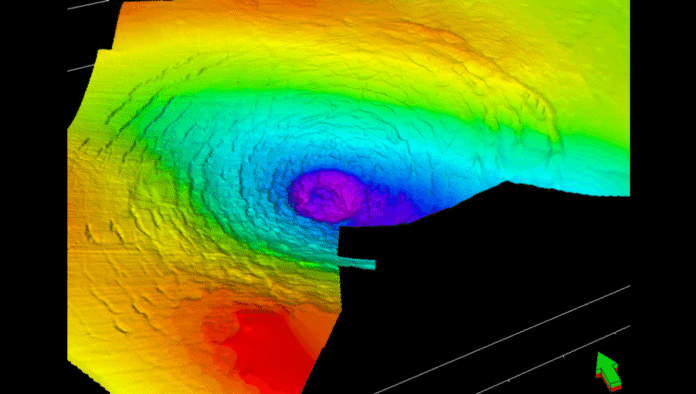
Recent research has confirmed that the Silverpit Crater in the North Sea was formed by a massive asteroid impact millions of years ago. Scientists analysed geological samples and identified minerals typically associated with high-energy space impacts. This finding strengthens earlier theories that the structure beneath the seabed is a genuine impact crater rather than a geological formation created by other processes.
The discovery provides valuable insights into Earth’s impact history and the geological evolution of the North Sea region.
Location and Discovery of the Crater
The Silverpit Crater lies approximately 700 metres beneath the seabed in the North Sea, about 80 miles off the coast of Yorkshire in the United Kingdom. For millions of years, the crater remained hidden under thick layers of sediment.
It was first discovered in 2002 during seismic surveys conducted for oil and gas exploration. Advanced imaging techniques revealed a circular geological structure beneath the seabed, prompting scientists to investigate whether it might be an ancient meteorite impact site.
Formation by a High-Velocity Asteroid Impact
Scientists estimate that the Silverpit Crater formed around 43–46 million years ago, when a large asteroid struck the seabed at extremely high velocity. Such impacts release enormous energy, instantly compressing and heating surrounding rocks.
Recent research identified shocked quartz and feldspar crystals in rock samples obtained from a nearby oil well. These minerals develop distinctive internal structures only under intense pressure created during high-velocity impacts. Their presence provides strong evidence that the crater was formed by an asteroid collision.
Distinctive Geological Features
The Silverpit Crater measures about 3 kilometres in width and is surrounded by a system of concentric faults extending up to 20 kilometres in diameter. These circular fractures formed as shock waves from the asteroid impact propagated through the surrounding rocks.
The crater’s circular structure and central peak resemble classic hypervelocity impact craters observed on Earth and other planetary bodies. Its exceptional preservation beneath sediment layers has allowed scientists to study its geological structure in remarkable detail.