

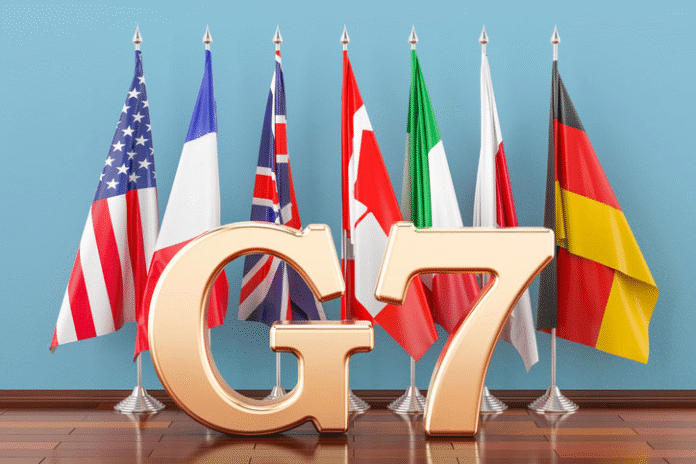
The Group of Seven (G7) is an informal bloc of advanced industrialised democracies—Canada, France, Germany, Italy, Japan, the United Kingdom, and the United States—that convenes annually to discuss major global issues, including economic governance, international security, and emerging topics like artificial intelligence (AI). Proponents argue that the group’s small, relatively like-minded membership fosters decisive collective action, though critics highlight its lack of enforcement mechanisms and the exclusion of emerging powers.
How G7 Started
The G7 began in 1975 as the Group of Six—comprising France, West Germany, Italy, Japan, the UK, and the US—to address pressing economic concerns such as inflation and recession triggered by the OPEC oil embargo. Canada joined in 1976, forming the G7. While originally focused on economic policy, Cold War politics soon influenced the agenda.
Since 1981, the European Union (EU) has participated as a “nonenumerated” member, represented by the presidents of the European Council and European Commission. Though there are no formal criteria for membership, all G7 participants are wealthy democracies. In 2024, the combined GDP of the G7 (excluding the EU) was nearly $57 trillion—about 29% of the global economy.
G7 USP
Unlike formal organizations such as the United Nations or NATO, the G7 has no charter or permanent secretariat. Its presidency rotates annually among members, setting the agenda and organizing the summit. Preparatory meetings, led by ministers and senior officials known as “sherpas,” shape policy proposals. Occasionally, nonmember countries are invited to participate in select discussions.
What Happened with Russia?
Russia joined the G7 in 1998, expanding it to the G8. U.S. President Bill Clinton supported Russia’s inclusion to elevate its international status and encourage democratic and economic reforms under President Boris Yeltsin. Clinton also hoped G8 membership would ease tensions over NATO’s eastward expansion.
However, skepticism persisted, especially among finance ministries, given Russia’s smaller economy and significant public debt. Over time, Russia’s turn toward authoritarianism under Vladimir Putin and its growing divergence from Western norms heightened tensions.
In 2014, following Russia’s annexation of Crimea, it was suspended indefinitely from the group. Additional friction stemmed from Russia’s support of Syria’s Bashar al-Assad, including in the aftermath of chemical attacks, and from interference in U.S. and European elections.
Russia’s full-scale invasion of Ukraine in early 2022 further deepened the rift. The G7 responded with unprecedented sanctions, including phasing out Russian oil and gas imports, freezing Russian financial assets, and restricting access to Western currencies. These actions aimed to cripple Russia’s war capabilities and isolate it economically. At the same time, G7 members have delivered military equipment and hundreds of billions of dollars in aid to Ukraine. In a landmark move, they agreed to lend Ukraine an additional $50 billion using windfall profits from frozen Russian assets as collateral.