

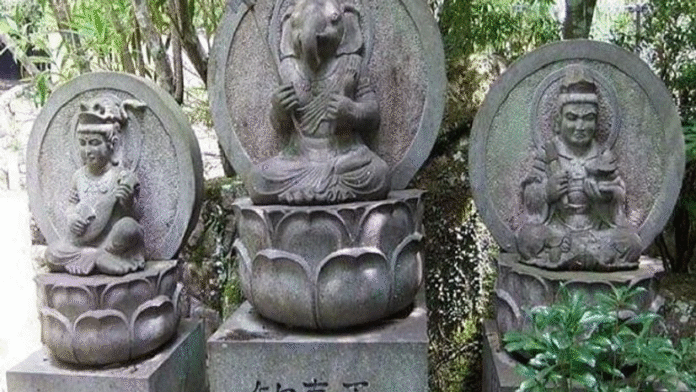
Japan’s spiritual landscape is a captivating blend of Shintoism, Buddhism, folklore, and ancient mythology. But what surprises most people is how deeply Indian deities have influenced Japanese culture for over a thousand years. From temple halls to Samurai traditions, Hindu gods quietly live on in Japan, sometimes with new names, sometimes with new forms, but always with the same divine essence.
Here are seven Hindu gods who traveled across borders, transformed with time, yet continue to be worshipped in Japan even today.
1. Lord Ganesha – Kangiten: The embracing god of bliss
In Japan, Ganesha appears as Kangiten, an elephant-headed deity often shown as a male-female pair locked in an embrace. While the form is unique, the meaning is familiar, remover of difficulties, bringer of joy, success, and prosperity. Just like Ganesha, Kangiten is called upon when people seek breakthroughs and good fortune.
2. Maa Saraswati – Benzaiten: Goddess of art, wealth and warriors
One of Japan’s most beloved deities, Benzaiten, comes from Saraswati. But in Japan, she evolves beyond music and knowledge, she becomes a goddess of wealth, beauty, fertility, and even battle. Samurai once worshipped her as a warrior goddess. With multiple arms and weapons at times, she resembles Saraswati, Lakshmi, and Durga all at once.
3. Lord Shiva – Daikoku: The smiling god of abundance
Shiva’s Japanese counterpart, Daikoku, is part of the Seven Lucky Gods. Though Shiva is often linked with destruction, Daikoku represents prosperity and abundance standing on rice bales and holding a golden mallet that showers blessings. Some forms of Daikoku draw directly from Mahakala, one of Shiva’s fierce manifestations.
4. Goddess Lakshmi – Kichijoten: The Japanese vision of grace & prosperity
Kichijoten embodies everything Lakshmi stands for beauty, fertility, happiness, and wealth. She is portrayed as a radiant woman with serene elegance. Her presence in Japanese temples shows how both cultures revere feminine energy as the source of abundance.
5. Indra Dev – Taishakuten: Protector of the realm
Indra crosses borders as Taishakuten, a powerful protector deity often riding an elephant, just like his Hindu form. Revered especially by warriors, Taishakuten symbolizes strength, justice, and divine authority, a guardian watching over the nation.
6. Kubera/Vaisravana – Bishamonten: The warrior god
In Japan, Kubera transforms into Bishamonten, the god of warriors and one of the Seven Lucky Gods. Depicted with armor, a spear, and a pagoda, he protects the righteous and punishes evil. Bishamonten is not just a god of wealth, he is Japan’s fierce defender of faith and justice.
7. Yama – Enma: The fearsome judge of the afterlife
Just like Yama in Hindu mythology, Enma rules the realm of the dead and judges souls. Depicted with an intense expression, Enma ensures that justice prevails in the afterlife. The similarities between the two show how concepts like karma and retribution traveled across Asia.
A cultural connection that still thrives
These shared deities prove that India and Japan have been connected in ways far deeper than trade routes or political ties. They reflect a cultural conversation thousands of years old, where ideas, stories, and gods evolved yet retained their essence.
For spiritual seekers, this is a reminder of the universality of divine energies.
It’s ’s magical to see how the gods of India continue to live, breathe, and evolvefar beyond the borders where they were born.