

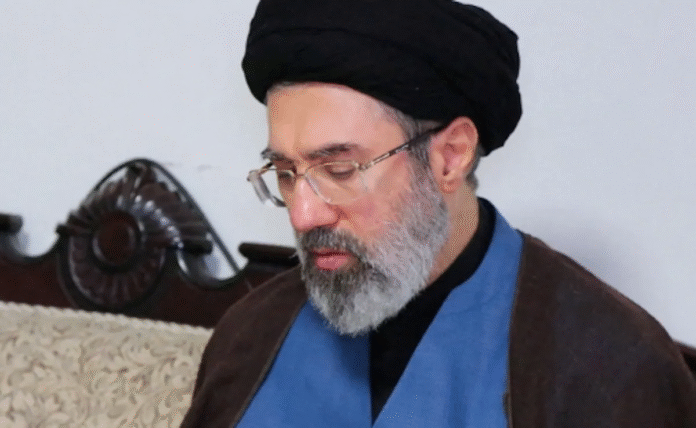
Following the assassination of Iran’s long-time Supreme Leader Ali Khamenei in reported US–Israel strikes, security around his successor Mojtaba Khamenei has been significantly tightened.
Iranian authorities have reportedly deployed one of the country’s most secretive and elite security units — the Counterterrorism Special Force, commonly known as NOPO — to protect the new leader amid continuing threats from the United States and Israel.
Mojtaba Khamenei’s security heightened
The 56-year-old cleric was elevated to the top leadership position by the Assembly of Experts on March 8. Since the early days of the conflict, he has remained largely out of public view.
Some reports suggest he may have been injured during the initial airstrikes that killed several senior Iranian military figures and members of his family, though Iranian authorities have denied the claims.
According to media reports citing Iranian sources, Mojtaba is currently believed to be in a highly secure location with restricted communications while the conflict continues.
Elite counterterror force deployed
Iran has reportedly assigned the protection of its new leader to NOPO, a specialised counterterrorism unit known for handling high-risk operations such as hostage rescues and tactical missions.
The deployment reportedly occurred shortly after the assassination of Ali Khamenei during the strikes on February 28.
Ali Safavi of the Paris-based National Council of Resistance of Iran told Fox News Digital that NOPO has now been tasked with securing Mojtaba Khamenei.
He noted that the unit typically conducts complex counterterror operations rather than personal protection duties.
What is NOPO?
NOPO was established in 1991 and operates as a specialised police force within Iran’s internal security structure. Although the powerful Islamic Revolutionary Guard Corps plays a central role in national defence, NOPO functions separately and focuses on high-risk tactical missions.
The force is relatively small but highly trained. It reportedly consists of six brigades — four based in Tehran and one each in Mashhad and Isfahan.
Security analysts say the unit is considered one of the most capable and heavily trained forces in Iran’s law-enforcement system.
Recruitment and training
Entry into NOPO is highly selective. Candidates are typically recruited from other special police units after rigorous screening that assesses physical fitness, intelligence and psychological stability.
Once selected, recruits undergo extensive tactical training including martial arts, urban combat, parkour-style mobility techniques, airborne operations and maritime training such as diving and water-based missions.
Role in internal security
Apart from counterterror operations, the force has also reportedly been deployed to maintain internal security during periods of unrest.
NOPO has been linked to crackdowns on protests, including demonstrations that followed the death of Mahsa Amini in 2022 and other economic protests in recent years.
The United States Treasury Department sanctioned the unit in 2021, accusing it of involvement in serious human rights abuses.
Uncertainty over Mojtaba Khamenei’s whereabouts
Despite his appointment earlier this month, Mojtaba Khamenei has not appeared publicly. Iranian state media has referred to him as a “wounded veteran”, a phrase that has fuelled speculation about his health.
While some international reports suggest he may have suffered injuries in the initial strikes, Iranian officials insist that the country’s new supreme leader is safe.
For now, his exact location remains undisclosed as tensions with the United States and Israel persist and Iran tightens security around its leadership.