

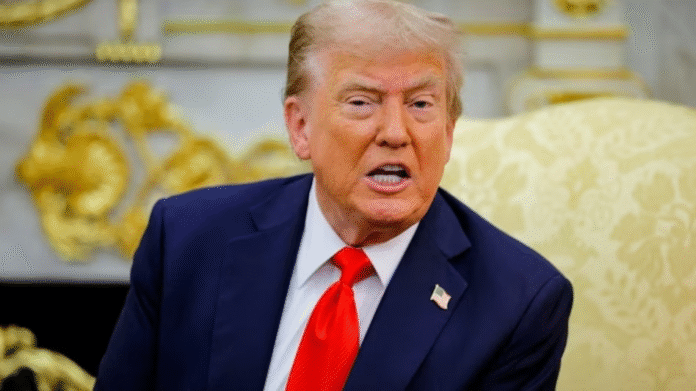
The United States has officially begun implementing the controversial $100,000 fee for new H-1B visa applications from Sunday, September 21 (US time). The executive order, signed by President Donald Trump at the White House on Saturday, has created uncertainty and unease among immigrant communities, especially Indian workers, who form the largest group of H-1B beneficiaries.
The H-1B program, which allows US companies to hire skilled foreign workers in specialty occupations such as IT, engineering, finance, and healthcare, is particularly important for Indian technology firms. According to US government data, Indians account for nearly 70% of all H-1B visa holders.
White House Clarification Ends Confusion
After the announcement sparked panic, White House Press Secretary Caroline Levitt issued a clarification:
- The $100,000 fee is not annual but a one-time charge at the time of filing.
- It applies only to new H-1B visa applicants, not those renewing or extending their visas.
- Existing H-1B holders will not be charged a re-entry fee if they travel abroad.
- The new rule will apply from the upcoming H-1B lottery cycle.
“The announcement does not affect current H-1B visa holders or renewals. It applies only to new applications filed after September 21, 2025,” Levitt said.
The US Citizenship and Immigration Services (USCIS) also posted on X:
“President Trump’s new H-1B visa rules apply only to new, prospective applications that have not yet been filed. Applications submitted before September 21, 2025, will not be affected.”
Why the Rule Matters
The sharp fee hike marks a dramatic shift in US immigration policy. Previously, H-1B filing fees ranged between $1,500 to $6,000, depending on the size and type of employer. The new $100,000 fee is nearly 20 times higher than past charges.
Experts say the move could discourage small businesses and startups from hiring foreign talent, while large corporations may still afford the cost. Immigration lawyers warn it may also fuel brain drain away from the US, as skilled professionals consider other destinations like Canada, the UK, and Australia.
Impact on Indian Professionals and IT Companies
India’s $245 billion IT services sector, which relies heavily on H-1B visas to send engineers and consultants to US clients, is expected to be the hardest hit.
- Indian professionals: For middle-class families, the $100,000 cost per application is prohibitively expensive, potentially limiting opportunities.
- Indian IT firms: Companies like Infosys, TCS, and Wipro may have to absorb higher costs or reduce the number of employees sent to the US.
- Startups and small firms: They may find the fee unaffordable, creating barriers to accessing US markets.
Industry bodies in India have expressed concern, calling the decision a “protectionist barrier” that could affect bilateral trade and technology collaboration.
Political & Historical Context
This is not the first time Trump has tightened H-1B rules. During his first presidency (2017–2021), he introduced the “Buy American, Hire American” policy, which increased scrutiny on visa approvals. The new $100,000 fee is seen as part of his second-term push to curb foreign worker inflows and encourage companies to hire locally.
However, critics argue that the US economy depends on foreign talent, especially in the STEM sector, where domestic worker shortages are acute. According to the US Chamber of Commerce, restricting H-1B visas could harm innovation and competitiveness.
Reactions and Next Steps
The announcement has sparked intense debate across tech hubs in Silicon Valley, Bangalore, and Hyderabad. Immigration attorneys are bracing for a wave of consultations, while advocacy groups are urging the Biden-era legal challenges against restrictive immigration policies to be revived.
For now, the rule stands. The first test will come in April 2026, when the next H-1B lottery cycle begins. Until then, businesses, workers, and governments will closely monitor the fallout.
In short, Trump’s $100,000 H-1B fee has shaken up the global talent market, and while the White House insists it is a one-time charge only for new applicants, the move could reshape how Indian professionals and companies engage with the US job market.