

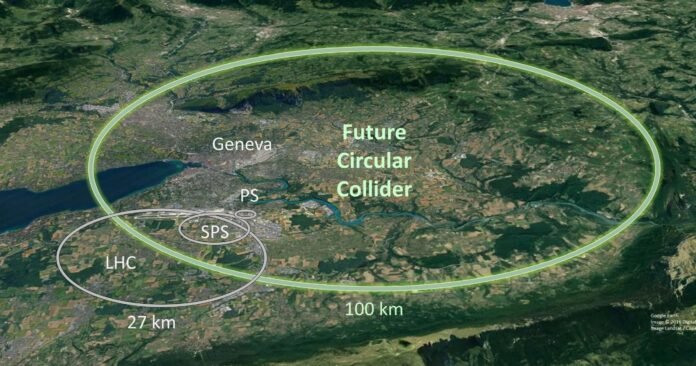
In the realm of cutting-edge science, few projects match the scale and ambition of CERN’s Future Circular Collider (FCC). Unveiled in 2025 as the successor to the renowned Large Hadron Collider (LHC), the FCC promises to push the boundaries of physics, unlocking mysteries of the universe that remain unsolved. With an estimated budget of $17 billion, this colossal initiative stands as one of the most significant scientific undertakings in history.
A Vision for the Future
The FCC will be housed within a 91-kilometre underground circular tunnel beneath the French-Swiss border. This vast infrastructure will support two distinct operational phases. The first phase, expected to launch around 2046, will feature an electron-positron collider. The second phase, scheduled for 2070, will introduce a proton-proton collider capable of reaching unprecedented energy levels.
Pushing the Limits of Physics
At the heart of the FCC’s mission lies a quest to probe the fundamental nature of reality. Scientists hope to explore the enigmatic realms of dark matter and dark energy, phenomena that constitute the majority of the universe but remain largely unexplained. The collider will also investigate the properties of fundamental particles, potentially discovering entities even smaller than electrons. With projected energy levels of 100 trillion electronvolts—seven times the LHC’s maximum capacity—the FCC could pave the way for groundbreaking discoveries in particle physics.
Advancing Scientific Innovation
To achieve such ambitious goals, the FCC will leverage cutting-edge technology, including next-generation superconducting magnets, state-of-the-art cryogenic systems, and ultra-high vacuum environments. These advancements are not only vital for particle physics but could also lead to technological breakthroughs with applications in various industries, from medical imaging to quantum computing.
Environmental and Ethical Considerations
As with any large-scale scientific project, the FCC is subject to scrutiny regarding its environmental and economic impact. CERN has pledged to conduct comprehensive environmental assessments, with independent experts evaluating the project before a final decision is made by CERN’s member states in 2028. However, some critics argue that the immense funding could be better allocated to smaller-scale research projects, sparking debates on the sustainability of such a vast scientific endeavor.
Building on the Legacy of the LHC
Since its inception in 2008, the LHC has revolutionized our understanding of the universe. Perhaps its most famous achievement was the confirmation of the Higgs boson, a cornerstone of the Standard Model of particle physics. The FCC seeks to build on this legacy, potentially uncovering new forces of nature and redefining our grasp of the cosmos.
A Monumental Opportunity for Science
The Future Circular Collider represents more than just a technological marvel—it embodies humanity’s relentless pursuit of knowledge. While its success hinges on securing funding and overcoming engineering challenges, its potential to reshape our understanding of physics is unparalleled. If realized, the FCC could mark the dawn of a new era in scientific discovery, transforming not only the field of particle physics but the future of innovation itself.