

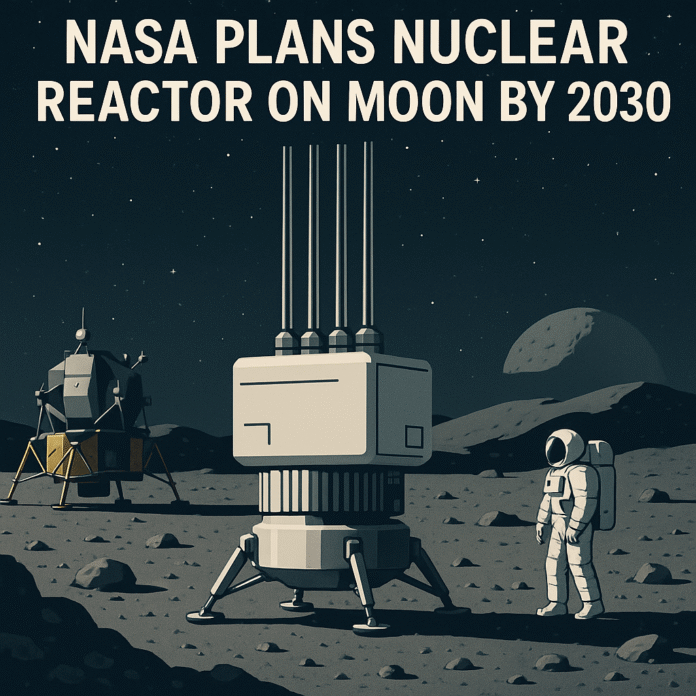
The United States space agency NASA is accelerating its plans to build a nuclear reactor on the Moon by 2030, as part of its broader vision to establish a permanent human base on the lunar surface. The move comes amid rising global interest in lunar exploration, with countries like China, Russia, India, and Japan also pursuing missions — some with plans for long-term settlements.
According to Politico, acting NASA Administrator Sean Duffy, appointed by President Donald Trump, cited potential geopolitical competition, warning that China and Russia could attempt to establish “keep-out zones” on the Moon. He emphasized the need to fast-track nuclear energy development for future lunar infrastructure, Mars missions, and national security in space.
In a letter to NASA, Duffy called for proposals from commercial firms to build a small reactor capable of generating at least 100 kilowatts of power — enough to support a small lunar habitat but modest compared to typical Earth-based power sources. A typical onshore wind turbine, for example, produces 2–3 megawatts.
The concept of lunar nuclear power is not new. In 2022, NASA awarded contracts to three companies to design reactor prototypes. In May 2025, China and Russia announced plans to build an automated nuclear power station on the Moon by 2035.
Many scientists argue nuclear power is essential for sustained lunar missions. The Moon experiences two-week cycles of daylight and darkness, making solar power unreliable for continuous energy needs. Dr. Sungwoo Lim from the University of Surrey said, “Nuclear energy is not just desirable, it is inevitable.”
Experts like Professor Lionel Wilson of Lancaster University believe placing reactors on the Moon by 2030 is technically feasible, provided there is adequate funding and enough Artemis launches to deploy necessary infrastructure.
However, the plan raises safety and political concerns. Transporting radioactive material into space requires strict licensing and safety protocols. Some scientists also fear the push is more political than scientific. Dr. Simeon Barber of the Open University warned that the current lunar race risks echoing the Cold War-era space race, prioritizing national interests over international cooperation and scientific discovery.
Duffy’s remarks regarding “keep-out zones” seem to reference the Artemis Accords — a 2020 international agreement signed by multiple nations to promote peaceful, cooperative exploration of the Moon, including the creation of safety zones around operational sites.
Despite recent budget cuts to NASA, including a proposed 24% reduction in 2026 affecting missions like the Mars Sample Return, the agency appears committed to advancing nuclear capabilities as a cornerstone of future space exploration.