

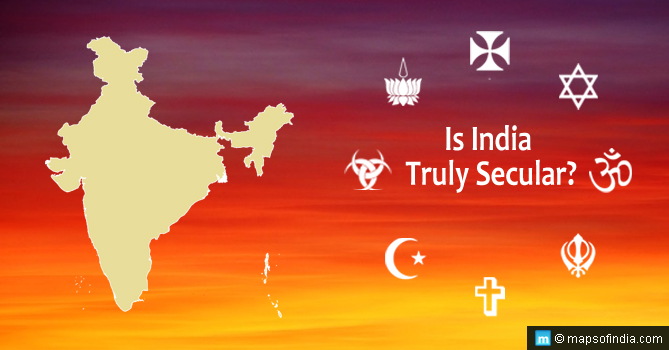
India identifies itself as a secular republic, with constitutional provisions designed to safeguard religious freedom and equality. However, the practical experience of citizens often reveals a significant disconnect between constitutional principles and societal behaviour. This paper critically examines the operationalisation of secularism in India, highlighting the contrast between legal frameworks and lived realities. Through selected examples—communal violence, caste-based discrimination, electoral use of religion, and housing discrimination—this analysis seeks to contextualise the challenges confronting Indian secularism in the post-independence period.
1. Introduction
Since gaining independence in 1947, India has projected itself as a pluralistic and secular state. The Constitution enshrines the principles of religious liberty, equality before law, and the non-establishment of any state religion. Yet, more than seventy-five years later, it is necessary to ask whether these ideals translate meaningfully into societal practices.
This paper explores the evolving nature of Indian secularism and assesses whether the lived experiences of citizens align with the constitutional vision.
2. Constitutional Framework of Secularism
India’s secularism differs fundamentally from the Western separationist model. Rather than enforcing strict separation between religion and the state, the Indian model promotes “principled equidistance”, allowing the state to intervene in religious matters to ensure social justice and equality.
Key constitutional provisions include:
Article 25–28: guarantee freedom of religion, religious practice, and propagation.
The Preamble: explicitly defines India as a secular republic.
Judicial interpretations: often reinforce the state’s duty to treat all religions impartially.
Thus, at the normative level, secularism forms a core component of India’s democratic identity.
3. Tensions Between Ideals and Social Behaviour
Despite strong constitutional foundations, the practical functioning of secularism remains inconsistent. Religious and caste-based identities continue to influence social relationships, political mobilisation, and public discourse.
The persistence of these divisions reveals that secularism in India is not merely a legal issue but a deeply social and cultural challenge.
4. Case Studies Illustrating Secularism’s Limitations
4.1 Communal Riots
Episodes of communal violence, including the 1984 anti-Sikh riots, the 1992–93 post-Babri riots, and the 2002 Gujarat riots, expose the fragility of inter-religious harmony. These events demonstrate that communal polarisation can override constitutional guarantees, leading to significant human and material losses.
Such recurring incidents reflect a societal vulnerability to identity-based mobilisation.
4.2 Caste-Based Discrimination
Despite constitutional safeguards, caste remains a powerful determinant of social hierarchy and discrimination.
Instances of untouchability, social exclusion, violence related to inter-caste unions, and educational or workplace biases illustrate the enduring influence of caste structures.
This shows that secularism cannot be fully realised without dismantling entrenched caste-based prejudices.
4.3 Religion in Electoral Politics
Political actors frequently invoke religious imagery, rhetoric, and symbolism during electoral campaigns.
This instrumentalisation of religion for political gain undermines the secular basis of democracy and intensifies communal divisions.
The practice blurs the distinction between political legitimacy and religious identity, challenging the neutrality expected of a secular state.
4.4 Housing Discrimination
Perhaps one of the most subtle yet pervasive manifestations of weakened secular values is housing discrimination.
Empirical observations indicate that individuals from certain religious groups or castes—such as Muslims, Dalits, or interfaith couples—often face difficulty securing rental accommodation.
These discriminatory practices, though less visible than communal violence, reveal systemic biases embedded within everyday social interactions.
5. Factors Contributing to the Persistence of Non-Secular Practices
5.1 Historical Legacies
India’s deeply layered religious and caste structures have persisted for centuries. Legal reforms alone cannot instantly reshape social consciousness.
5.2 Political Incentives
Electoral reliance on religious identity creates a conducive environment for communal politics, thereby weakening secular principles.
5.3 Social Misinterpretation of Secularism
Secularism is often misunderstood as being anti-religion or minority-centric, contributing to resistance and miscommunication.
5.4 Socio-Economic Inequalities
Economic insecurity, limited educational access, and lack of awareness make individuals more susceptible to divisive narratives.
6. Discussion
The evidence suggests that India functions as a secular state in its constitutional design, yet often falls short in its societal implementation.
Secularism in India operates within a complex intersection of law, identity, and politics. While the judiciary and constitutional framework uphold secularism, societal practices often challenge it.
The contrast between principle and practice underscores the need for a more robust engagement with secular values at the cultural and educational levels.7. Conclusion
India’s commitment to secularism remains constitutionally intact, but its realisation in everyday life is uneven and incomplete.
While the state continues to affirm its secular identity, social behaviour frequently reflects religious and caste-based biases.
The future of Indian secularism depends not only on legal safeguards but on the collective willingness of citizens to engage with diversity, challenge prejudice, and uphold the dignity of all communities.
Thus, India may be described as secular in principle, yet still evolving towards secularism in practice. Achieving true secularism requires ongoing social reform, political responsibility, and a sustained commitment to equality.
(The article has been written by Soniya yadav, a student of Kanoria Mahila Mahavidyalaya, Jaipur)