

(PC: Ministry Of Railways)
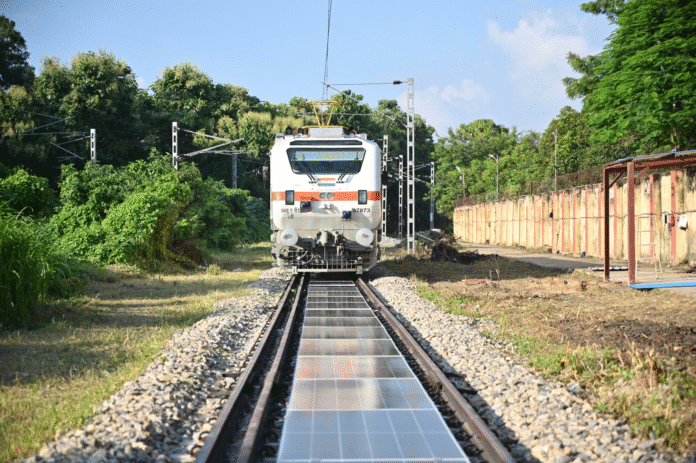
In a landmark move toward green energy, Indian Railways has commissioned the nation’s first removable solar panel system installed between railway tracks at Banaras Locomotive Works (BLW), Varanasi. Inaugurated on Independence Day, this pioneering initiative marks a significant stride in the country’s journey toward net-zero carbon emissions by 2030.
Project Highlights
- Location: Line No. 19, Banaras Locomotive Works (BLW), Varanasi
- Length of Installation: 70 meters
- Number of Panels: 28
- Installed Capacity: 15 kWp
- Power Density: 220 kWp/km
- Energy Output: 880 units/km/day (approx. 3.21 lakh units/year/km)
Technical Breakdown In Simple Terms
The solar panels installed between the railway tracks are pretty sleek and efficient. Each panel measures about 2.2 meters long and 1.1 meters wide, with a thickness of just 3 cm. They weigh around 32 kg each—not too heavy, considering their power. These panels use advanced monocrystalline PERC bifacial cells, which means they can absorb sunlight from both sides, boosting energy output. There are 144 half-cut cells in each panel, designed to improve performance even in low light or partial shading.
In terms of efficiency, they’re top-notch—each panel converts sunlight into electricity at a rate of 21.31%, which is considered excellent in solar tech. To keep them firmly in place, engineers used a combination of epoxy adhesive and rubber pads. This setup helps absorb vibrations from passing trains and keeps the panels stable. Plus, they’re mounted with stainless steel Allen bolts, making them easy to remove for cleaning or maintenance. The system is built to handle high voltage—up to 1500 volts—and meets Class A safety standards, which ensures durability and protection against electrical hazards.
Why It Matters
- No Land Acquisition Needed: Utilizes space between tracks, avoiding costly land purchases.
- Maintenance-Friendly: Removable design allows for easy cleaning and track upkeep without disrupting train operations.
- Scalable Model: If expanded across India’s 1.2 lakh km rail network, it could revolutionize energy generation for stations, signaling systems, and grid support.
A Step Toward Net-Zero
This initiative complements Indian Railways’ broader renewable energy strategy, which includes rooftop solar installations and large-scale solar procurement. Developed indigenously by BLW engineers, the project showcases India’s capability to innovate sustainable infrastructure solutions. General Manager Naresh Pal Singh praised the team’s efforts, calling it “a new dimension in solar energy utilization” and a model for future green energy projects across the railway network.