

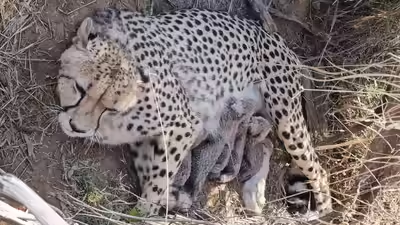
In a landmark moment for wildlife conservation, India’s cheetah population has crossed the 50‑mark, highlighting the success of the country’s ambitious efforts to bring back a species that disappeared from its landscapes decades ago.
The milestone comes after Jwala, a Namibian‑born cheetah, gave birth to five healthy cubs at Kuno National Park in Madhya Pradesh, raising the total number of cheetahs in the country to around 53.
This achievement was confirmed by Union Environment, Forest and Climate Change Minister Bhupender Yadav and widely hailed by officials and conservationists alike.
A Return After Decades
Cheetahs were declared extinct in India in the early 1950s due to habitat loss, hunting and declining prey. To restore this iconic big cat, the Government of India launched Project Cheetah in 2022, a pioneering wildlife conservation mission under the National Tiger Conservation Authority (NTCA). As part of this initiative, cheetahs were translocated from Namibia and South Africa to Kuno National Park — the first intercontinental relocation of a large carnivore of its kind.
Significance of the Milestone
The birth of five cubs from Jwala — one of the experienced mothers in the reserve — is seen as a strong indicator that the cheetahs are adapting well to their new habitat. Crossing the 50‑individual threshold is not just a statistical landmark but a symbol of hope for the species’ long‑term survival in India’s landscapes. Officials and wildlife experts have described this as a testament to careful planning, improved habitat conditions, dedicated veterinary care and community involvement around Kuno.
Beyond Numbers: Wider Conservation Impact
The growing cheetah population also has broader ecological implications. As top predators, cheetahs play a critical role in maintaining healthy grassland ecosystems by controlling prey populations and supporting biodiversity. India’s conservation strategy includes plans to establish additional habitats, such as Gandhi Sagar Wildlife Sanctuary and Nauradehi Wildlife Sanctuary, which could serve as future homes for cheetahs, helping to develop a metapopulation — a connected network of groups across protected landscapes.
A Triumph for Conservation
The celebration of this milestone reflects years of dedicated efforts by forest departments, wildlife scientists, community stakeholders and international partners. Crossing the 50‑mark is more than a numerical achievement — it’s a victory for species restoration, habitat stewardship and India’s commitment to wildlife conservation. As Project Cheetah continues, hopes remain high that the cheetah will soon once again thrive across the subcontinent’s grasslands.