

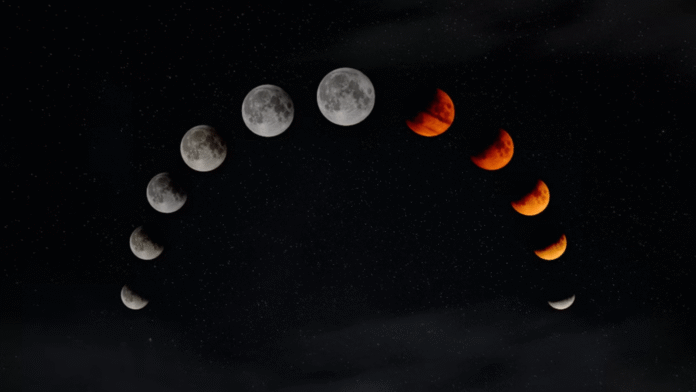
Skywatchers in India are in for a celestial treat. The first total lunar eclipse of 2026 will occur on March 3, and while lunar eclipses happen several times a year worldwide, not all are visible from India. That’s what makes this one special.
In India, a lunar eclipse is known as Chandra Grahan, and the good news is that you can watch it with the naked eye. No telescopes, no special glasses. Just a clear sky and a view of the eastern horizon.
What Is a Lunar Eclipse?
A lunar eclipse happens when the Earth moves between the Sun and the Moon, casting its shadow on the Moon’s surface.
During totality, the Moon can turn a deep reddish colour — a phenomenon popularly known as a “Blood Moon.” This red glow occurs because sunlight passing through Earth’s atmosphere bends and filters out blue light, leaving behind reddish tones.
Lunar Eclipse 2026: India Timings (IST)
According to available astronomical data, the eclipse will follow this schedule:
- Start of penumbral phase: 4:58 pm
- Start of total eclipse: 4:58 pm
- Maximum phase: Around 5:10 pm – 5:25 pm
- End of totality: 5:32 pm
- End of penumbral phase: 7:53 pm
Important Note:
In most parts of India, the Moon will be rising during the eclipse, which means viewers will catch only the final phase of the event. The most noticeable changes will appear around sunset and moonrise, lasting roughly 20 minutes.
There’s no need to stay up late — just step outside at dusk and look east.
Where Will It Be Best Visible?
While most of India will witness a partial view at moonrise, the Northeast region is expected to get the best experience.
Cities Likely to See 100% Totality:
- Dibrugarh
- Dispur
- Guwahati
- Itanagar
- Shillong
In these cities, the Moon is expected to be fully covered by Earth’s shadow for a brief period before sunset transitions into evening.
How to Watch the Lunar Eclipse
Watching a lunar eclipse is simple:
- No protective eyewear required (unlike a solar eclipse).
- Binoculars can enhance the view but aren’t necessary.
- Find an open space with a clear view of the eastern horizon.
- Hope for clear skies!
You may notice the Moon gradually darkening and then glowing red as the eclipse peaks.
Why This Eclipse Matters
For many parts of India, this will be a short viewing window — but it’s a rare reminder of the beauty of celestial mechanics. Sometimes, the most spectacular events require nothing more than stepping outside and looking up.
Mark your calendar for March 3, 2026, and don’t miss this brief but stunning sky show