


Can you imagine an extraordinary education story emerging from a government school in a small town and making a mark on the global map? It may sound surprising, but it is true.
A government school in Ratlam has scripted such a story—one that now resonates globally with the powerful phrase “Silence to Symphony.” This transformation has been driven by a pioneering framework called the “Cycle of Growth,” launched by the school’s Vice Principal, educationist Gajendra Singh Rathore.
A Global Model of Educational Innovation
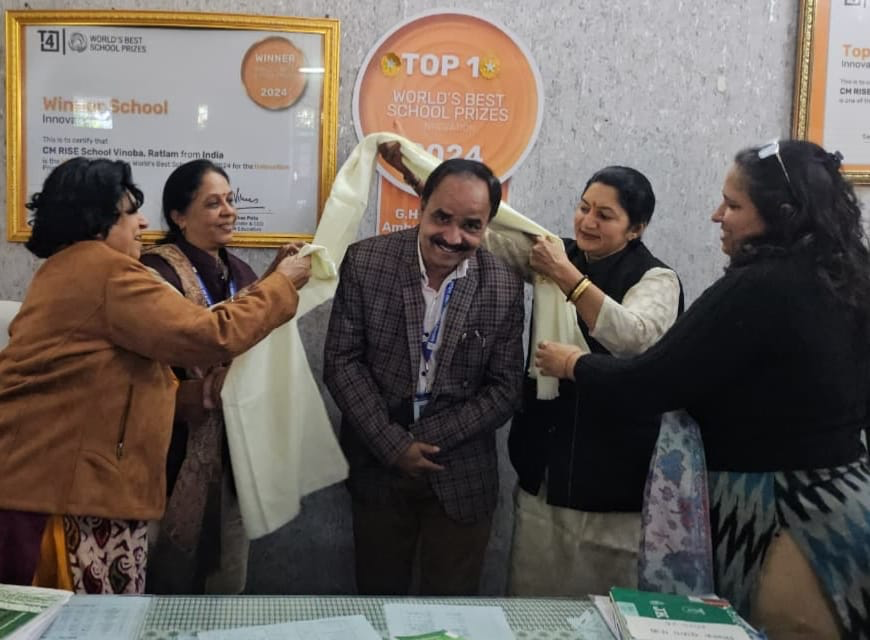
The journey of this remarkable transformation has been documented in the book “Cycle of Growth,” authored by Rathore, who serves as Vice Principal of Sandipani School (CM Rise Vinoba School). The book narrates how a government school, despite limited resources, evolved into a global model of innovation, ultimately winning the prestigious T4 Education Global Innovation Award.
The book offers deep insights into the strategies, challenges, and innovations that powered this change. Designed as a practical guide, it provides valuable lessons for teachers, principals, policymakers, and students, especially those working in under-resourced educational environments.
One Conversation, One Step at a Time
Summing up his philosophy, Rathore writes:
“True growth begins when teachers, parents, students, and the community move forward with one conversation and one step at a time.”
This simple yet powerful idea lies at the heart of the Cycle of Growth, which focuses on collective responsibility and consistent effort.
Empowering Marginalised Students
The book also highlights how students from marginalised communities were empowered to create impact-based stories. Many of these students came from families where generations had been engaged in manual labour, and their only perceived future was to join the same workforce.
However, under this new model, they were given something transformative—the courage to dream, to envision a better future, to spread their wings, and to make a meaningful mark on the world.
A Model for Education Reform
The success of the Cycle of Growth demonstrates how vision, leadership, and community collaboration can bring about a sea change in education, even within the government school system.
Kudos to Gajendra Singh Rathore
Congratulations to Gajendra Singh Rathore for creating a powerful and replicable model that has the potential to redefine education development and inspire schools across India and beyond.
I am profoundly impressed by Cycle of Growth – From Silence to Symphony, authored by Gajendra Singh Rathore, a visionary school leader and Vice-Principal of CM Rise Vinoba, Ratlam (Madhya Pradesh, India). The book compellingly chronicles the remarkable transformation of a government school that once served students primarily from the nearby Ambedkar Nagar slum—struggling with low attendance, limited parental engagement, and weak academic outcomes—into an institution of international repute. Within just three years, the school achieved global recognition, including the 2024 World’s Best School Prize for Innovation by T4 Education, along with a USD 10,000 award.
This is not merely a success story; it is a practical blueprint for systemic change in resource-constrained public education. Rathore demonstrates how purposeful leadership, strong team-building, and a deeply embedded culture of appreciation can fundamentally redefine a school’s ecosystem. Central to the narrative is the “Cycle of Growth” model, conceptualized in 2022 from Rathore’s on-ground leadership experience. By positioning teachers as agents of change, the model addresses persistent challenges such as inconsistent student performance and disengagement through continuous professional development and collaborative leadership.
The book offers invaluable insights into team-building and instructional leadership. Rathore’s innovative use of daily “Huddle Spaces”—featuring capsule trainings, role-plays, team-building exercises, and appreciative feedback through classroom walkthroughs—builds trust, boosts morale, and avoids micromanagement. Teachers are empowered to take ownership, collaborate meaningfully, and replicate their enthusiasm in classrooms and communities alike. The result is a motivated, cohesive team driving sustained improvement.
One of the book’s most powerful contributions is its emphasis on the transformative impact of a culture of appreciation. By recognizing teachers through initiatives such as “Teacher of the Month” Google Forms, public acknowledgements, and rewards, the school shifted from apathy to excellence. This ethos extended to students and parents as well, with recognition for perfect attendance and achievements celebrated in meetings, community gatherings, and local festivals—fostering pride, inclusion, and shared responsibility.
Multi-Layered Oppurtunity
Equally compelling are the book’s multi-layered strategies for parental and community engagement. Communication evolved from traditional diaries and phone calls to online PTMs and active WhatsApp groups. Innovative practices—such as integrating community knowledge into NCERT lessons and showcasing student projects at local events—dramatically increased parental involvement and trust.
For students, motivated teachers introduced project-based learning, sports programs to improve attendance, social-emotional learning, and data-driven assessments. These interventions delivered outstanding results, including improved board examination outcomes and prestigious state-level recognition such as Daksh Vidyalaya status.
What truly sets Cycle of Growth apart is its practicality, scalability, and replicability. Rathore’s refusal to accept limitations makes this book a motivational and operational guide for educators worldwide. In an era marked by educational inequities, it offers hope and direction—proving that a strong team can be built anywhere, and a committed team can achieve anything.
This journey is an inspiration for school leaders, teachers, parents, policymakers, and the younger generation alike. I wholeheartedly recommend Cycle of Growth – From Silence to Symphony to anyone seeking to orchestrate meaningful change in education. It powerfully demonstrates that with visionary leadership and collective effort, even the most challenged schools can rise to global standards in a remarkably short time.