

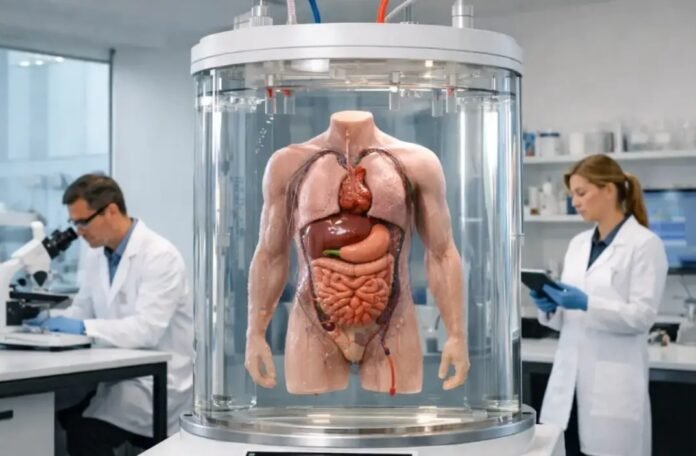
A controversial new idea emerging from the world of biotechnology is pushing the boundaries of science—and ethics. Reports suggest that a US-based startup, R3 Bio , is exploring the possibility of developing lab-grown human biological systems, sometimes referred to in media as “bodyoids.” While the term itself is not scientific, it broadly describes experimental concepts involving human-derived biological structures that could one day transform medical research.
At its foundation, this idea builds upon advances in organoids and regenerative medicine. Scientists today can already grow miniature versions of organs—such as liver, kidney, or brain tissues—from stem cells in controlled lab environments. However, the concept of creating integrated, full-body biological systems without a brain or consciousness remains far beyond current scientific capability and is largely theoretical at this stage.
Despite this, the potential applications being explored are significant. One of the major limitations in modern medicine is the reliance on animal testing, which often fails to accurately replicate human biological responses. More advanced human-based models could improve drug testing by offering better insights into how treatments affect complex biological systems. In the long term, such research could also contribute to developments in organ science, potentially helping address shortages in transplantable organs.
Yet, the ethical concerns surrounding such possibilities are profound. Even if these biological systems are designed to be non-sentient, the idea of creating human-like structures for experimentation raises difficult moral questions. Scholars in bioethics argue that society must carefully consider where to draw the line between innovation and exploitation. Concerns range from the commodification of human biological material to the broader psychological and societal impact of such technologies.
It is also important to approach such developments with caution. Much of the discussion remains speculative, and there is limited publicly verified scientific data supporting the creation of full-body systems as described. Experts emphasise that current biotechnology is still far from achieving such capabilities, and significant scientific, regulatory, and ethical challenges remain.
In conclusion, the idea of lab-grown “bodyoids” represents both an intriguing scientific frontier and a complex ethical crossroads. As biotechnology continues to evolve, the challenge will not only be what science can achieve, but also what society is willing to accept.