

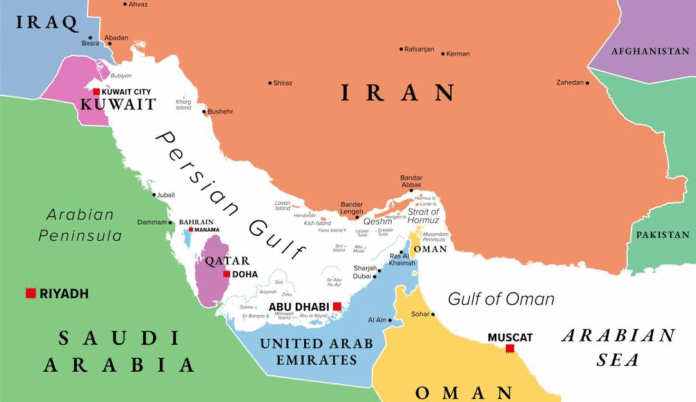
Amid a sharp escalation in tensions in the Middle East following joint strikes by the United States and Israel on Iran, Tehran has reportedly decided to close the strategically vital Strait of Hormuz, one of the world’s most critical maritime chokepoints.
According to a media report, ships and vessels operating in the region received VHF transmissions from Iran’s Revolutionary Guards stating that “no ship is allowed to pass the Strait of Hormuz.” An official from the European Union’s naval mission Aspides confirmed the transmission. However, there has been no formal statement from Iranian authorities so far.
Strategic Importance of the Strait of Hormuz
The Strait of Hormuz lies between Iran and the United Arab Emirates and Oman. Stretching approximately 100 miles (161 km) in length and narrowing to just 21 miles at its tightest point, it serves as a crucial gateway between the Persian Gulf and the Arabian Sea.
An estimated 20–30 percent of global crude oil supplies transit through this narrow corridor, making it one of the most important energy arteries in the world. Major oil-producing nations within the Organization of the Petroleum Exporting Countries (OPEC) — including Saudi Arabia, Iraq, the UAE, Kuwait, Kazakhstan, Algeria, and Oman — rely heavily on this route for exports. Any disruption could trigger severe economic consequences globally, potentially affecting oil prices, supply chains, and financial markets.
Escalation Following Strikes
The situation across the Middle East remains tense after the US-Israel joint strikes on Iran. In response, Iran reportedly launched retaliatory strikes targeting US bases in Kuwait, Qatar, Saudi Arabia, and neighbouring Iraq. Iran also carried out strikes in the UAE, targeting the capital Abu Dhabi and the financial hub Dubai.
Reports indicate that one person was killed in Abu Dhabi. In Dubai, the international airport was temporarily closed and the Burj Khalifa evacuated as a precautionary measure. UAE authorities stated that additional incoming missiles were intercepted and neutralised.
As tensions continue to rise, Gulf nations have urged restraint and called for immediate de-escalation. Several European countries, including the United Kingdom, France, and Germany, have also appealed for dialogue while closely monitoring developments in the region.
https://twitter.com/RT_com/status/2027791720251896314?s=20
https://twitter.coRT_com/status/2027791720251896314?s=20
read: https://ebnw.net/business/strait-of-hormuz-tensions-global-oil-trade-at-risk-amid-iran-israel-conflict/