

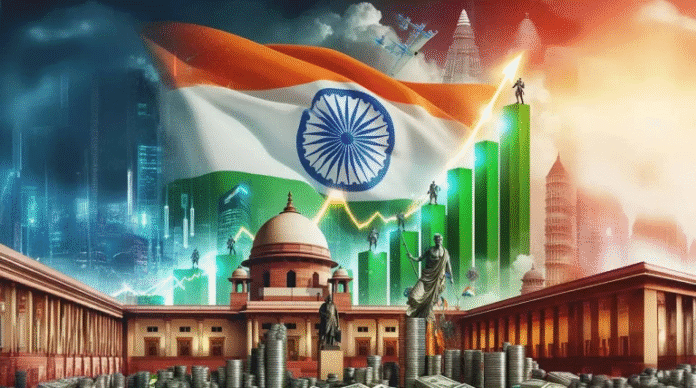
India is steadily moving closer to a major economic milestone. According to an analysis by the State Bank of India (SBI), the country is on track to become an upper-middle-income economy by the end of this decade, driven by sustained growth in per capita income and a rapidly expanding economic size. If current trends continue, India’s gross national income (GNI) per capita is expected to reach around $4,000 by 2030, placing it in the same income bracket as China and Indonesia under the World Bank’s classification.
Understanding the World Bank Income Scale
The World Bank classifies economies into four income groups—low income, lower-middle income, upper-middle income, and high income—based on per capita GNI calculated in US dollars. At present, the upper-middle-income threshold ranges between $4,000 and $4,500. Over the past three decades, global data show a steady increase in the number of countries graduating into higher income categories, reflecting long-term economic convergence across developing regions.
A Slow but Steady Income Transition
India’s journey up the income ladder has been gradual yet consistent. It took nearly 60 years after Independence for the country to move from low-income to lower-middle-income status in 2007. In the early 1960s, India’s per capita GNI was just about $90. By 2009, it had risen to nearly $1,000, doubled to $2,000 by 2019, and is projected to touch $3,000 by 2026. SBI’s estimates suggest that crossing the $4,000 mark by 2030 is achievable if momentum is maintained.
Economy Grows at an Unprecedented Pace
Alongside rising incomes, India’s overall economic size has expanded rapidly. After taking decades to reach the $1 trillion GDP milestone, the economy doubled to $2 trillion within seven years and crossed $4 trillion by 2025. Current projections indicate that India could overtake Germany to become the world’s third-largest economy by 2028, trailing only the United States and China.
This acceleration reflects structural changes, including stronger domestic demand, digitalisation, infrastructure investment, and reforms in manufacturing, taxation, and financial systems.
What It Means for India
SBI notes that India now ranks among the fastest-growing major economies globally, improving its relative position in the world economic order. Achieving upper-middle-income status would mark a critical transition—bringing higher consumption capacity, deeper capital markets, and greater global economic influence.
Looking further ahead, India’s aspiration to become a high-income country by 2047, the centenary of Independence, will require sustained per capita GNI growth of 7.5–9 per cent, depending on how global income thresholds evolve. While challenges such as income inequality, productivity gaps, and employment generation remain, current trends suggest that India’s near-term transition to the upper-middle-income category is firmly within reach.
Key Facts at a Glance
- World Bank classifies countries using per capita GNI (US dollars)
- Upper-middle-income threshold: ~$4,000–$4,500
- India became a lower-middle-income country in 2007
- Per capita GNI projected to reach $4,000 by 2030
- India may become the world’s third-largest economy by 2028
As India moves closer to this economic inflection point, the challenge ahead will be to ensure that growth remains inclusive, sustainable, and broad-based, translating national prosperity into improved living standards for all.