

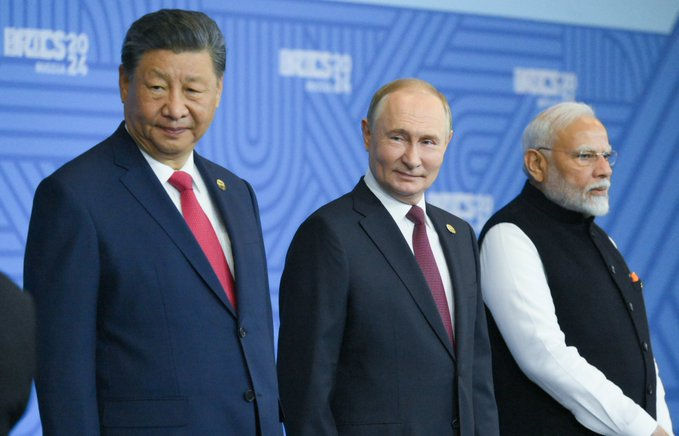
The SCO Summit Signals a Shift Toward a Multipolar Global Order
By Nirjala Goud
In the face of escalating U.S. tariffs under President Donald Trump, India, China, and Russia are forging a formidable alliance, leveraging their collective economic and strategic might to counter American trade pressures. The recent Shanghai Cooperation Organization (SCO) Summit has emerged as a pivotal platform for these nations to showcase unity and explore regional solutions. With a combined GDP of $53.9 trillion, a population of 3.1 billion, and a shared vision for a multipolar world, this trilateral partnership could reshape global economic dynamics.
A United Front Against U.S. Tariffs
The SCO Summit, held at a time when Trump imposed a steep 50% tariff on Indian goods, underscored the growing alignment among India, China, and Russia. This coalition, representing nearly one-third of global GDP and 38% of the world’s population, is positioning itself as a counterweight to Western dominance. Their combined economic clout is staggering: over $5 trillion in exports, $4.7 trillion in foreign reserves (38% of the global total), and a military expenditure of $549 billion, accounting for one-fifth of the world’s defense budget. Together, these nations consume 35% of global energy, with each bringing unique strengths to the table—China’s manufacturing prowess, Russia’s energy dominance, and India’s dynamic service economy.
The summit highlighted a shared resolve to mitigate the impact of U.S. tariffs, widely perceived as unfair across Asia. Gaurav Goyal, Founder and Director of Finocrat Technologies, noted that the summit reflects India’s shift away from reliance on U.S. concessions toward regional partnerships. “India no longer wants to depend solely on the U.S. but is instead collaborating with neighboring countries,” Goyal stated. This strategic pivot is fostering deeper economic ties, with China and Russia opening their markets to India to offset the effects of American tariffs.
Economic and Strategic Synergies
The SCO Summit has paved the way for enhanced cooperation in critical sectors such as energy, infrastructure, and digital payments. India is actively improving trade relations with China to bolster economic resilience, while also collaborating with Russia and other SCO members on energy and infrastructure projects. These efforts aim to create a robust regional framework that can withstand external economic pressures.
The combined economic indicators of India, China, and Russia paint a picture of immense potential. Their $53.9 trillion GDP (PPP) and $5 trillion in exports position them as a powerhouse capable of challenging the U.S.-led unipolar world order. By promoting Eurasian trade corridors and exploring local currency transactions, this alliance could reduce dependence on the U.S. dollar, fostering a multipolar economic system.
The Double-Edged Sword for India
While the India-China-Russia partnership offers a buffer against U.S. tariffs, it is not without challenges. India’s economic ties with the U.S. remain significant, with bilateral trade reaching $212.3 billion in 2024, an 8.3% increase from the previous year. U.S. consumers continue to drive demand for Indian goods, with exports to the U.S. totaling $77.5 billion in 2024, according to the U.S. Trade Representative.
This deep economic interdependence complicates India’s alignment with China and Russia.Moreover, India faces security concerns due to ongoing border disputes with China and Pakistan’s role within the SCO. These tensions highlight the delicate balance India must maintain as it navigates this trilateral partnership. While the alliance provides a platform to counter U.S. pressures, it also requires India to tread cautiously to safeguard its strategic interests.
A New Global Economic Equation
The SCO Summit signals a broader shift toward a multipolar world, where India, China, and Russia are poised to play a pivotal role. By leveraging their collective economic and military strength, these nations are challenging the dominance of Western-led institutions and fostering regional integration. The emphasis on Eurasian trade routes and local currency transactions could diminish the U.S. dollar’s global hegemony, paving the way for a more balanced international order.For investors, the summit is a positive development. The unity displayed by SCO members offers opportunities for enhanced trade and investment in Asia, particularly in energy and infrastructure. As Goyal aptly noted, “China and Russia are opening their economies to India, which will boost trade and help mitigate the impact of U.S. tariffs.”
A Strategic Pivot for India
The India-China-Russia alliance, forged in the crucible of U.S. tariff pressures, represents a bold step toward a multipolar global order. While the partnership offers India a chance to diversify its economic dependencies and strengthen regional ties, it must carefully navigate security concerns and its substantial trade relationship with the U.S. As the SCO Summit demonstrates, this trilateral coalition is not just a response to immediate economic challenges but a strategic move to redefine the global economic landscape. With their combined resources and shared vision, India, China, and Russia are laying the foundation for a new era of global cooperation and resilience.