

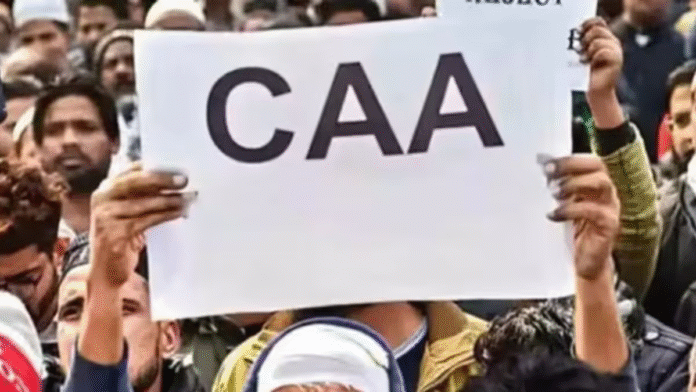
First Citizenship Under the CAA in Assam
In a landmark development in the implementation of the Citizenship Amendment Act (CAA), a 60-year-old woman from Assam’s Cachar district has become the first person in the state to officially receive Indian citizenship under the law.
Dipali Das, a resident of Hawaithang in the Dholai block, was granted her citizenship certificate on March 6, bringing an end to years of legal uncertainty surrounding her nationality. Her case has become a significant example of how the Citizenship Amendment Act is being applied in Assam to resolve long-standing citizenship disputes.
Migration From Bangladesh and the Beginning of a Citizenship Dispute
Dipali Das reportedly migrated to India from Bangladesh along with her husband on February 7, 1988, citing persecution as the reason for leaving their home country. The couple settled in the Cachar district of Assam and began rebuilding their lives there.
For years, the family lived quietly in the region. However, the absence of official documentation proving Indian citizenship eventually brought her under government scrutiny.
In 2013, authorities launched an investigation into her nationality. A police chargesheet concluded that she had entered India after March 1971, the cut-off date linked to citizenship verification in Assam. As a result, she was categorized as a suspected foreign national, initiating a lengthy legal process regarding her citizenship status.
Detention in Silchar and Release During the COVID-19 Pandemic
In 2019, Dipali Das was formally declared a foreigner and was placed in a detention centre in Silchar. She spent nearly two years in detention while the legal dispute over her citizenship continued.
Her situation changed in April 2020 when the Supreme Court of India ordered the release of declared foreigners who had spent more than two years in detention. The directive was issued to reduce overcrowding in detention centres during the COVID-19 pandemic.
Following this order, Dipali Das was released on bail. Despite gaining freedom from detention, uncertainty regarding her citizenship status persisted.
Legal Assistance and Application Under the Citizenship Amendment Act
After her release, Dipali Das received help from social worker Kamal Chakraborty, who connected her with advocate Dharmananda Deb.
The lawyer assisted her in filing a citizenship application under the Citizenship Amendment Act.
Interestingly, the earlier police chargesheet that identified her as having migrated from Bangladesh became important supporting evidence for the application under the CAA framework.
After completing the legal process, authorities approved her application and issued an official Indian citizenship certificate on March 6, formally recognizing her as an Indian citizen.
Key Facts About the Citizenship Amendment Act (CAA)
- The Citizenship Amendment Act was passed by the Indian Parliament in December 2019.
- It provides a pathway to Indian citizenship for persecuted minorities from Pakistan, Bangladesh, and Afghanistan.
- Eligible communities include Hindus, Sikhs, Buddhists, Jains, Parsis, and Christians.
- Applicants must have entered India before December 31, 2014.
- Assam has long experienced citizenship disputes related to migration and the National Register of Citizens verification process.
Relief for the Family After Years of Legal Struggle
Dipali Das and her husband have six children—one son and five daughters—many of whom have built their lives in India.
- Their eldest son runs a small business in the Dholai area.
- Four daughters work in Bengaluru, pursuing employment opportunities.
- The youngest daughter recently married and continues to live in Cachar.
Receiving the citizenship certificate has brought immense relief to the family. It not only resolves Dipali Das’s legal identity but also helps protect the future citizenship status of her children, most of whom were born and raised in India.
Conclusion: A Milestone in CAA Implementation in Assam
Dipali Das’s case marks an important milestone in the practical implementation of the Citizenship Amendment Act in Assam. After decades of uncertainty, legal battles, and detention, the issuance of her citizenship certificate demonstrates how the CAA is being used to resolve complex citizenship disputes involving migrants who sought refuge in India.
For many families facing similar uncertainties, this development may represent a significant precedent and a step toward clarity in citizenship verification processes in Assam.