

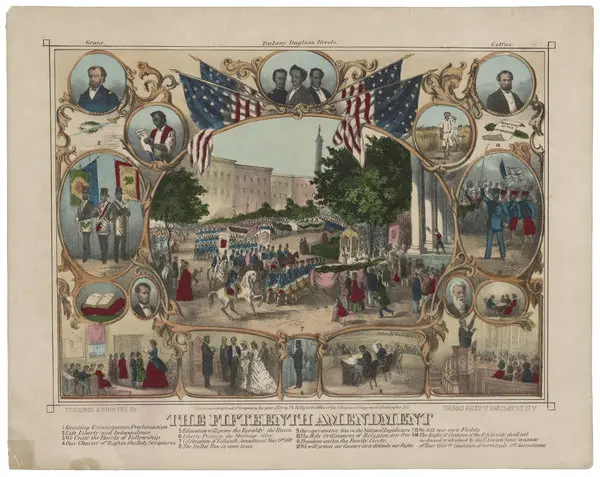
February 3 holds a quiet but powerful place in American history—a date when the promise of democracy was formally widened, even if not yet fully kept.
On February 3, 1870, the United States ratified the 15th Amendment to the Constitution, declaring that the right to vote could not be denied on the basis of “race, color, or previous condition of servitude.” Coming just five years after the end of the Civil War, the amendment was the final pillar of the Reconstruction Amendments, following the 13th (ending slavery) and the 14th (granting citizenship and equal protection). Together, they sought to remake a nation shattered by war—and redefine who counted as a full participant in its democracy.
The road to that February day began earlier. Congress passed the amendment on February 26, 1869, amid fierce debate and resistance. Its purpose was clear and urgent: to protect the political rights of newly freed Black men, whose freedom meant little without a voice in government. Section 1 outlawed racial discrimination in voting, while Section 2 gave Congress the authority to enforce those protections through law—an acknowledgment that words alone would not be enough.
History soon proved that fear well-founded. Despite the amendment’s ratification, its promise was systematically undermined. Southern states erected a web of Jim Crow laws—poll taxes, literacy tests, and grandfather clauses—designed to appear neutral while effectively disenfranchising Black voters. For nearly a century, the 15th Amendment existed more as an ideal than a reality.
The amendment’s limits were also evident in who it left out. Women of all races were excluded, a division that fractured reform movements and delayed universal suffrage until the 19th Amendment in 1920.
It was not until the civil rights movement of the 20th century—culminating in the Voting Rights Act of 1965—that the federal government began to meaningfully enforce what had been promised back in 1870. That landmark law breathed life into the 15th Amendment, turning constitutional principle into practical protection.
So February 3 is more than a date on the calendar. It marks a moment when the nation formally committed itself to a broader vision of democracy—one that would take generations of struggle, activism, and legislation to even begin to fulfill. The 15th Amendment reminds us that progress in American history often comes in two stages: first declared, then demanded.