

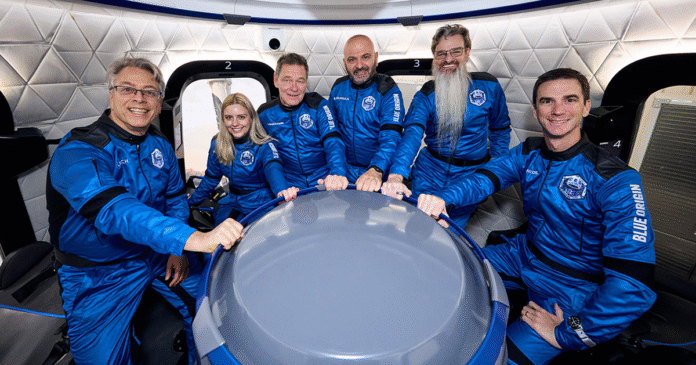
Blue Origin’s upcoming New Shepard mission is shaping up to be more than a routine suborbital flight. It brings together two powerful narratives a former SpaceX executive returning to space under a rival banner, and Michaela Benthaus, who is set to become the first wheelchair user to travel to space. Together, the mission marks a defining moment for inclusivity, commercial spaceflight, and the evolving identity of the private space race.
Breaking barriers beyond Earth’s atmosphere
Michaela Benthaus, a German aerospace engineer and former European Space Agency professional, will make history as the first wheelchair user to cross the boundary of space. She has used a wheelchair since a serious mountain biking accident in 2018, yet continued working in the aerospace sector, advocating for accessibility and inclusive design. Her selection signals a shift in how physical ability is perceived in human spaceflight.
A rare crossover from SpaceX to Blue Origin
Adding further intrigue to the mission is the presence of Timothy “TJ” Creamer, a former SpaceX executive and experienced astronaut. His participation highlights the increasingly fluid movement of talent within the private space industry, even as competition between companies like Blue Origin and SpaceX remains intense. For industry watchers, the crossover underscores Blue Origin’s growing credibility among veteran space professionals.
Inside the New Shepard mission profile
The flight will launch from Blue Origin’s Launch Site One in West Texas and carry a six-member crew aboard the reusable New Shepard rocket. The suborbital journey is expected to last around ten minutes, during which passengers will cross the Karman line the internationally recognised edge of space and experience brief weightlessness before returning to Earth.
Why this mission is different from earlier flights
While New Shepard has previously flown scientists, entrepreneurs and celebrities, this mission stands apart for its broader social impact. Benthaus’ inclusion represents a tangible step toward making spaceflight more representative, challenging long-held assumptions about who can participate in space missions.
When and how the world can watch history unfold
The launch is scheduled for December 18, with Blue Origin set to stream the event live on its official website and YouTube channel. Coverage is expected to begin roughly 40 minutes before liftoff, allowing viewers worldwide to follow the countdown and witness the milestone moment in real time.
A signal of where commercial spaceflight is headed
As private companies push space closer to public participation, this mission sends a clear message: access to space is expanding beyond traditional boundaries. With technological maturity and evolving mind-sets, the future of space travel appears increasingly inclusive not just in ambition, but in action.