

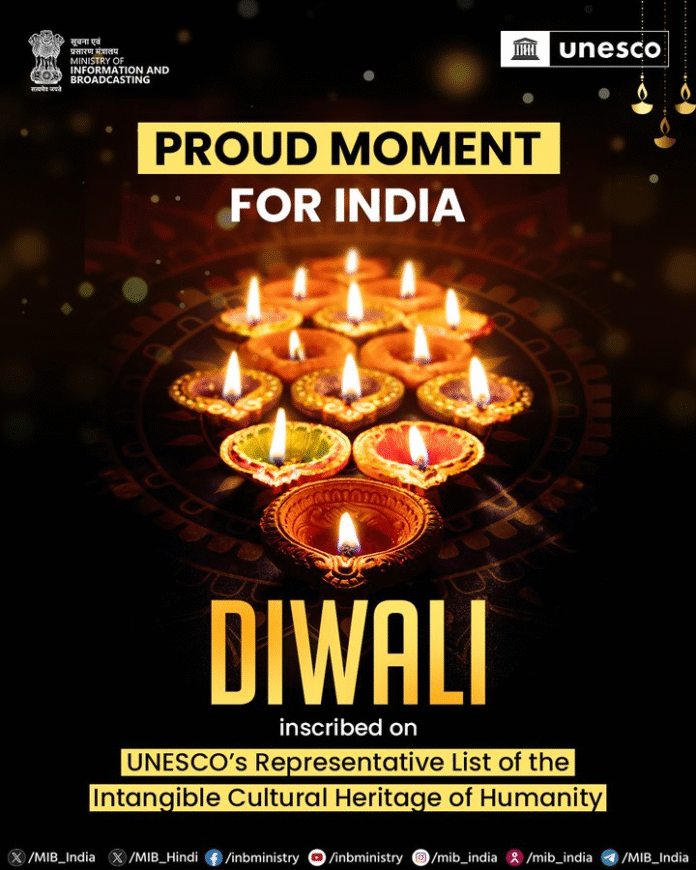
In a landmark decision on 10 December 2025, UNESCO officially inscribed Deepavali popularly known as Diwali on its Representative List of the Intangible Cultural Heritage of Humanity. This makes Diwali the 16th Indian tradition to earn global recognition, joining celebrated practices like Yoga, Durga Puja, and more on the prestigious list.
The decision was announced during UNESCO’s 20th session of the Intergovernmental Committee for Safeguarding Intangible Cultural Heritage, hosted at Delhi’s historic Red Fort marking a symbolic moment of pride for India’s cultural legacy.
Why UNESCO chose diwali
UNESCO’s inscription recognises Diwali not simply as a festival, but as a living cultural tradition: a rich tapestry of rituals, shared memories, community participation, spiritual symbolism and intergenerational transmission. The festival’s themes of light triumphing over darkness, good over evil, and unity across diverse communities resonated with heritage experts.
More than just lights and fireworks, Diwali embodies social cohesion, traditional crafts, spiritual values, and a sense of renewal a festival that brings families, neighbours and communities together across India and beyond. UNESCO emphasised this inclusive, community-based spirit in its decision.
India’s cultural legacy is even brighter now
With this addition, India’s count of UNESCO-recognised intangible cultural heritages rises to 16, reinforcing the country’s status as one of the world’s most culturally rich nations.
The recognition comes after another landmark inclusion only last year Durga Puja highlighting India’s continuing efforts to bring its diverse cultural practices to global attention.
According to UNESCO’s official description, Diwali is celebrated annually across India and in Indian communities worldwide. Based on the lunar calendar, the festival usually falls in October or November, and spans several days. During this time, homes and public spaces are cleaned and decorated, lamps and candles are lit, prayers offered, and joyous celebrations held to mark the triumph of light over darkness.
Political and social resonance: Reactions and its significance
The Indian government welcomed the UNESCO decision with pride. Narendra Modi described the recognition as a momentous occasion for India and the global Indian diaspora calling Diwali the “soul of our civilisation.” He said the inclusion would further enhance the festival’s global popularity and help share India’s cultural values worldwide.
The inclusion also arrives at a time when India is hosting the UNESCO heritage panel bringing global attention to the country’s heritage diplomacy and cultural richness.
What this means
For Indians at home and abroad this UNESCO tag ensures Diwali’s heritage is formally recognized for its cultural, social and spiritual importance. It also helps safeguard the festival’s living traditions for future generations, promoting cultural continuity in a rapidly globalizing world.
For the world, it offers a chance to appreciate, understand, and even participate in one of humanity’s most evocative celebrations a festival that transcends religion and geography, and stands for hope, unity and renewal.