

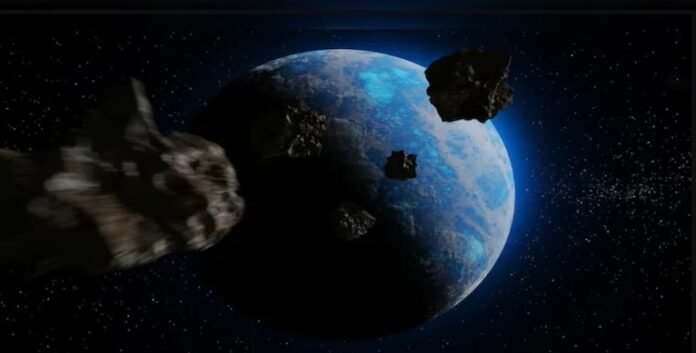
Mark your calendars! This Christmas Eve, a massive asteroid named 2024 XN1, nicknamed the “Christmas Eve Asteroid,” will make its closest approach to Earth. NASA’s Asteroid Watch dashboard has confirmed that the space rock, which measures between 95 and 230 feet in diameter and travels at a staggering speed of 14,743 mph, will skim past our planet at 02:56 am GMT on December 24, 2024.
Size and Speed
Comparable in size to an airplane, 2024 XN1 is the largest among the five asteroids that are expected to make close approaches to Earth in the coming days. Scientists estimate its potential destructive power to be equivalent to 12 million tonnes of TNT—a reminder of the immense energy such celestial objects carry.
How Close Is Close?
While the asteroid is classified as a “near miss” in astronomical terms, there’s no cause for alarm. 2024 XN1 will safely pass Earth at a distance of approximately 4.48 million miles (7.21 million kilometers), which is about 18 times the distance between Earth and the Moon.
Despite its harmless fly-by, the asteroid’s proximity underscores the importance of continuous monitoring of near-Earth objects (NEOs) to better understand and prepare for potential future risks.
Discovery and Monitoring
The asteroid was first discovered on December 12, 2024, by NASA and the European Space Agency’s planetary defense systems. Once its orbit was calculated, scientists confirmed it would pass within 4.65 million miles (7.5 million kilometers) of Earth, classifying it as a “close approach.”
NASA’s Asteroid Watch dashboard has been instrumental in tracking this space rock. The dashboard provides real-time updates about asteroids and comets making close approaches, offering insights into their size, speed, and proximity. Users can explore detailed data about each asteroid’s encounter, fostering public awareness and understanding of such events.
A Safe but Significant Fly-By
While 2024 XN1 is the largest of the upcoming asteroids, none of the objects pose any immediate threat to Earth. However, this event highlights the necessity of ongoing efforts to monitor space rocks and develop strategies to mitigate potential risks from hazardous NEOs in the future.
As NASA’s experts assure, “There is no risk of collision,” but the Christmas Eve Asteroid serves as a powerful reminder of the vastness of space and the vital role of science in keeping our planet safe.
So, as you celebrate Christmas Eve, spare a moment to think about 2024 XN1—a silent traveler in the cosmos passing by, reminding us of the wonders and mysteries of the universe.