

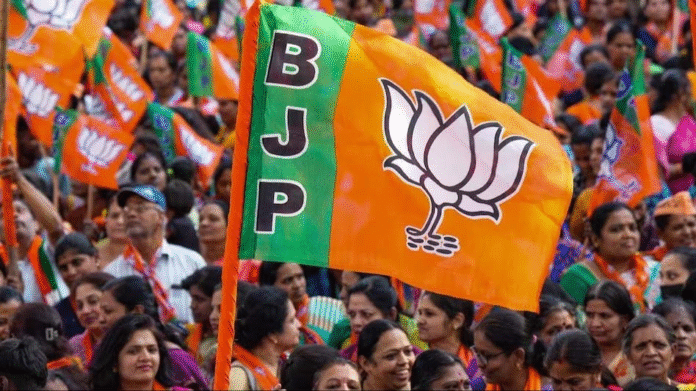
Bharatiya Janata Party (BJP) celebrates its foundation day on April 6. The BJP traces its origins to the Bharatiya Jana Sangh (BJS; Indian People’s Association), founded in 1951 by Shyama Prasad Mukherjee as the political wing of the Rashtriya Swayamsevak Sangh (RSS; “National Volunteers Corps”), a pro-Hindu organisation. The BJS advocated rebuilding India along lines rooted in Hindu cultural values and called for a strong, unified state.
In 1967, the BJS gained a significant foothold in the Hindi-speaking regions of northern India. A decade later, under the leadership of Atal Bihari Vajpayee, it joined three other parties to form the Janata Party, which came to power at the national level. However, internal conflicts and factionalism led to the government’s collapse in July 1979.
The BJP was formally established in 1980 following a split within the Janata Party, largely over the issue of dual membership with the RSS. Former BJS members reorganized themselves as the BJP under leaders such as Vajpayee, Lal Krishna Advani, and Murli Manohar Joshi.
Ideology and Early Growth
The BJP promoted Hindutva (“Hindu-ness”), an ideology seeking to define Indian culture in terms of Hindu values. It was critical of the secular policies of the Indian National Congress. The party began gaining electoral traction in 1989, partly by mobilizing support around the demand to build a Hindu temple at a disputed site in Ayodhya, then occupied by the Babri Masjid.
By 1991, the BJP had significantly expanded its political presence, winning 117 seats in the Lok Sabha and forming governments in several states.
The demolition of the Babri Masjid in December 1992 by groups associated with the broader movement led to widespread violence and backlash, damaging the party’s image among secular sections of society. In response, BJP leaders organised a series of rath yatras (political processions) invoking the Hindu deity Rama as a symbol of cultural revival, aiming to broaden public support.
Electoral Success and NDA Governments
In the 1996 general elections, the BJP emerged as the largest party in the Lok Sabha and briefly formed a government, though it lacked a majority. In 1998, it returned to power at the head of a coalition government led by Prime Minister Atal Bihari Vajpayee. That same year, India conducted nuclear tests, drawing international criticism.
The government fell in 1999 after losing a confidence vote by a single vote. However, in the subsequent elections, the BJP-led NDA secured a stable majority, and Vajpayee again became prime minister. His government emphasised economic reforms, infrastructure development, and efforts to improve relations with Pakistan.
The NDA lost power in 2004 to the Congress-led United Progressive Alliance (UPA), and the BJP remained in opposition through the 2009 elections.
Return to Power under Narendra Modi
Ahead of the 2014 general elections, the BJP capitalised on widespread dissatisfaction with the incumbent government. Narendra Modi, then Chief Minister of Gujarat, was chosen as the party’s prime ministerial candidate. The BJP won 282 seats, securing a clear majority, and Modi was sworn in as prime minister on May 26, 2014.
The BJP government pursued a mix of economic reforms and policies aligned with Hindutva. Major initiatives included the 2016 demonetization of high-value currency notes to combat illicit cash holdings and the introduction of the Goods and Services Tax (GST) in 2017 to streamline indirect taxation. The government also promoted measures reflecting cultural and ideological priorities.
Despite facing criticism over economic challenges such as unemployment and rising living costs, the BJP won a decisive victory in the 2019 elections, increasing its parliamentary majority.
Second Term and Recent Developments
During its second term, the BJP government undertook several major actions. In August 2019, it revoked the special status of Jammu and Kashmir and brought the region under direct federal control. In 2020, the government imposed a nationwide lockdown in response to the COVID-19 pandemic and later introduced economic reforms aimed at recovery.
Agricultural reform laws passed in 2020 triggered large-scale protests, which continued for over a year before the government repealed the laws in 2021.
In the 2024 general elections, the BJP aimed for a larger mandate but did not secure a single-party majority. However, the NDA coalition won enough seats to form the government, allowing the BJP to remain in power. Once known as a pro-Hindu political party in post-independence India, it is now enjoying a broad support among members of the higher castes and in northern India, while also attempting to expand its base among lower castes by appointing leaders from these communities to prominent positions.
The BJP-led National Democratic Alliance (NDA) secured a majority in the 2014, 2019, and 2024 Lok Sabha elections. While the BJP achieved an outright majority on its own in 2014 and 2019, it fell short of the 272 seats required for a single-party majority in 2024.