

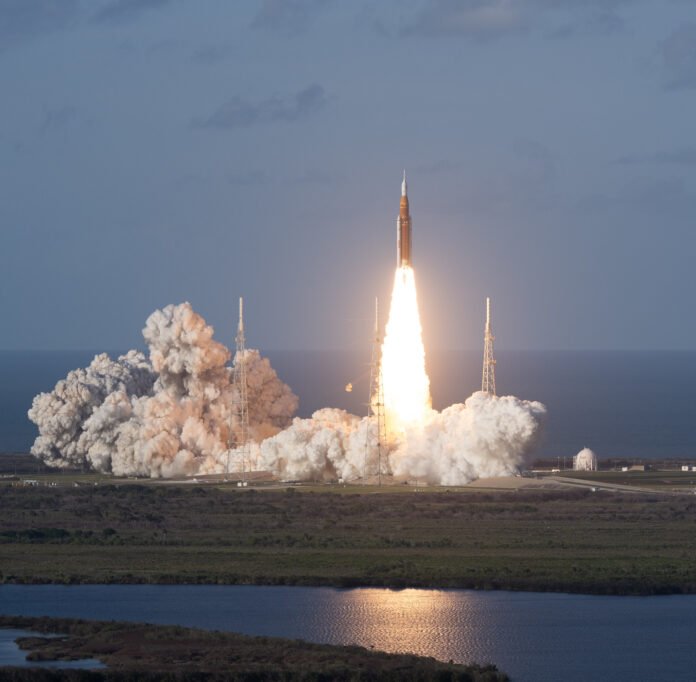
In a landmark moment for space exploration, NASA successfully launched the Artemis II mission on April 1, 2026, marking humanity’s first crewed journey toward the Moon in over 50 years since the Apollo era.
The mission represents a major step in NASA’s ambitious Artemis program, aimed at establishing a sustained human presence on the Moon and eventually enabling missions to Mars.
A Historic Mission with a Diverse Crew
Artemis II carries four astronauts aboard the Orion spacecraft, launched atop NASA’s powerful Space Launch System (SLS) rocket from Kennedy Space Center in Florida.
The crew includes:
●Commander Reid Wiseman
●Pilot Victor Glover
●Mission Specialist Christina Koch
●Mission Specialist Jeremy Hansen (Canadian Space Agency)
This mission is historic not only for its destination but also for its representation:
●Christina Koch becomes the first woman to travel into deep lunar space
●Victor Glover becomes the first person of color on such a mission
●Jeremy Hansen becomes the first non-American to journey toward the Moon
Mission Profile: A 10-Day Journey Around the Moon
Unlike the Apollo missions, Artemis II is not a lunar landing mission. Instead, it is a crewed lunar flyby designed to test critical systems.
Key highlights of the mission include:
●Duration: Approximately 10 days
●Trajectory: A free-return path around the Moon
●Distance: Over 250,000 miles (400,000 km) from Earth—farther than any humans have traveled
●Return: Planned splashdown in the Pacific Ocean
After launch, the spacecraft first enters high Earth orbit, where astronauts perform system checks before executing the trans-lunar injection that sends them toward the Moon.
Why Artemis II Matters
Artemis II is more than just a symbolic return—it is a critical test mission. NASA aims to validate:
●Life-support systems
●Navigation and propulsion
●Communication systems
●Heat shield performance during re-entry
This is also the first time astronauts are flying aboard both the SLS rocket and Orion spacecraft, making it a crucial step in proving their reliability for future missions.
From Artemis I to the Future of Lunar Exploration
The mission builds on the success of Artemis I (2022), an uncrewed test flight that orbited the Moon.
Looking ahead:
●Artemis III (expected 2027–28) aims to land astronauts on the Moon’s south pole
●Future missions will support the development of a long-term lunar base
●The program is seen as a stepping stone for human missions to Mars
A New Era of Space Exploration
Artemis II signals the beginning of a new chapter in human spaceflight. With international collaboration, advanced technology, and renewed ambition, NASA is once again pushing the boundaries of exploration.
More than five decades after Apollo 17, humanity is not just returning to the Moon—but preparing to stay, explore deeper, and venture further into the cosmos than ever before.