

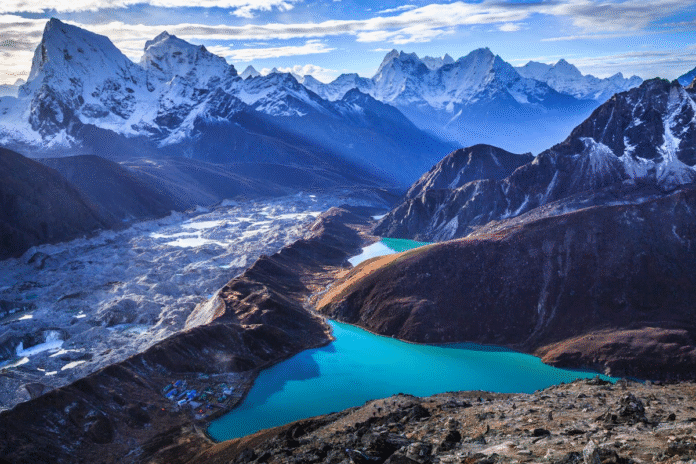
The Indian Himalayan region is witnessing an alarming increase in climatic and geological disasters, transforming once-rare events into frequent and devastating occurrences. From glacial lake outbursts and flash floods to landslides, avalanches, and cloudbursts, the Himalayan landscape is becoming increasingly unstable. The impact extends from Ladakh to Arunachal Pradesh, and beyond into Nepal, Bhutan, and Sikkim, raising serious concerns for infrastructure safety, local livelihoods, and national security.
Recent Disasters in the Himalayas: A Pattern Emerges
Since 2021, the Himalayas have experienced a series of destructive events:
- February 2021 (Chamoli, Uttarakhand): A glacier fragment collapse triggered flash floods that destroyed a hydroelectric power project.
- October 2023 (Sikkim): The South Lhonark glacial lake burst, severely damaging the Chungthang dam.
- August 2025 (Harsil): Flash floods disrupted key military and civilian transit routes.
These disasters often set off chain reactions, such as secondary landslides, road collapses, and community isolation, compounding their impact and hampering emergency response.
Geographical and Geopolitical Fragility
The Himalayan region’s vulnerability spans both ecological and strategic dimensions:
- Ladakh is grappling with glacier retreat and thawing permafrost.
- Jammu & Kashmir face landslides that frequently block essential border highways.
- Himachal Pradesh and Uttarakhand struggle with over-tourism and erratic weather patterns.
- Nepal and Sikkim are exposed to cross-border glacial lake outburst floods (GLOFs).
- Bhutan and Arunachal Pradesh endure flash floods exacerbated by limited early warning systems.
This regional fragility demands coordinated interstate and international collaboration to mitigate shared climate threats.
Development Pressures and Environmental Risks
Rapid infrastructure development often ignores the seismically active and geologically young nature of the Himalayas:
- Roads, tunnels, and dams are sometimes built without thorough hazard assessments.
- Construction destabilizes fragile slopes, increasing the risk of landslides and erosion.
- For the Indian armed forces, disasters can disrupt supply chains and strategic connectivity along sensitive borders.
Balancing development with environmental safety is essential for long-term strategic and civilian resilience.
India’s Policy Shift Toward Climate Resilience
A key milestone was the 15th Finance Commission (2021–26), which embedded climate resilience into fiscal planning:
- Introduced a Mitigation Fund under the State Disaster Risk Management Funds
- Allocated ₹1.6 lakh crore for:
- Hazard mapping
- Early warning systems
- Climate-proof infrastructure
- States like Sikkim and Uttarakhand have already begun implementing these interventions.
The upcoming 16th Finance Commission (2026–31) is expected to further link fiscal transfers to resilience performance, incentivizing long-term disaster preparedness.
Empowering Local Governance and Innovation
Strengthening local governance is key to Himalayan resilience:
- Direct access to mitigation funds by panchayats and municipalities is being considered.
- Innovations include:
- Green infrastructure incentives
- Disaster insurance schemes
- Climate-responsive budgeting
These tools aim to empower remote mountain communities to manage risks from glaciers, earthquakes, and monsoon floods.
Global Recognition and Cross-Border Cooperation
India’s G20 Presidency in 2023 elevated Disaster Risk Resilience as a global priority:
- Advocated for financial tools like insurance pools
- Emphasized cross-border data sharing
- Proposed joint response drills and integrated early warning systems across national boundaries
Given the shared river basins and hazard zones, regional cooperation between India, Nepal, Bhutan, and China is critical to building a resilient Himalayan ecosystem.
Sustainable Development in the Himalayas: A Delicate Balance
Safeguarding the Himalayas requires an integrated approach that respects ecology, security, and cultural heritage:
- Promote low-impact tourism and renewable energy
- Mandate risk assessments before approving infrastructure
- Strengthen community preparedness and scientific monitoring
The Himalayas are the source of major river systems, host to unique biodiversity, and crucial to regional stability. Protecting them is not only an environmental imperative but a strategic national priority.