

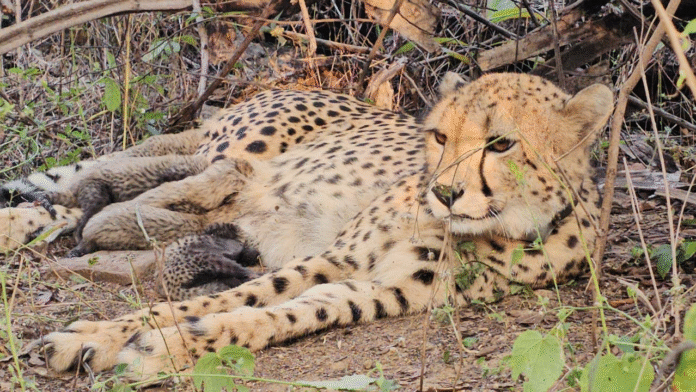
In a landmark moment for India’s wildlife conservation, Mukhi, a cheetah born at Kuno National Park in 2023 to Namibian female Jwala, has given birth to five healthy cubs. This is the first time a cheetah born in India has reproduced—an encouraging sign that the species is adapting well to Indian habitats.
Madhya Pradesh Chief Minister Mohan Yadav and Union Environment Minister Bhupender Yadav announced the news, calling it a major milestone for Project Cheetah, launched in 2022 to revive a species that disappeared from India more than seven decades ago. The large litter also lifts hopes for establishing a self-sustaining cheetah population, with Kuno now recording a cub survival rate higher than the global average.
A Species Lost and Found
Cheetahs once ran wild across India—from Punjab and Rajasthan to the Deccan Plateau. Mughal emperors and Indian royalty famously used them as hunting animals, a tradition that eventually contributed to their decline. Excessive trapping, habitat loss, trophy hunting during the British Raj, and a bounty system pushed the species to the brink.
The last three known cheetahs were killed in 1947, and in 1952, India officially declared the cheetah extinct.
The Return to Indian Grasslands
India began correcting that ecological loss in September 2022, when African cheetahs were reintroduced to Kuno National Park under one of the world’s most ambitious wildlife relocation programmes.
Mukhi’s successful litter marks a turning point—a signal that the species is beginning to settle, breed, and rebuild its future on Indian soil. Conservationists hope this momentum will help restore the balance of India’s grassland ecosystems and bring the world’s fastest land animal back to its historic home.