

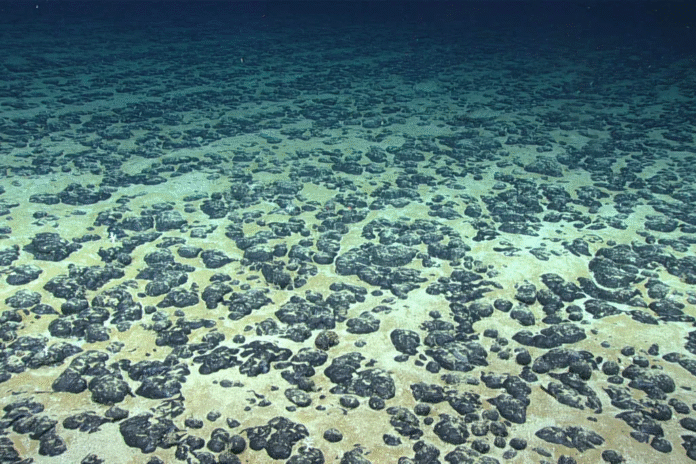
Scientists exploring the deep Pacific Ocean have reported the discovery of what they describe as “dark oxygen,” detected nearly 4,000 metres below the ocean surface in regions where sunlight does not penetrate. The finding challenges the long-standing scientific understanding that oxygen on Earth is produced primarily through photosynthesis, a light-dependent process. The discovery emerged during research on polymetallic nodules scattered across the Pacific seabed and has sparked fresh debate about oxygen generation in extreme, lightless environments.
What Is “Dark Oxygen”?
“Dark oxygen” refers to oxygen detected in deep-sea environments where sunlight is completely absent. Traditionally, oxygen production has been associated with photosynthesis, a biological process carried out by plants, algae, and certain bacteria that use sunlight to convert water and carbon dioxide into oxygen and energy-rich compounds.
However, researchers recorded measurable increases in oxygen levels in parts of the deep ocean where photosynthesis cannot occur. The study, published in the journal Nature Geoscience, reported that oxygen concentrations near polymetallic nodules rose over time during experiments conducted in sealed chambers placed on the seafloor.
How Scientists Detected Oxygen in the Deep Sea
The research was carried out in the Clarion–Clipperton Zone, a vast and mineral-rich region of the Pacific Ocean seabed. Scientists deployed specialised instruments known as benthic chambers to isolate small sections of the ocean floor and monitor chemical changes over time.
Unexpectedly, oxygen levels inside these sealed chambers increased rather than decreased. Under normal conditions, oxygen in deep-sea sediments is consumed by microbes and chemical reactions. The observed increase indicated that some process within the seabed environment was generating oxygen despite complete darkness.
To confirm the findings, researchers repeated measurements multiple times and conducted controlled laboratory simulations to rule out equipment malfunction or contamination.
Role of Polymetallic Nodules
Polymetallic nodules are rock-like mineral deposits found on abyssal plains of the ocean floor. They contain economically important metals such as manganese, nickel, and cobalt and form extremely slowly over millions of years.
Researchers propose that these nodules may function like natural electrochemical cells. Minerals within the nodules could facilitate reactions capable of splitting seawater molecules into hydrogen and oxygen, even without sunlight. Although the precise mechanism remains under investigation, such electrochemical processes could explain the unexpected oxygen production observed in deep-sea conditions.
Key Points
- Photosynthesis is the primary natural process responsible for oxygen production on Earth and requires sunlight.
- The Clarion–Clipperton Zone in the Pacific Ocean is known for its extensive deposits of polymetallic nodules.
- Polymetallic nodules form over millions of years on deep ocean abyssal plains.
- Nature Geoscience is a prominent peer-reviewed journal publishing research on Earth and environmental sciences.
Implications for Science and Astrobiology
This discovery could significantly reshape scientific understanding of Earth’s oxygen cycle. If oxygen can be generated through non-biological, light-independent chemical reactions, it expands knowledge of how essential elements circulate in extreme environments.
The findings also carry implications for astrobiology. Oxygen in a planet’s atmosphere has often been considered a potential biosignature indicating life. However, if oxygen can be produced abiotically in dark environments, scientists may need to reassess how they interpret atmospheric oxygen on other planets.
Additionally, the research raises environmental concerns regarding deep-sea mining. Since polymetallic nodules may play an active chemical role in deep-ocean ecosystems, their removal could disrupt fragile and poorly understood marine environments.