

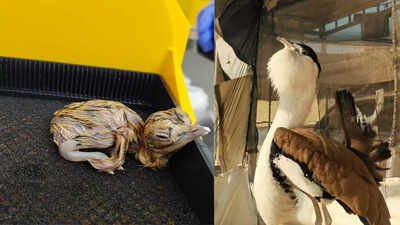
In a remarkable blend of science and conservation, Jaisalmer has emerged as the center of a breakthrough effort to save one of India’s most endangered birds—the Great Indian Bustard, locally known as Godawan. The latest development, involving the successful use of Artificial Insemination (AI) technology, marks a significant milestone in wildlife conservation.
The Breakthrough: Birth of New Chicks Using AI
At the Godawan Captive Breeding Centres in Ramdevra and Sudasari, scientists recently recorded the birth of new chicks—one through natural breeding and another through artificial insemination.
This may seem like a small step, but for a species on the brink of extinction, it is nothing short of historic. With these births, the total number of Great Indian Bustards in the conservation programme has risen to around 70–72 birds, a crucial improvement for a species whose wild population had once dropped below 150.
Why AI Technology Matters
The Great Indian Bustard has an extremely low reproductive rate—a female typically lays only one egg per year, and survival rates in the wild are very low due to predators and habitat challenges.
This is where AI (Artificial Insemination) becomes a game-changer. By carefully collecting and using genetic material, scientists can:
●Increase breeding success
●Improve genetic diversity
●Reduce dependency on natural mating, which is often unsuccessful
Experts from institutions like the Wildlife Institute of India have highlighted that applying AI to such a sensitive species is a major scientific achievement, opening new doors for conservation globally.
From Breeding to the Wild: The Bigger Plan
The success of AI breeding is just one part of a larger conservation mission known as Project Great Indian Bustard. Along with breeding, authorities are now preparing for the next phase—“soft release”.
In this process, chicks raised in controlled environments will gradually be introduced to the wild.
They are trained to:
●Fly and strengthen muscles
●Find food independently
●Avoid predators and human contact
This step ensures that the birds are not just born—but are capable of surviving in their natural habitat.
A Global Conservation Model in the Making
The efforts in Jaisalmer are now being seen as a model for wildlife conservation, combining advanced science with traditional ecological understanding. The project also includes international collaboration and follows global breeding protocols, further strengthening its impact.
Importantly, this initiative is not just about saving one species. It represents how technology like AI can be used responsibly to restore biodiversity, especially for species with critical population declines.
Conclusion: A New Chapter for India’s State Bird
The successful use of AI in breeding the Great Indian Bustard signals a turning point. From the silent deserts of Rajasthan now comes a message of hope—that even species on the edge of extinction can be revived with the right mix of science, dedication, and vision.
As these tiny chicks take their first steps in the sands of Jaisalmer, they carry with them more than life—they carry the future of an entire species.